Class 12 Physics · NCERT Chapter 3
~36 min readCurrent Electricity Class 12 Physics Notes
A complete, exam-ready pass on current electricity — electric current, current density and drift velocity, Ohm's law, resistance and resistivity and their temperature dependence, series–parallel combinations, Kirchhoff's junction and loop rules, the Wheatstone bridge and the metre bridge, emf versus terminal voltage and internal resistance, ammeter–voltmeter–galvanometer conversion, and the potentiometer with its two classic measurements (emf comparison and internal resistance). Every topic ends with mark-wise question banks matching the CBSE pattern, followed by the chapter's full NCERT exercises (3.1–3.23) and two free CBSE-pattern test PDFs. No signup required.
What is electric current in one line?
Electric current is the rate of flow of electric charge through a conductor, measured in amperes (A), defined as I = q/t for steady current or I = dq/dt in general.
Electric Current and Drift Velocity
Electric current
The rate of flow of charge. Conventional current direction is opposite to the electron flow direction. The SI unit is the ampere (1 A = 1 C/s).
Drift velocity
The average velocity acquired by electrons in a conductor under an applied electric field. is the average relaxation time between collisions. Relating it to current: , where is electron density, the cross-section.
MCQ Questions
1 Mark Questions
- 1Define electric current. Write its SI unit.
- 2What is current density? Write its SI unit.
- 3Define drift velocity of electrons in a conductor.
- 4Write the relation between current, drift velocity and the free-electron number density.
2 Mark Questions
- 1A current of 5 A flows through a wire for 2 minutes. How much charge crosses any section of the wire?
- 2A steady current of 3.0 A flows through a copper wire of area of cross-section 2.0 × 10⁻⁶ m². Find the drift velocity of the free electrons if their number density is 8.5 × 10²⁸ m⁻³.
- 3Distinguish between the drift speed and the thermal speed of free electrons in a conductor. Which is the larger at room temperature?
- 4How does the drift velocity of electrons in a metallic conductor change when (i) the temperature is increased and (ii) the potential difference across the conductor is doubled?
3 Mark Questions
- 1The number density of free electrons in a copper conductor is 8.5 × 10²⁸ m⁻³. How long does an electron take to drift from one end of a wire 3.0 m long to its other end? The area of cross-section is 2.0 × 10⁻⁶ m² and it carries a current of 3.0 A.
- 2Show that the current density in a conductor is j = n e v_d, and hence derive the relation I = n A e v_d.
- 3A wire of cross-sectional area 1.0 × 10⁻⁶ m² carries a current of 2.0 A. If the free-electron number density is 8.5 × 10²⁸ m⁻³, find the time taken by an electron to drift through a 1.0 cm length of the wire.
Ohm's Law and Resistance
Ohm's law
At constant temperature, the current through a conductor is directly proportional to the potential difference across it, where R is the resistance in ohms (Ω). Not all materials obey it — semiconductors and electrolytes do not.
- — a material property independent of dimensions.
- .
- Resistance of metals increases with temperature; that of semiconductors decreases.
- Resistors in series:
- .
- Resistors in parallel:
- .
MCQ Questions
1 Mark Questions
- 1State Ohm's law.
- 2Write the formula for resistivity of a material and state its SI unit.
- 3How does the resistance of a metal change when its temperature rises?
- 4Define one ohm.
2 Mark Questions
- 1A negligibly small current is passed through a wire of length 15 m and uniform cross-section 6.0 × 10⁻⁷ m², and its resistance is measured to be 5.0 Ω. Find the resistivity of the material.
- 2At room temperature (27.0 °C) the resistance of a heating element is 100 Ω. Find the temperature of the element when its resistance becomes 117 Ω, given the temperature coefficient of the material is 1.70 × 10⁻⁴ °C⁻¹.
- 3A silver wire has a resistance of 2.1 Ω at 27.5 °C and 2.7 Ω at 100 °C. Determine the temperature coefficient of resistivity of silver.
- 4Distinguish between resistance and resistivity of a conductor.
3 Mark Questions
- 1Derive the relation R = ρL/A for a conducting wire in terms of the microscopic quantities m, n, e and τ, and state the physical assumptions involved.
- 2A wire of resistance 5 Ω is stretched so that its length becomes double. Find its new resistance, assuming the volume and resistivity remain unchanged.
- 3Explain why the resistance of a metal increases while that of a semiconductor (e.g. carbon) decreases with temperature. Support your answer with the concept of relaxation time τ and drift velocity.
Combination of Resistances
Resistors in series
The same current flows through every resistor in a series combination; the total potential drop is the sum of the individual drops V = V₁ + V₂ + V₃. The equivalent resistance is therefore larger than the largest individual resistance and equals the algebraic sum of all the resistances.
Resistors in parallel
Every resistor in a parallel combination has the same potential difference across it; the total current is the sum of the branch currents. The reciprocal of the equivalent resistance is the sum of the reciprocals, and the equivalent resistance is smaller than the smallest individual resistance.
Combination formulas
Two resistors in series carry the same current and divide the voltage proportionally to their resistances; two in parallel share the same voltage and divide the current inversely to their resistances. Identical resistors in a network can often be reduced by symmetry before applying the series–parallel laws.
MCQ Questions
1 Mark Questions
- 1Write the formula for the equivalent resistance of resistors connected (i) in series and (ii) in parallel.
- 2Why is the equivalent resistance of a parallel combination smaller than the smallest individual resistance?
- 3State the ratio of maximum to minimum resistance obtainable with n identical resistors of resistance R.
- 4What is the effective resistance of two identical resistors R connected in parallel?
2 Mark Questions
- 1Three resistors 1 Ω, 2 Ω and 3 Ω are combined in series and connected to a battery of emf 12 V (negligible internal resistance). Find the total resistance and the potential drop across each resistor.
- 2Three resistors 2 Ω, 4 Ω and 5 Ω are combined in parallel and connected to a battery of emf 20 V (negligible internal resistance). Determine the current through each resistor and the total current drawn.
- 3Given resistors 1 Ω, 2 Ω and 3 Ω, combine them to obtain an equivalent resistance of (i) 11/3 Ω, (ii) 11/5 Ω, (iii) 6 Ω and (iv) 6/11 Ω.
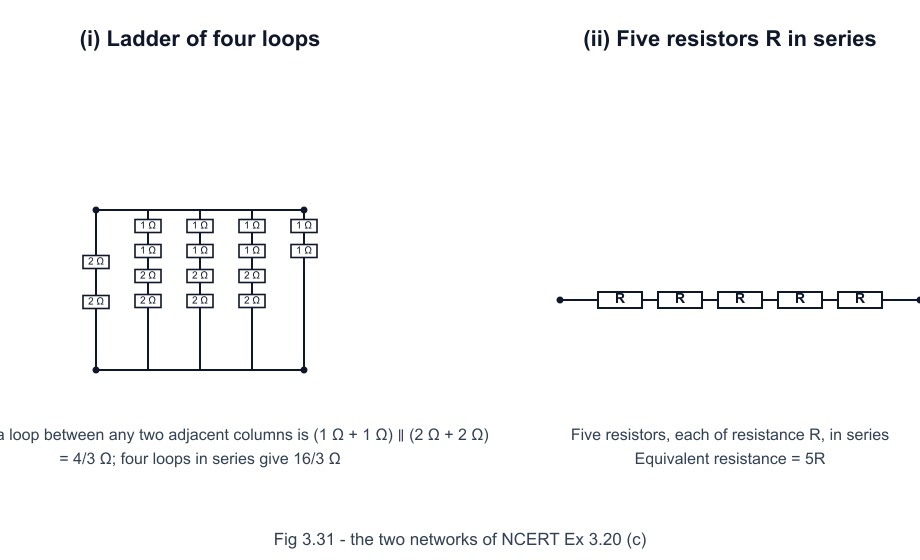
- 4A ladder network (as in Fig. 3.31(i)) has four identical loops: each loop is a 1 Ω + 1 Ω series combination in parallel with a 2 Ω + 2 Ω series combination. Find the total end-to-end resistance.
3 Mark Questions
- 1Given n resistors each of resistance R, how will you combine them to get (i) the maximum and (ii) the minimum effective resistance? What is the ratio of the maximum to the minimum resistance?
- 2Determine the equivalent resistance of the networks shown in Fig. 3.31: (i) the ladder of four loops built from 1 Ω and 2 Ω resistors, and (ii) five resistors each of resistance R in series.
- 3A wire of resistance 12 Ω is bent to form a closed square. Find the resistance between two diagonally opposite corners of the square.
Kirchhoff's Laws
Kirchhoff's junction rule
The algebraic sum of currents meeting at a junction is zero. Equivalent to conservation of charge: current entering a junction equals current leaving it.
Kirchhoff's loop rule
The algebraic sum of the potential differences around any closed loop is zero. Equivalent to conservation of energy.
Sign convention
MCQ Questions
1 Mark Questions
- 1State Kirchhoff's junction rule.
- 2State Kirchhoff's loop rule.
- 3Name the conservation law underlying each of Kirchhoff's two rules.
- 4State the sign convention for applying the loop rule to resistors and batteries while traversing a loop.
2 Mark Questions
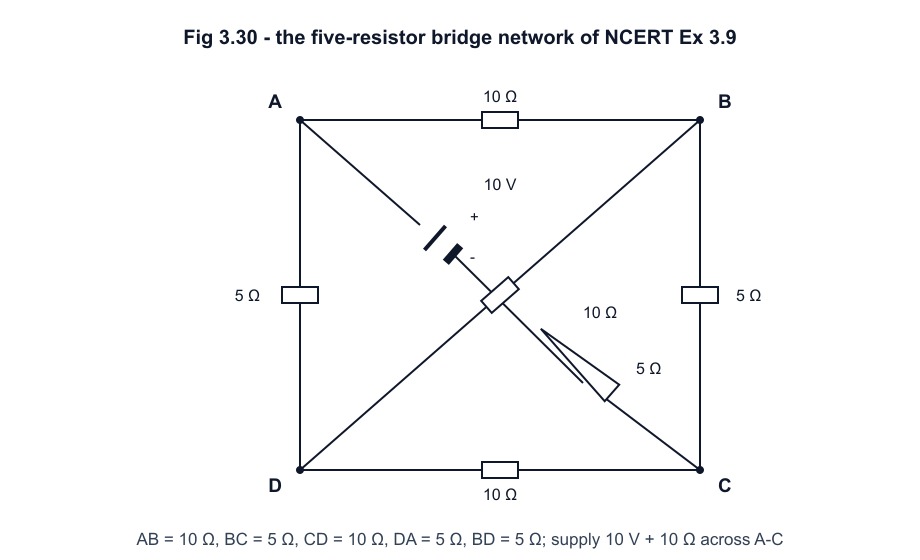
- 1Using Kirchhoff's junction and loop rules, write three independent equations for the five branch currents of the bridge network of Fig. 3.30 (AB = 10 Ω, BC = 5 Ω, CD = 10 Ω, DA = 5 Ω, BD = 5 Ω, source 10 V in series with 10 Ω across A–C).
- 2At a junction, a current of 5 A enters and the currents leaving are I₁ and I₂. If I₂ = 2 A, find I₁.
- 3Distinguish between Kirchhoff's junction rule and loop rule, and state the conservation principle behind each.
- 4Explain why Kirchhoff's junction rule remains valid even when the connecting wires at a junction are bent or reoriented.
3 Mark Questions
- 1State Kirchhoff's two laws and justify each with a conservation principle. Under what conditions are they valid in a circuit?
- 2A cell of emf 4 V and internal resistance 2 Ω is connected in parallel with a cell of emf 2 V and internal resistance 2 Ω, and a 6 Ω resistor is connected across the common terminals. Using Kirchhoff's laws find the current in the 6 Ω resistor.
- 3A circuit contains two loops sharing a common branch: loop 1 has a 6 V battery (r = 1 Ω) and loop 2 a 3 V battery (r = 1 Ω), with a 3 Ω resistor in the shared branch. Use Kirchhoff's laws to find the current through the shared 3 Ω resistor.
Wheatstone Bridge and Meter Bridge
Wheatstone bridge condition
When the four resistances P, Q, R, S are arranged in a bridge and the galvanometer shows zero deflection (balanced), the ratio condition holds — no current flows through the galvanometer.
Meter bridge
MCQ Questions
1 Mark Questions
- 1State the balance condition of a Wheatstone bridge.
- 2What is the function of the galvanometer in a metre bridge experiment?
- 3Why is a metre bridge also called a slide-wire bridge?
- 4Why are the connecting strips of a metre bridge made of thick copper?
2 Mark Questions
- 1In a metre bridge, the balance point is found to be at 39.5 cm from the end A when the resistor S in the right gap is 12.5 Ω. Determine the resistance R. Why are the connections between resistors in a Wheatstone or metre bridge made of thick copper strips?
- 2Determine the balance point of the metre bridge of the question above if the resistors R and S are interchanged.
- 3What happens if the galvanometer and the cell are interchanged at the balance point of a metre bridge? Would the galvanometer show any current?
- 4The four arms of a Wheatstone bridge are PQ = 2 Ω, QR = 4 Ω, RS = 3 Ω and SP = 6 Ω. Is the bridge balanced? A 3 Ω resistor is now placed in parallel with QR — is the bridge still balanced?
3 Mark Questions
- 1Describe, with a labelled diagram, how an unknown resistance is determined experimentally using a metre bridge.
- 2Derive the balance condition P/Q = R/S of a Wheatstone bridge using Kirchhoff's laws.
- 3In a metre bridge experiment the balance point shifts from 39.5 cm to 60.5 cm when R and S are interchanged. If S = 12.5 Ω, find R and show that the balance condition is unchanged when the galvanometer and cell are interchanged.
EMF, Internal Resistance and Cells
EMF and terminal voltage
The terminal voltage of a cell is the EMF minus the drop across its internal resistance . is the current drawn. For a battery of cells, connect in series to increase EMF and in parallel to reduce internal resistance.
MCQ Questions
1 Mark Questions
- 1Define the emf of a cell.
- 2Write the relation between emf ε, terminal voltage V, current I and internal resistance r.
- 3When is the terminal voltage of a cell equal to its emf?
- 4What is the difference between the emf and the terminal voltage of a cell?
2 Mark Questions
- 1A battery of emf 10 V and internal resistance 3 Ω is connected to a resistor and delivers a current of 0.5 A. Find the resistance of the resistor and the terminal voltage of the battery.
- 2A storage battery of emf 8.0 V and internal resistance 0.5 Ω is being charged by a 120 V dc supply using a series resistor of 15.5 Ω. Find the terminal voltage during charging and state the purpose of the series resistor.
- 3Six lead-acid secondary cells each of emf 2.0 V and internal resistance 0.015 Ω are joined in series to supply a resistance of 8.5 Ω. Find the current drawn from the supply and the terminal voltage.
- 4The storage battery of a car has an emf of 12 V and an internal resistance of 0.4 Ω. What is the maximum current that can be drawn from the battery?
3 Mark Questions
- 1Derive the expression for the power delivered by a cell of emf ε and internal resistance r to an external resistance R. For what value of R is the power maximum?
- 2A secondary cell after long use has an emf of 1.9 V and a large internal resistance of 380 Ω. What maximum current can be drawn from the cell? Could the cell drive the starting motor of a car?
- 3Explain why a low-voltage supply that must give high currents needs a very low internal resistance, and why a high-tension (HT) supply of 6 kV must have a very large internal resistance.
Ammeter, Voltmeter and Galvanometer
Galvanometer
A moving-coil galvanometer is a sensitive device that detects tiny currents (of the order of 10⁻³ A or less) and shows both the magnitude and direction of current. A radial magnetic field keeps the deflecting torque proportional to the current, so the scale is uniform. Its resistance G is typically a few tens of ohms.
Ammeter (galvanometer + low shunt)
A galvanometer shunted by a small resistance S becomes an ammeter. Only a fraction I_g of the current I flows through the galvanometer; the rest bypasses it through the shunt. An ideal ammeter has zero resistance and is always connected in series with the branch whose current is being measured.
Voltmeter (galvanometer + high series resistance)
A galvanometer in series with a large resistance R becomes a voltmeter. The high resistance keeps the current through the galvanometer below I_g and limits the current drawn from the circuit, so the voltmeter reads the true potential difference. An ideal voltmeter has infinite resistance and is connected in parallel.
MCQ Questions
1 Mark Questions
- 1State the function of an ammeter and how it is connected in a circuit.
- 2State the function of a voltmeter and how it is connected in a circuit.
- 3Why must an ammeter have a very low resistance and a voltmeter a very high resistance?
- 4Why does a shunt used with a galvanometer have a very small resistance?
2 Mark Questions
- 1A galvanometer of resistance 20 Ω gives full-scale deflection for a current of 10 mA. Find the shunt resistance that converts it into an ammeter of range 0–5 A.
- 2The same galvanometer (20 Ω, 10 mA) is to be converted into a voltmeter of range 0–50 V. Find the resistance that must be connected in series.
- 3Explain why a galvanometer is converted into an ammeter with a low shunt in parallel rather than with a series resistance, and why a voltmeter uses a large series resistance rather than a shunt.
- 4A galvanometer of resistance G gives full-scale deflection for a current I_g. It is shunted with S. Give the formula for the range of the resulting ammeter.
3 Mark Questions
- 1Describe how a galvanometer is converted into an ammeter, and derive the expression for the shunt resistance S = I_g G/(I − I_g).
- 2Describe how a galvanometer is converted into a voltmeter, and derive the expression for the required series resistance R = V/I_g − G.
- 3A galvanometer of resistance 30 Ω gives full-scale deflection for a current of 2 mA. Find (i) the shunt needed to measure currents up to 2 A and (ii) the series resistance needed to measure voltages up to 2 V.
Potentiometer
A potentiometer measures EMF without drawing current from the cell, giving a more accurate result than a voltmeter. It compares EMFs because the potential gradient along a wire is uniform.
Why not a voltmeter?
MCQ Questions
1 Mark Questions
- 1Why does a potentiometer measure the emf of a cell more accurately than a voltmeter?
- 2State the principle of a potentiometer.
- 3What is a balance point in a potentiometer experiment?
- 4Why is a very high resistance (e.g. 600 kΩ) connected in series with the galvanometer in a potentiometer circuit?
2 Mark Questions
- 1In a potentiometer arrangement, a cell of emf 1.25 V gives a balance point at 35.0 cm of the wire. When the cell is replaced by another cell the balance point shifts to 63.0 cm. What is the emf of the second cell?
- 2A 2.0 V potentiometer with a standard cell of emf 1.02 V balances at 67.3 cm. A cell of unknown emf ε balances at 82.3 cm. Find ε.
- 3A 2.0 V potentiometer is used to determine the internal resistance of a 1.5 V cell: the balance point is 76.3 cm in open circuit and 64.8 cm when a resistor of 9.5 Ω is connected across the cell. Determine r.
- 4What purpose does the high resistance of 600 kΩ serve in the potentiometer circuit of Exercise 3.22, and is the balance point affected by it?
3 Mark Questions
- 1Describe, with a labelled circuit diagram, how a potentiometer is used to compare the emfs of two cells.
- 2Describe, with a labelled circuit diagram, how a potentiometer is used to measure the internal resistance of a cell, and derive the formula r = (l₁/l₂ − 1) R.
- 3A potentiometer wire of length 10 m and total resistance 10 Ω is driven by a 2.0 V cell of internal resistance 0.40 Ω. A standard cell of 1.02 V balances at 67.3 cm. (i) Find the potential gradient along the wire. (ii) Would the method work if the driver cell had an emf of 1.0 V instead of 2.0 V?
NCERT Exercise Questions
Exercises (NCERT 3.1–3.13) & Additional Exercises (3.14–3.23)
3.1) The storage battery of a car has an emf of 12 V. If the internal resistance of the battery is 0.4 Ω, what is the maximum current that can be drawn from the battery?
3.2) A battery of emf 10 V and internal resistance 3 Ω is connected to a resistor. If the current in the circuit is 0.5 A, what is the resistance of the resistor? What is the terminal voltage of the battery when the circuit is closed?
3.3) (a) Three resistors 1 Ω, 2 Ω, and 3 Ω are combined in series. What is the total resistance of the combination? (b) If the combination is connected to a battery of emf 12 V and negligible internal resistance, obtain the potential drop across each resistor.
3.4) (a) Three resistors 2 Ω, 4 Ω and 5 Ω are combined in parallel. What is the total resistance of the combination? (b) If the combination is connected to a battery of emf 20 V and negligible internal resistance, determine the current through each resistor, and the total current drawn from the battery.
3.5) At room temperature (27.0 °C) the resistance of a heating element is 100 Ω. What is the temperature of the element if the resistance is found to be 117 Ω, given that the temperature coefficient of the material of the resistor is 1.70 × 10⁻⁴ °C⁻¹.
3.6) A negligibly small current is passed through a wire of length 15 m and uniform cross-section 6.0 × 10⁻⁷ m², and its resistance is measured to be 5.0 Ω. What is the resistivity of the material at the temperature of the experiment?
3.7) A silver wire has a resistance of 2.1 Ω at 27.5 °C, and a resistance of 2.7 Ω at 100 °C. Determine the temperature coefficient of resistivity of silver.
3.8) A heating element using nichrome connected to a 230 V supply draws an initial current of 3.2 A which settles after a few seconds to a steady value of 2.8 A. What is the steady temperature of the heating element if the room temperature is 27.0 °C? Temperature coefficient of resistance of nichrome averaged over the temperature range involved is 1.70 × 10⁻⁴ °C⁻¹.
3.9) Determine the current in each branch of the network shown in Fig. 3.30.
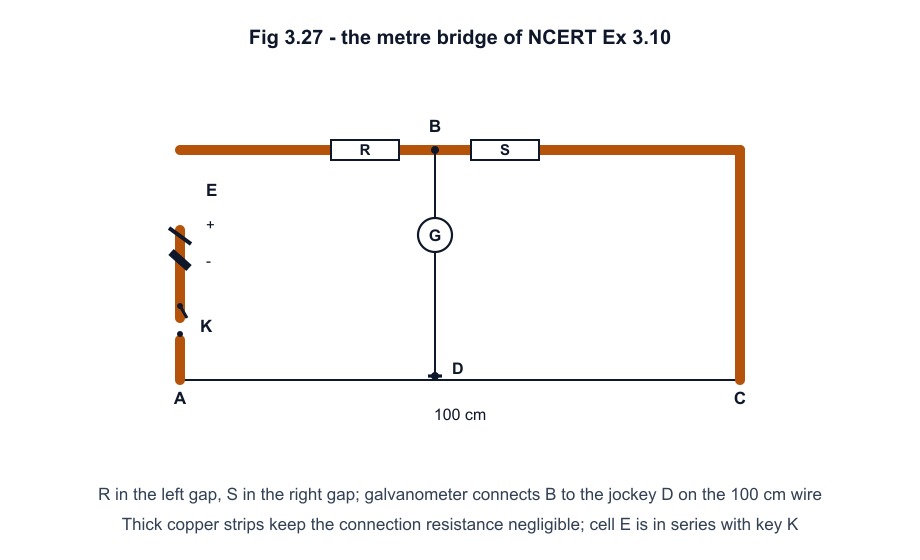
3.10) (a) In a meter bridge [Fig. 3.27], the balance point is found to be at 39.5 cm from the end A, when the resistor S is of 12.5 Ω. Determine the resistance of R. Why are the connections between resistors in a Wheatstone or meter bridge made of thick copper strips? (b) Determine the balance point of the bridge above if R and S are interchanged. (c) What happens if the galvanometer and cell are interchanged at the balance point of the bridge? Would the galvanometer show any current?
3.11) A storage battery of emf 8.0 V and internal resistance 0.5 Ω is being charged by a 120 V dc supply using a series resistor of 15.5 Ω. What is the terminal voltage of the battery during charging? What is the purpose of having a series resistor in the charging circuit?
3.12) In a potentiometer arrangement, a cell of emf 1.25 V gives a balance point at 35.0 cm length of the wire. If the cell is replaced by another cell and the balance point shifts to 63.0 cm, what is the emf of the second cell?
3.13) The number density of free electrons in a copper conductor estimated in Example 3.1 is 8.5 × 10²⁸ m⁻³. How long does an electron take to drift from one end of a wire 3.0 m long to its other end? The area of cross-section of the wire is 2.0 × 10⁻⁶ m² and it is carrying a current of 3.0 A.
3.14) The earth's surface has a negative surface charge density of 10⁻⁹ C m⁻². The potential difference of 400 kV between the top of the atmosphere and the surface results (due to the low conductivity of the lower atmosphere) in a current of only 1800 A over the entire globe. If there were no mechanism of sustaining atmospheric electric field, how much time (roughly) would be required to neutralise the earth's surface? (This never happens in practice because there is a mechanism to replenish electric charges, namely the continual thunderstorms and lightning in different parts of the globe). (Radius of earth = 6.37 × 10⁶ m.)
3.15) (a) Six lead-acid type of secondary cells each of emf 2.0 V and internal resistance 0.015 Ω are joined in series to provide a supply to a resistance of 8.5 Ω. What are the current drawn from the supply and its terminal voltage? (b) A secondary cell after long use has an emf of 1.9 V and a large internal resistance of 380 Ω. What maximum current can be drawn from the cell? Could the cell drive the starting motor of a car?
3.16) Two wires of equal length, one of aluminium and the other of copper have the same resistance. Which of the two wires is lighter? Hence explain why aluminium wires are preferred for overhead power cables. (ρ(Al) = 2.63 × 10⁻⁸ Ω m, ρ(Cu) = 1.72 × 10⁻⁸ Ω m, relative density of Al = 2.7, of Cu = 8.9)
3.17) What conclusion can you draw from the following observations on a resistor made of alloy manganin? (I (A): 0.2, 0.4, 0.6, 0.8, 1.0, 2.0 / V (V): 3.94, 7.87, 11.8, 15.7, 19.7, 39.4 — and I (A): 3.0, 4.0, 5.0, 6.0, 7.0, 8.0 / V (V): 59.2, 78.8, 98.6, 118.5, 138.2, 158.0)
3.18) (a) A steady current flows in a metallic conductor of non-uniform cross-section. Which of these quantities is constant along the conductor: current, current density, electric field, drift speed? (b) Is Ohm's law universally applicable for all conducting elements? If not, give examples of elements which do not obey Ohm's law. (c) A low voltage supply from which one needs high currents must have very low internal resistance. Why? (d) A high tension (HT) supply of, say, 6 kV must have a very large internal resistance. Why?
3.19) (a) Alloys of metals usually have (greater/less) resistivity than that of their constituent metals. (b) Alloys usually have much (lower/higher) temperature coefficients of resistance than pure metals. (c) The resistivity of the alloy manganin is nearly independent of / increases rapidly with increase of temperature. (d) The resistivity of a typical insulator (e.g., amber) is greater than that of a metal by a factor of the order of (10²²/10²³).
3.20) (a) Given n resistors each of resistance R, how will you combine them to get the (i) maximum and (ii) minimum effective resistance? What is the ratio of the maximum to minimum resistance? (b) Given the resistances of 1 Ω, 2 Ω, 3 Ω, how will you combine them to get an equivalent resistance of (i) 11/3 Ω, (ii) 11/5 Ω, (iii) 6 Ω, (iv) 6/11 Ω? (c) Determine the equivalent resistance of networks shown in Fig. 3.31.
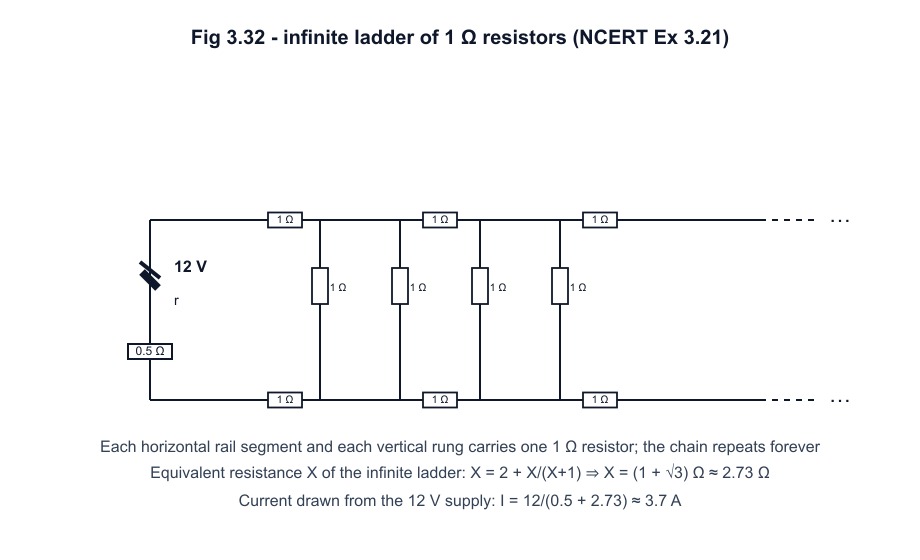
3.21) Determine the current drawn from a 12 V supply with internal resistance 0.5 Ω by the infinite network shown in Fig. 3.32. Each resistor has 1 Ω resistance.
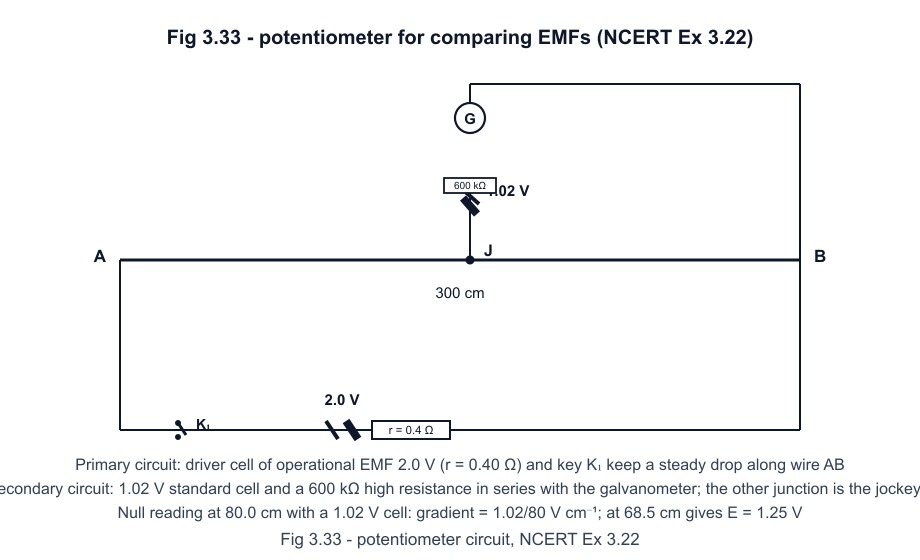
3.22) Figure 3.33 shows a potentiometer with a cell of 2.0 V and internal resistance 0.40 Ω maintaining a potential drop across the resistor wire AB. A standard cell which maintains a constant emf of 1.02 V (for very moderate currents up to a few mA) gives a balance point at 67.3 cm length of the wire. To ensure very low currents drawn from the standard cell, a very high resistance of 600 kΩ is put in series with it, which is shorted close to the balance point. The standard cell is then replaced by a cell of unknown emf ε and the balance point found similarly, turns out to be at 82.3 cm length of the wire. (a) What is the value of ε? (b) What purpose does the high resistance of 600 kΩ have? (c) Is the balance point affected by this high resistance? (d) Would the method work in the above situation if the driver cell of the potentiometer had an emf of 1.0 V instead of 2.0 V? (e) Would the circuit work well for determining an extremely small emf, say of the order of a few mV (such as the typical emf of a thermo-couple)? If not, how will you modify the circuit?
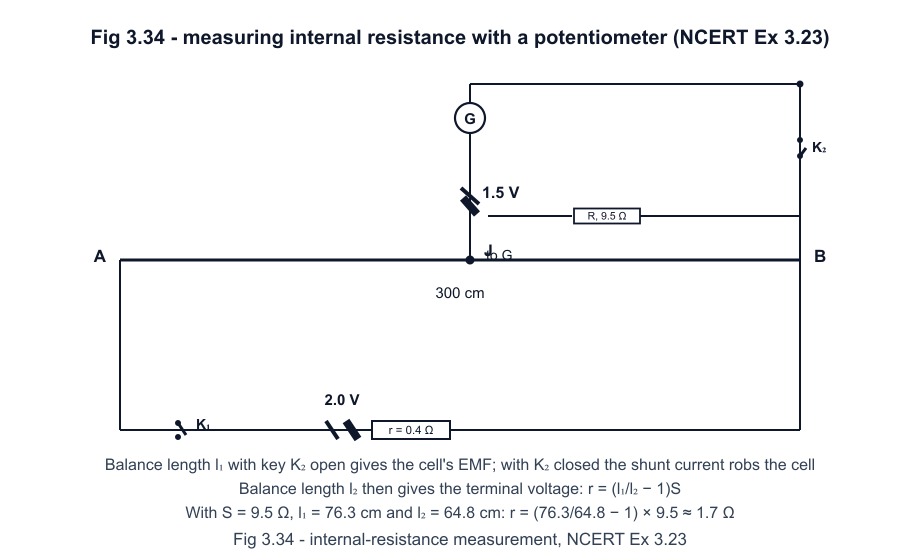
3.23) Figure 3.34 shows a 2.0 V potentiometer used for the determination of internal resistance of a 1.5 V cell. The balance point of the cell in open circuit is 76.3 cm. When a resistor of 9.5 Ω is used in the external circuit of the cell, the balance point shifts to 64.8 cm length of the potentiometer wire. Determine the internal resistance of the cell.
Answers at a glance
- 13.1 — 30 A (I_max = ε/r = 12/0.4).
- 23.2 — Resistance = 17 Ω (R + r = ε/I = 10/0.5 = 20); terminal voltage V = ε − Ir = 10 − 0.5 × 3 = 8.5 V.
- 33.3 — (a) 6 Ω. (b) Potential drops across 1 Ω, 2 Ω, 3 Ω are 2 V, 4 V, 6 V (current 2 A).
- 43.4 — (a) 20/19 Ω. (b) Currents through 2 Ω, 4 Ω, 5 Ω are 10 A, 5 A, 4 A; total current = 19 A.
- 53.5 — 1027 °C (R = R₀(1 + αΔt): Δt = 17/(100 × 1.70 × 10⁻⁴) = 1000 °C).
- 63.6 — 2.0 × 10⁻⁷ Ω m (ρ = RA/L = 5 × 6.0 × 10⁻⁷/15).
- 73.7 — 0.0039 °C⁻¹ (α = ΔR/R₀Δt = 0.6/(2.1 × 72.5)).
- 83.8 — 867 °C (R from 230/3.2 to 230/2.8 Ω; Δt = (R/R₀ − 1)/α).
- 93.9 — Branch currents: AB = 4/17 A, BC = 6/17 A, CD = −4/17 A, AD = 6/17 A, BD = −2/17 A; total current = 10/17 A.
- 103.10 — (a) R = 8.2 Ω (R/S = l/(100 − l) = 39.5/60.5 times 12.5). Thick copper strips keep the connection resistance (unaccounted in the bridge formula) negligible. (b) 60.5 cm from A. (c) The galvanometer shows no current — the bridge stays balanced.
- 113.11 — 11.5 V while charging (charging current = (120 − 8)/(0.5 + 15.5) = 7 A; V = ε + Ir = 8 + 7 × 0.5). The series resistor limits the charging current — in its absence the current would be dangerously high.
- 123.12 — 2.25 V (ε₂ = ε₁ l₂/l₁ = 1.25 × 63/35).
- 133.13 — 2.7 × 10⁴ s ≈ 7.5 h (v_d = I/(nAe) ≈ 1.1 × 10⁻⁴ m/s; t = 3.0/v_d).
- 143.14 — ≈ 283 s (Q = σ × 4πR²; t = Q/I with I = 1800 A). An estimate: it ignores the Earth's curvature effects
- 153.15 — (a) I = 1.4 A, V = 11.9 V (R_tot = 8.5 + 6 × 0.015). (b) 0.005 A; impossible — a starter motor needs ~100 A for a few seconds.
- 163.16 — Aluminium wire is lighter: mass ratio Cu : Al = (1.72/2.63) × (8.9/2.7) ≈ 2.2, so aluminium is preferred for overhead power cables.
- 173.17 — V/I is constant to a high accuracy: Ohm's law is obeyed, and the resistivity of manganin is nearly independent of temperature.
- 183.18 — (a) Only the current (steady); current density, electric field and drift speed vary inversely with the cross-section. (b) No — vacuum diodes and semiconductor diodes are non-ohmic. (c) I_max = ε/r. (d) To keep the short-circuit current within safe limits.
- 193.19 — (a) greater, (b) lower, (c) nearly independent of, (d) 10²².
- 203.20 — (a) (i) all in series → nR; (ii) all in parallel → R/n; ratio = n². (b) (i) 1 Ω ∥ 2 Ω in series with 3 Ω; (ii) 2 Ω ∥ 3 Ω in series with 1 Ω; (iii) all in series; (iv) all in parallel. (c) (i) 16/3 Ω; (ii) 5R.
- 213.21 — Equivalent resistance X of the infinite network satisfies 2 + X/(X + 1) = X, giving X = (1 + √3) Ω ≈ 2.73 Ω; current drawn = 12/(0.5 + 2.73) ≈ 3.7 A.
- 223.22 — (a) ε = 1.25 V (ε = 1.02 × 82.3/67.3). (b) It reduces the current through the galvanometer when the jockey is far from the balance point. (c) No. (d) No — if the measured emf exceeds the driver emf there is no balance point. (e) Unsuitable for a few mV (balance point hugging end A, large percentage error); put a suitable resistor in series with AB to shrink the gradient.
- 233.23 — r = 1.7 Ω (r = (l₁/l₂ − 1) R = (76.3/64.8 − 1) × 9.5 = 1.685 ≈ 1.7 Ω).
CBSE Pattern Questions
How CBSE asks this chapter
MCQ Questions
1 Mark Questions
- 1State Ohm's law.
- 2Define drift velocity and write its SI unit.
- 3State Kirchhoff's junction rule and loop rule.
- 4Define the temperature coefficient of resistance.
2 Mark Questions
- 1Three resistors of 2 Ω, 3 Ω and 6 Ω are connected in parallel. Find the equivalent resistance. (Ans: 1/R = 1/2 + 1/3 + 1/6 = 1, so R = 1 Ω)
- 2A wire of resistance 5 Ω is drawn out to three times its length. Find its new resistance. (Ans: R′ = n²R = 45 Ω)
- 3A copper wire of cross-section 1 mm² carries a current of 2 A. If the electron density is 8 × 10²⁸ m⁻³, find the drift velocity. (Ans: vd = I/(neA) ≈ 1.6 × 10⁻⁴ m/s)
3 Mark Questions
- 1Derive the relation I = neAvd and hence obtain Ohm's law in terms of drift velocity and relaxation time.
- 2State and explain Kirchhoff's laws of electrical circuits with reference to the conservation of charge and energy.
- 3Describe the metre bridge. Derive the balance condition (unknown X from known R).
5 Mark Questions
- 1Explain the principle, construction and working of a potentiometer, and how it is used to (a) compare the emfs of two cells and (b) measure the internal resistance of a cell.
- 2Derive the expressions for the current, terminal voltage and energy balance when cells are connected in series and in parallel, and give the conditions for maximum current.
PDF: Assignments & Tests
Free PDF Downloads & Assignments
Practice path: complete Assignment 1 first (topic-by-topic), then Assignment 2 (mixed difficulty with figure-based NCERT questions), then attempt the timed tests.
Covers all eight topics: electric current and drift velocity, Ohm's law and resistance, combination of resistances, Kirchhoff's laws, Wheatstone and metre bridge, emf and internal resistance, ammeter/voltmeter/galvanometer, and the potentiometer. Arranged topic by topic.
Second set with multi-topic integration problems, JEE-style numericals, and figure-based NCERT questions (Exercises 3.9, 3.10, 3.20(c), 3.21, 3.22, 3.23). Higher difficulty than Assignment 1. Answer key included.
Full CBSE-pattern paper: Section A (10 MCQ/VSA × 1M), Section B (4 × 2M), Section C (4 × 3M), Section D (2 × 5M). Complete marking scheme included.
Second 40-mark CBSE-pattern paper with fresh questions and a full solution key.
Quick Revision
Key formulas at a glance
Memorise these equations — direct application numericals and derivations in CBSE & JEE frequently hinge on these.
Current
Drift velocity
Ohm's law
Resistance
Temperature dependence
Resistors in series
Resistors in parallel
Kirchhoff's loop rule
Wheatstone balance
Metre bridge
Terminal voltage
Ammeter shunt
Voltmeter series R
Potentiometer: emf comparison
Potentiometer: internal resistance
Exam Strategy
How this chapter is asked
High-yield question patterns observed across CBSE boards, JEE Main & Advanced, and NEET.
- I = n e A v_d is the key link between current and drift velocity.
- Metals: resistance rises with temperature; semiconductors: falls.
- Series adds resistances (R = R₁ + R₂); parallel gives a value smaller than the smallest (1/R = 1/R₁ + 1/R₂).
- Kirchhoff: junction rule ↔ conservation of charge; loop rule ↔ conservation of energy.
- Wheatstone balance: P/Q = R/S; metre bridge: R/S = l/(100 − l).
- Terminal voltage: V = ε − Ir (delivering), V = ε + Ir (charging).
- An ammeter goes in series with a low resistance; a voltmeter goes in parallel with a high resistance.
- Potentiometer measures true emf (zero current at balance): ε₁/ε₂ = l₁/l₂.
- Internal resistance from a potentiometer: r = (l₁/l₂ − 1) R.
- Metre-bridge balance is unchanged when the galvanometer and the cell are interchanged.
Practice Numericals
Step-by-step worked examples
Standard exam-level problems solved with clear conceptual breakdowns.
Charge from a steady current
Step-by-Step Solution
- 1I = q/t ⇒ q = I t = 2.0 × 60 = 120 C.
- 2The same charge crosses every section of the wire since the current is steady.
Final Answer
Drift velocity of electrons
Step-by-Step Solution
- 1v_d = I/(n A e) = 3.0/(8.5 × 10²⁸ × 2.0 × 10⁻⁶ × 1.6 × 10⁻¹⁹).
- 2v_d = 3.0/2.72 × 10⁴ ≈ 1.1 × 10⁻⁴ m s⁻¹.
Final Answer
Metre bridge — unknown resistance
Step-by-Step Solution
- 1At balance, R/S = l/(100 − l) = 39.5/(60.5).
- 2R = 12.5 × 39.5/60.5 = 8.16 ≈ 8.2 Ω.
Final Answer
Internal resistance of a cell by potentiometer
Step-by-Step Solution
- 1r = (l₁/l₂ − 1) R, where l₁ = 76.3 cm and l₂ = 64.8 cm.
- 2r = (76.3/64.8 − 1) × 9.5 = (1.1775 − 1) × 9.5 = 1.685 ≈ 1.7 Ω.
Final Answer
Resistance of a wire bent into a square
Step-by-Step Solution
- 1Each side of the square has resistance 12/4 = 3 Ω.
- 2Between diagonal corners the two paths each contain two sides in series: 3 + 3 = 6 Ω.
- 3The two 6 Ω paths are in parallel: R = 6×6/(6+6) = 3 Ω.
Final Answer
Converting a galvanometer into an ammeter
Step-by-Step Solution
- 1S = I_g G/(I − I_g) = (0.01 × 20)/(5 − 0.01).
- 2S = 0.2/4.99 ≈ 0.04 Ω.
Final Answer
FAQ
Frequently asked questions
What is drift velocity?
It is the small average velocity acquired by free electrons under an applied electric field, given by v_d = eEτ/m. Typical values are only a few millimetres per second.
Why is a potentiometer more accurate than a voltmeter?
At balance, a potentiometer draws no current from the cell, so it measures the true EMF. A voltmeter draws a small current and measures only the terminal voltage.
What is the Wheatstone bridge condition?
The bridge balances when P/Q = R/S, at which point no current flows through the galvanometer connecting the two ratio arms.
Does Ohm's law apply to all materials?
No. Semiconductors, electrolytes, diodes and certain substances show non-linear current-voltage behaviour and do not obey Ohm's law.
Why does a potentiometer measure the emf of a cell more accurately than a voltmeter?
At the balance point no current is drawn from the cell being measured, so there is no internal-resistance drop (V = ε). A voltmeter always draws a small current through the cell's internal resistance, so it reads the terminal voltage V = ε − Ir, which is slightly less than the true emf. That is why the potentiometer is the standard way to compare emfs and to measure the internal resistance.
When is the terminal voltage of a cell greater than its emf?
While the cell is being charged. The charging current flows through the cell against its emf, and the potential difference across the terminals becomes V = ε + Ir, which exceeds the emf by the internal drop. The same formula V = ε − Ir works: during charging the current entering the cell is taken as negative, so V = ε − (−I)r = ε + Ir.
Why does resistance increase with temperature for a metal but decrease for a semiconductor?
In a metal the free-electron density is fixed, and heating increases the amplitude of lattice vibrations, shortening the relaxation time τ and so the drift velocity for a given field; resistivity ρ = m/(n e² τ) rises. In a semiconductor the electron (and hole) number density n itself rises sharply with temperature, and this rise outweighs the fall in τ, so resistivity decreases.
What happens to the null point if the galvanometer and cell of a metre bridge are interchanged at balance?
Nothing measurable — the bridge remains balanced and the galvanometer still shows zero deflection. The balance condition P/Q = R/S depends only on the four arm resistances, not on where the cell and the galvanometer are placed; interchanging them leaves the steady-state current distribution through the galvanometer branch unchanged at zero.
Why is a high resistance of 600 kΩ put in series with the standard cell in a potentiometer, and does it affect the balance point?
Before the null point is located, the jockey may sit at a point of the wire whose potential is far from the cell's emf, so the cell would push a potentially large current through the galvanometer. The 600 kΩ high resistance caps that current to a safe few-milliamp level; it is shorted close to the balance point so that when the null is found the cell genuinely draws no current. The balance point itself is unaffected because at balance the galvanometer current is zero anyway.
Next Chapters
Continue learning
Same chapter
Read alongside
Interactive Quiz
Chapter MCQ practice test
Instant scoring with complete solutions — test your mastery in under 15 minutes.
Chapter MCQ Mock Test
Evaluate how well you have retained the concepts, formulas, and reaction mechanisms from this chapter. Questions adhere strictly to latest CBSE, JEE & NEET trends.
Master this chapter with expert live guidance
Self-study notes lay the ground, but conceptual doubts clear fastest in an interactive classroom. Narayan Gurukul Academy (ClassApna) conducts small-batch CBSE, JEE & NEET coaching with daily doubt solving and rigorous mock tests.
Small batches · 1-on-1 personal mentorship · Live online & offline centre