Class 11 Physics · NCERT Chapter 4
Laws of Motion Class 11 Notes
Master Newton's three laws of motion, momentum, impulse, friction and circular motion with exam-ready notes and interactive MCQs for Class 11 Physics.
Written byDeep Narayan· Science & Mathematics EducatorReviewed byPushpanjali
State Newton's second law of motion and write its mathematical form.
The rate of change of momentum of a body is directly proportional to the applied force and takes place in the direction in which the force acts. Mathematically, F = dp/dt = ma, where the net external force F equals the change in momentum per unit time. In SI units the constant of proportionality k is taken as 1, giving F = ma with 1 N = 1 kg m/s².
Aristotle's Fallacy and the Law of Inertia
Aristotle believed that a force is necessary to keep a body in uniform motion. He argued that an arrow keeps flying because the air behind it pushes it forward. Galileo showed this view is wrong: a body in uniform motion needs no force to keep moving once the opposing force of friction is removed. Friction is what actually slows moving bodies down in everyday life.
Law of Inertia
Galileo extrapolated his observations on inclined planes to arrive at the law of inertia: in the absence of an external force, a body continues in its state of rest or of uniform motion in a straight line.
Newton's First Law of Motion
Every body continues to be in its state of rest or of uniform motion in a straight line unless compelled by some external force to change that state. In simple terms: if the net external force on a body is zero, its acceleration is zero.
Force is not needed to keep a body moving
A force is needed in practice only to counter friction or other opposing forces. If you slide a book and the table were perfectly frictionless, it would keep moving forever with the same velocity.
MCQ Questions
1According to Galileo, a body moving with uniform velocity on a horizontal plane will
2Aristotle's view that a force is needed to keep a body in uniform motion is
3Newton's first law states that if the net external force on a body is zero, then
4The property of a body by which it resists any change in its state of rest or uniform motion is called
1 Mark Questions
- A passenger sitting in a car at rest, pushes the car from within. The car doesn't move, why?
- Give the magnitude and direction of the net force acting on a rain drop falling with a constant speed.
- Why are the passengers in a moving car thrown outwards when the car suddenly takes a turn?
- If a ball is thrown up in a moving train, it comes back to the thrower's hands. Why?
- The distance travelled by a moving body is directly proportional to time. Is any external force acting on it?
- Bodies of larger mass need greater initial effort to put them in motion. Why?
- An athlete runs a certain distance before taking a long jump. Why?
- The wheels of vehicles are provided with mudguards. Why?
2 Mark Questions
- A man getting out of a moving bus runs in the same direction for a certain distance. Comment.
- A bob of mass 0.1 kg hung from the ceiling of a room by a string 2 m long is oscillating. At its mean position the speed of the bob is 1 m·s⁻¹. What is the trajectory of the oscillating bob if the string is cut when the bob is (i) at the mean position, (ii) at its extreme position?
Assertion–Reason Questions
Select the correct alternative for each assertion–reason pair from the codes given below: (a) Both A and R are true and R is the correct explanation of A. (b) Both A and R are true but R is NOT the correct explanation of A. (c) A is true but R is false. (d) A is false but R is also false.
- Assertion (A): A man in a closed cabin, which is falling freely, does not experience gravity. Reason (R): Inertial and gravitational masses have equivalence.
- Assertion (A): The driver in a vehicle moving with a constant speed on a straight road is in a non-inertial frame of reference. Reason (R): A reference frame in which Newton's laws of motion are applicable is non-inertial.
- Assertion (A): A table cloth can be pulled from a table without dislodging the dishes. Reason (R): To every action there is an equal and opposite reaction.
Momentum and Newton's Second Law
Momentum
The momentum p of a body is the product of its mass m and velocity v: p = m v. Momentum is a vector quantity, directed along the velocity.
The greater the rate of change of momentum, the greater the force applied. When a stone is whirled by a string at constant speed, the magnitude of momentum stays fixed but its direction changes, so a force is needed to change the momentum vector.
SI unit of force
One newton is the force that produces an acceleration of 1 m/s² on a mass of 1 kg. Therefore 1 N = 1 kg m/s².
- F = 0 implies a = 0, so the second law is consistent with the first law.
- It is a vector law: Fₓ = dpₓ/dt = maₓ, Fᵧ = dpᵧ/dt = maᵧ, F_z = dp_z/dt = ma_z. A force not parallel to velocity changes only the component of velocity along the force.
- It applies to a single particle where F is the net external force; it also applies to a system of particles where F is the total external force and a is the acceleration of the centre of mass.
- It is a local law: acceleration here and now is determined by the force here and now, not by the history of motion.
MCQ Questions
1The SI unit of force, the newton, is defined as
2Momentum of a body of mass m moving with velocity v is
3A force of 10 N acts on a body of mass 2 kg. The acceleration produced is
4Newton's second law is a vector law. This means that
1 Mark Questions
- Calculate the force acting on a body which changes the momentum of the body at the rate of 1 kg-m/s².
2 Mark Questions
- If the net force acting upon the particle is zero, show that its linear momentum remains constant.
- A force of 36 dynes is inclined to the horizontal at an angle of 60°. Find the acceleration produced in a mass of 18 g that moves in a horizontal direction.
- The motion of a particle of mass m is described by h = ut + ½gt². Find the force acting on the particle. (F = mg)
- A particle of mass 0.3 kg is subjected to a force F = −kx, with k = 15 N·m⁻¹. What will be its initial acceleration if it is released from a point 20 cm away from the origin?
- A spring balance is attached to the ceiling of a lift. When the lift is at rest spring balance reads 49 N of a body hang on it. If the lift moves: (i) Downward (ii) upward, with an acceleration of 5 ms⁻² (iii) with a constant velocity. What will be the reading of the balance in each case?
3 Mark Questions
1. A block of mass 500 g is at rest on a horizontal table. What steady force is required to give the block a velocity of 200 cms⁻¹ in 4 s?
2. A force of 100 N gives a mass m₁ an acceleration of 10 m·s⁻², and a mass m₂ an acceleration of 20 m·s⁻². What acceleration would the force produce if both the masses are tied together?
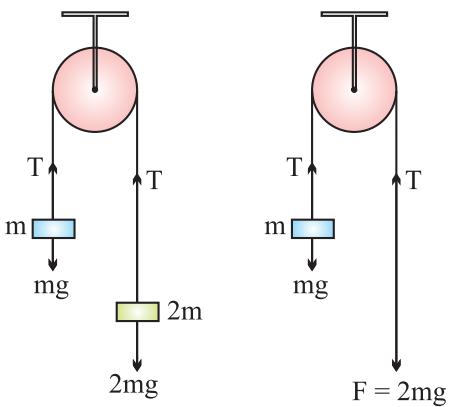
3. The pulley arrangements of the figure are identical; the mass of the rope is negligible. In (a), a mass m is lifted up by attaching a mass 2m to the other end of the rope. In (b), m is lifted up by pulling the other end of the rope with a constant downward force F = 2mg. In which case is the acceleration of m more?
4. Three blocks of masses m₁ = 10 kg and m₂ = 20 kg, and a third block, are connected by strings on a smooth horizontal surface and pulled by a force of 60 N, as shown. Find the acceleration of the system and the friction in the string.

5. A helicopter of mass 2000 kg rises with a vertical acceleration of 15 m·s⁻². The total mass of the crew and passengers is 500 kg. Give the magnitude and direction of: (i) the force on the floor of the helicopter by the crew and passengers, (ii) the action of the rotor of the helicopter on the surrounding air, (iii) the force on the helicopter due to the surrounding air. (g = 10 m/s²)
6. Two blocks of mass 2 kg and 5 kg are connected by an ideal string passing over a pulley. The block of mass 2 kg is free to slide on a surface inclined at an angle of 30° with the horizontal, whereas the 5 kg block hangs freely. Find the acceleration of the system and the tension in the string.
7. Show that Newton's second law of motion is the real law of motion.
Assertion–Reason Questions
Select the correct alternative for each assertion–reason pair from the codes given below: (a) Both A and R are true and R is the correct explanation of A. (b) Both A and R are true but R is NOT the correct explanation of A. (c) A is true but R is false. (d) A is false but R is also false.
- Assertion (A): The apparent weight of a body in an elevator moving with some downward acceleration is less than the actual weight of the body. Reason (R): Part of the weight is spent in producing the downward acceleration when the body is in the elevator.
Case Study · Elevator and Apparent Weight
A person weighing 60 kg is standing on a platform balance kept on the floor of an elevator cab. The cab can move up or down with either a uniform velocity or a constant acceleration. The value of the velocity as well as the acceleration may be adjusted to any suitable value. Newton's second law of motion can be applied to the motion of the elevator cab.
(i) The observed weight of a person in an elevator is — (a) remains the same and is equal to the actual weight (b) always increases (c) always decreases (d) increases or decreases depending upon the motion of the elevator.
(ii) Find the observed weight of the person as recorded by the balance when the elevator cab is moving upward with a constant velocity of 2 m/s. (a) 0 N (b) 30 gN (c) 60 gN (d) 90 gN.
(iii) The elevator cab is in accelerated motion in the vertical downward direction with an acceleration of g/4. (a) 0 N (b) 45 gN (c) 90 gN (d) 60 gN.
(iv) The elevator cab starts falling freely downward due to some mechanical failure in its control system. (a) 0 N (b) 75 gN (c) 120 gN (d) 90 gN.
(v) The elevator cab is accelerating uniformly in the upward direction with a uniform acceleration of g/2. (a) 0 N (b) 120 gN (c) 30 gN (d) 90 gN.
Impulse
Often a large force acts for a very short time and produces a finite change in momentum — for example a ball hitting a wall and bouncing back. In such cases the force and the time of contact are hard to measure separately, but their product (the impulse) equals the change in momentum and is measurable.
Impulsive Force
A large force acting for a very short time to produce a finite change in momentum is called an impulsive force. It is like any other force except that it is large and acts for a short time.
Hands moving back on a catch
A cricketer draws his hands backwards while catching a fast ball. This increases the time of impact Δt, so for the same change in momentum the force F = Δp/Δt becomes much smaller, saving the hands from injury.
MCQ Questions
1Impulse of a force is equal to
2The impulse imparted to a body equals
3A batsman hits back a ball of mass 0.15 kg moving at 12 m/s without changing its speed. The impulse imparted is
1 Mark Questions
- What is the purpose of using shockers in a car?
- Why is it difficult to catch a cricket ball rather than a tennis ball even when both are moving with the same velocity?
- Calculate the impulse necessary to stop a 1500 kg car moving at a speed of 25 ms⁻¹.
- China wares are wrapped in straw paper before packing. Why?
- An impulse is applied to a moving object with a force at an angle of 20° w.r.t. velocity vector, what is the angle between the impulse vector and change in momentum vector?
2 Mark Questions
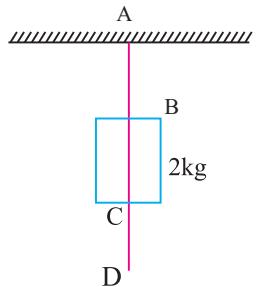
1. A mass of 2 kg is suspended from a support by thread AB. A thread CD of the same type is attached to the lower end of the 2 kg mass. (i) If the lower end of thread CD is pulled gradually, harder and harder, in the downward direction, which of the two threads will break, and why? (ii) If the lower thread is pulled with a jerk, what happens?
3 Mark Questions
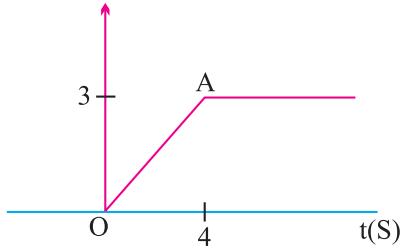
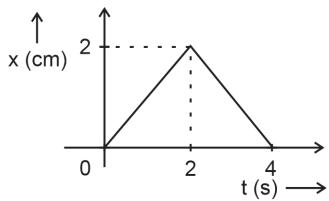
1. The figure shows the position–time graph of a particle of mass 4 kg. (a) What is the force on the particle for t < 0, t > 4 s and 0 < t < 4 s? (b) What is the impulse at t = 0 and t = 4 s? (Consider one-dimensional motion only.)
2. A hunter has a machine gun that can fire 50 g bullets with a velocity of 150 m·s⁻¹. A 60 kg tiger springs at him with a velocity of 10 m·s⁻¹. How many bullets must the hunter fire into the target so as to stop him in his track?
5 Mark Questions
- Show that the area under the force–time graph gives the magnitude of the impulse of the given force, when (i) the force is constant, (ii) the force is variable.
Case Study · Impulse
In our daily life we sometimes encounter situations in which a force acts on a body for a very short interval of time. For example, when a batsman hits a ball with his bat, the time of contact between bat and ball is very short. In this situation a finite change in the momentum of the ball is produced by the force, which is provided by the bat within the small duration of time. The product of the force and the time duration for which the force acts on a body is called the impulse, and it equals the change in momentum of the body.
(i) Which of the following physical quantities has the same dimensional formula as that of impulse? (a) Pressure (b) momentum (c) tension (d) surface energy.
(ii) A batsman hits back a ball straight in the direction of the bowler without changing its initial speed of 12 m/s. If the mass of the ball is 0.15 kg, determine the impulse imparted to the ball. (Assume linear motion of the ball.) (a) 1.8 N·s (b) 2.2 N·s (c) 3.6 N·s (d) 4.8 N·s.
(iii) The figure shows the position–time graph of a particle of mass 4 kg. What is the impulse at t = 4 s? (a) –3 kg·m/s (b) 3 kg·m/s (c) 2 kg·m/s (d) –2 kg·m/s.
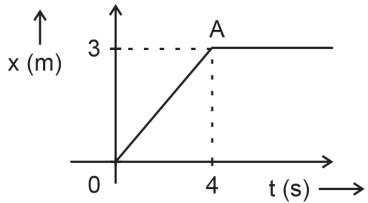
(iv) The figure shows the position–time graph of a body of mass 0.04 kg. What is the magnitude of the impulse at t = 2 s? (a) 16 × 10⁻⁴ kg·m·s⁻¹ (b) 2 × 10⁻⁴ kg·m·s⁻¹ (c) 4 × 10⁻⁴ kg·m·s⁻¹ (d) 8 × 10⁻⁴ kg·m·s⁻¹.
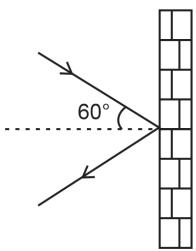
(v) A 3 kg ball strikes a heavy rigid wall with a speed of 10 m/s at an angle of 60° with the normal to the wall. It gets reflected with the same speed and is in contact with the wall for 0.2 s. What is the impulse exerted by the wall on the ball? (a) 60 N·s (b) 30 N·s (c) 15 N·s (d) 20 N·s.
Newton's Third Law of Motion
The second law tells us what force does but not where it comes from. In Newtonian mechanics, the force on a body always arises from some other body. Forces always occur in pairs: if body B exerts a force on body A, then A exerts an equal and opposite force on B.
Newton's Third Law of Motion
To every action there is always an equal and opposite reaction. Force on a body A by B is equal and opposite to the force on the body B by A: F_AB = −F_BA.
- Action and reaction simply mean force; any one of the two mutual forces may be called action and the other reaction.
- There is no cause-effect relation: action and reaction act at the same instant.
- Action and reaction act on different bodies, so they cannot cancel each other for a single body's motion. But as internal forces of a combined system they sum to zero.
Common misconception
The force of gravity on a book and the normal force of the table on the book are equal and opposite but they are NOT an action-reaction pair — they act on the same body. True action-reaction forces always act on two different bodies.
MCQ Questions
1Newton's third law states that to every action there is always an
2Action and reaction forces
3When you push a wall with a force F, the wall pushes you back with a force
4For a pair of bodies A and B, the third law gives
1 Mark Questions
- Why does a gun recoil when a bullet is fired?
- Why do action and reaction forces not balance each other?
2 Mark Questions
- A horse cannot pull a cart and run in empty space. Why? (using diagram)
3 Mark Questions
- Two masses of 5 kg and 3 kg are suspended with the help of a massless inextensible string passing over a frictionless pulley, as shown. Calculate the tensions T₁ and T₂ in the two parts of the string when the system is going upwards with a uniform acceleration. (Use g = 9.8 m/s².)
Assertion–Reason Questions
Select the correct alternative for each assertion–reason pair from the codes given below: (a) Both A and R are true and R is the correct explanation of A. (b) Both A and R are true but R is NOT the correct explanation of A. (c) A is true but R is false. (d) A is false but R is also false.
- Assertion (A): A rocket moves forward by pushing the surrounding air backwards. Reason (R): It drives the necessary thrust to move forward according to Newton's third law of motion.
Conservation of Momentum
The second and third laws together lead to the law of conservation of momentum. When a bullet is fired from a gun, the force on the bullet by the gun is F and the force on the gun by the bullet is −F, both acting for the same time interval. Their momenta become equal and opposite, so the total momentum stays zero.
Law of Conservation of Momentum
The total momentum of an isolated system of interacting particles is conserved — it remains unchanged if no external force acts on the system.
Applies to both elastic and inelastic collisions
Conservation of momentum holds whether a collision is elastic or inelastic. For elastic collisions there is the additional condition that total kinetic energy is also conserved.
MCQ Questions
1The law of conservation of momentum holds for
2When a gun is fired, the recoil speed of the gun is such that the total momentum of the gun-bullet system
3Conservation of momentum follows from
4A nucleus at rest disintegrates into two nuclei. They must move
2 Mark Questions
- A 50 g bullet is fired from a 10 kg gun with a speed of 500 ms⁻¹. What is the speed of the recoil of the gun.
5 Mark Questions
- Define the principle of conservation of linear momentum. Deduce the law of conservation of linear momentum from Newton's third law of motion.
Equilibrium of a Particle
A particle is in equilibrium when the net external force on it is zero. By the first law, it is then either at rest or moving with uniform velocity in a straight line.
- Under two forces F₁ and F₂, equilibrium requires F₁ = −F₂ (equal and opposite).
- Under three concurrent forces, the vector sum is zero: F₁ + F₂ + F₃ = 0.
- Three forces in equilibrium can be represented by the sides of a triangle with arrows taken in the same sense.
- For n forces, they can be represented by the sides of a closed n-sided polygon with arrows in the same sense.
- Equilibrium implies F₁ₓ + F₂ₓ + F₃ₓ = 0, F₁ᵧ + F₂ᵧ + F₃ᵧ = 0 and F₁z + F₂z + F₃z = 0.
Rotational equilibrium too
Equilibrium of a rigid body requires not only translational equilibrium (zero net force) but also rotational equilibrium (zero net torque), studied later.
MCQ Questions
1A particle is in equilibrium when the net external force on it is
2Under two forces F₁ and F₂, a particle is in equilibrium if
3Three concurrent forces acting on a particle in equilibrium can be represented by the
4If a particle is in equilibrium under forces F₁ and F₂, it is
1 Mark Questions
- A body is acted upon by a number of external forces. Can it remain at rest?
3 Mark Questions
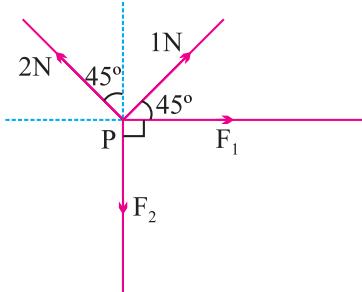
1. There are a few forces acting at a point P, produced by strings as shown, and the point is at rest. Find the forces F₁ and F₂. (See the figure.)
Friction
Friction is the component of the contact force parallel to the surfaces in contact that opposes impending or actual relative motion. When bodies slide in contact, the force parallel to the surfaces is called friction.
Static Friction
Static friction fₛ opposes impending (about-to-happen) relative motion. It is self-adjusting and satisfies fₛ ≤ μₛN, where μₛ is the coefficient of static friction and N the normal reaction. Its maximum value is fₛ,max = μₛN.
Kinetic Friction
Kinetic or sliding friction fₖ opposes actual relative motion between surfaces in contact and is given by fₖ = μₖN, where μₖ is the coefficient of kinetic friction. Experimentally μₖ is less than μₛ.
- Both static and kinetic friction are independent of the area of contact.
- Kinetic friction is nearly independent of velocity.
- The laws of friction are empirical (approximately true), not fundamental laws.
- Friction opposes relative motion, not motion itself.
- Rolling friction is much smaller (even by 2–3 orders of magnitude) than static or sliding friction for the same weight.
Friction in daily life
We can walk because of friction, and a car moves because friction between tyres and road provides the driving force. Brakes use kinetic friction, while ball bearings and cushions of air reduce friction in machines.
MCQ Questions
1The limiting value of static friction is
2For a given pair of surfaces, the coefficient of kinetic friction μₖ compared to the coefficient of static friction μₛ is
3Friction opposes
4A block just begins to slide down an inclined plane at angle θ with the horizontal. The coefficient of static friction is
1 Mark Questions
- You accelerate your car forward. What is the direction of the frictional force on a package resting on the floor of the car?
- Why are tyres made of rubber not of steel?
- Wheels are made circular. Why?
- On a rainy day skidding takes place along a curved path. Why?
- Lubricants are used between the two parts of a machine. Why?
- Why is it difficult to walk on sand?
2 Mark Questions
- A smooth block is released at rest on a 45° incline and then slides a distance d. If the time taken to slide on the rough incline is n times as large as the time taken to slide on the smooth incline, show that the coefficient of friction is μ = (1 − 1/n²).
- Define force of friction. How does ball bearing reduce friction?
- Define angle of friction and angle of repose.
- A block placed on a rough horizontal surface is pulled by a horizontal force F. Let f be the force applied by the rough surface on the block. Plot a graph of f versus F.
- A block of mass M is held against a rough vertical wall by pressing it with a finger. If the coefficient of friction between the block and the wall is μ and the acceleration due to gravity is g, calculate the minimum force necessary to be applied by the finger to hold the block against the wall.
3 Mark Questions
1. A force of 98 N is just required to move a mass of 45 kg on a rough horizontal surface. Find the coefficient of friction and angle of friction?
2. Calculate the force required to move a train of 2000 quintals up an inclined plane of 1 in 50 with an acceleration of 2 m·s⁻². The force of friction per quintal is 0.5 N.
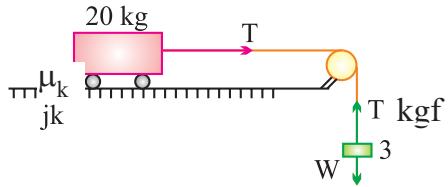
3. What is the acceleration of the block-and-trolley system shown in the figure, if the coefficient of kinetic friction between the trolley and the surface is 0.04? Also calculate the tension in the string. Take g = 10 m/s²; the mass of the string is negligible.
4. The rear side of a truck is open and a box of 40 kg mass is placed 5 m away from the open end. The coefficient of friction between the box and the surface below it is 0.15 on a straight road, the truck starts from rest and accelerates with 2 m/s². At what distance from the starting point does the box fall off the truck? (Ignore the size of the box.)
5. A block slides down an incline of 30° with the horizontal. Starting from rest, it covers 8 m in the first 2 s. Find the coefficient of static friction.
6. A rectangular box lies on a rough inclined surface. The coefficient of friction between the surface and the box is μ, and the mass of the box is m. (a) At what angle of inclination θ of the plane to the horizontal will the box just start to slide down the plane? (b) What is the force acting on the box down the plane if the angle of inclination of the plane is increased to a value greater than θ? (c) What force must be applied upwards along the plane to keep the box stationary, or to move it up the plane with uniform speed? (d) What force must be applied upwards along the plane to make the box move up the plane with acceleration a?
5 Mark Questions
- Derive an expression for the acceleration of a body sliding down a rough inclined plane.
- With the help of a suitable example, explain the terms static friction, limiting friction and kinetic friction. Show that static friction is a self-adjusting force. Also plot a graph showing the variation between the applied force F and the force of friction f.
Assertion–Reason Questions
Select the correct alternative for each assertion–reason pair from the codes given below: (a) Both A and R are true and R is the correct explanation of A. (b) Both A and R are true but R is NOT the correct explanation of A. (c) A is true but R is false. (d) A is false but R is also false.
- Assertion (A): It is difficult to move a cycle along the road with brakes on. Reason (R): Sliding friction is greater than rolling friction.
- Assertion (A): Friction forces are conservative forces. Reason (R): Potential energy can be associated with frictional force.
- Assertion (A): Use of ball bearings between the moving parts of a machine is a common practice. Reason (R): Ball bearings reduce vibrations and provide good stability.
- Assertion (A): Angle of repose is equal to angle of friction. Reason (R): When a body is at the point of motion, the force of friction at this stage is called limiting friction.
Case Study · Friction
When two bodies are in contact, each experiences a contact force due to the other. The component of the contact force parallel to the surfaces in contact, which opposes impending relative motion, is called static friction. Kinetic friction opposes the actual relative motion between the two bodies in contact, and rolling friction opposes the rolling motion of one body over the surface of another body. We often regard friction as something undesirable; however, in many practical situations friction is critically needed.
(i) What is the direction of friction? (a) Friction always acts tangential to the surface in contact (b) friction acts normal to the surface in contact (c) the direction depends upon the weight of the body that moves over the surface of another body (d) none of these.
(ii) Which one of the statements is not correct about friction? (a) Friction is a self-adjusting force (b) the force of friction is independent of the area of contact as long as the normal reaction remains the same (c) sliding friction is greater than static friction (d) limiting friction is the maximum static friction.
(iii) An automobile is moving on a horizontal road with a speed v. If the coefficient of friction between the tyres and the road is μ, what is the shortest distance in which the automobile can be stopped? (a) v²/μg (b) 2v²/μg (c) v²/4μg (d) v²/2μg.
(iv) What will be the maximum acceleration of a train in which a box lying on the floor will remain stationary, if the coefficient of friction between the box and the floor of the train is 0.15? (Take g = 10 m/s².) (a) 2 m/s² (b) 2.5 m/s² (c) 1 m/s² (d) 1.5 m/s².
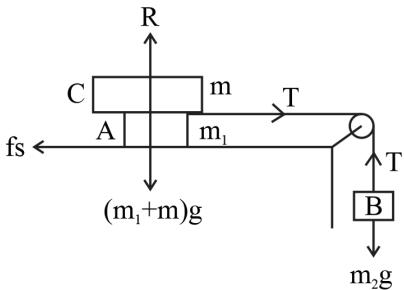
(v) In the figure, the masses of blocks A and B are 10 kg and 5 kg. Calculate the minimum mass of C which may stop A from slipping. The coefficient of friction between block A and the table is 0.2. (a) 5 kg (b) 15 kg (c) 25 kg (d) 35 kg.
Dynamics of Uniform Circular Motion
A body moving in a circle of radius R with uniform speed v has an acceleration v²/R directed towards the centre. By the second law, the force providing this acceleration is the centripetal force f_c = mv²/R. This is not a new kind of force — it is just the name given to whatever force (tension, gravity, friction) supplies the inward radial acceleration.
- For a stone rotated by a string, centripetal force is provided by the tension in the string.
- For a planet around the Sun, it is provided by the gravitational force.
- For a car taking a turn on a level road, it is provided by friction between tyres and road.
Maximum speed on a level road
For a car on a level circular road of radius R, friction alone provides the centripetal force, giving v² ≤ μₛRg and hence the maximum safe speed v_max = √(μₛRg), independent of the mass of the car.
Banked road — optimum speed
If the road is banked at angle θ, the horizontal components of the normal force and friction provide the centripetal force. With μₛ = 0 the optimum speed at which no friction is needed is v₀ = √(Rg tanθ). At this speed there is little wear and tear of the tyres.
MCQ Questions
1The centripetal force required for a body of mass m moving in a circle of radius R with speed v is
2The maximum speed with which a car can take a circular turn on a level road of radius R is (μₛ is the coefficient of static friction)
3The optimum speed of a car on a banked road of radius R banked at angle θ is
4For a car taking a turn on a level road, the centripetal force is provided by
1 Mark Questions
- What provides the centripetal force to a car taking a turn on a level road?
- The outer edge of a curved road is generally raised over the inner edge. Why?
- Explain why the water doesn't fall even at the top of the circle when the bucket full of water is upside down rotating in a vertical circle?
- Why does a speedy motorcyclist bend towards the centre of a circular path while taking a turn on it?
5 Mark Questions
- Why are circular roads banked? Derive an expression for the angle of banking of a road for a safe circular turn. Consider that the coefficient of friction between the tyre and the road is μ.
- Obtain an expression for the minimum velocity of projection of a body at the lowest point for looping the loop in a vertical circle.
Assertion–Reason Questions
Select the correct alternative for each assertion–reason pair from the codes given below: (a) Both A and R are true and R is the correct explanation of A. (b) Both A and R are true but R is NOT the correct explanation of A. (c) A is true but R is false. (d) A is false but R is also false.
- Assertion (A): Centripetal force is always required for motion in a curved path. Reason (R): On a banked curved track, vertical component of normal reaction provides the necessary centripetal force.
Case Study · Banking of Roads
The maximum permissible speed for a vehicle to negotiate a turn on a level circular road (without getting slip) depends upon the value of the coefficient of friction μ between the tyres and the road. But in practice this limiting value of speed for a sharp turn is quite low, especially in hilly areas where the turns are too sharp. In order to move the vehicle at a reasonable speed without skidding or slipping, the outer edge of the road is raised slightly higher than the inner edge. This is called banking of roads. Banking of roads provides the necessary centripetal force needed to take a sharp turn at a reasonable speed without skidding.
(i) The force responsible for the circular motion of the body is — (a) centripetal force (b) centrifugal force (c) gravitational force (d) none of these.
(ii) What is the maximum safe speed of a car negotiating a circular turn of radius r on a frictionless banked track with an angle of banking θ? (a) √(r tan θ) (b) √(r g sin θ) (c) √(g tan θ) (d) √(r g tan θ).
(iii) What is the maximum safe speed of a car on a circular road of radius 3 m, if the coefficient of friction between the tyres and the road is 0.1? (Take g = 10 m/s².) (a) 1.43 m/s (b) 1.73 m/s (c) 1.63 m/s (d) 1.53 m/s.
(iv) Which statement is not correct about banking of roads? (a) Banking of roads reduces wear and tear on the tyres of vehicles (b) it provides the required centripetal force (c) it reduces the friction between the road and the tyres (d) all are correct.
(v) A car sometimes overturns while taking a turn. When it overturns, — (a) the inner wheel leaves the ground first (b) the outer wheel leaves the ground first (c) both the wheels leave the ground simultaneously (d) either wheel leaves the ground first.
Solving Problems in Mechanics
The three laws of motion are the foundation of mechanics. To handle a typical problem systematically, choose a convenient part of an assembly of bodies as the system, apply the laws to it including all forces on it, and draw a free-body diagram.
Free-Body Diagram
A free-body diagram shows a chosen system and all the forces acting on it from the remaining parts of the assembly and other agencies. It does not include the forces the system exerts on the environment.
- Draw a schematic diagram of the assembly of bodies, links and supports.
- Choose a convenient part of the assembly as the system.
- Draw a separate free-body diagram showing all forces on the system by the environment; do not include forces on the environment by the system.
- Include given force magnitudes and directions; treat the rest as unknowns.
- If more than one system is chosen, use Newton's third law: if the force on A due to B is F, then the force on B due to A is −F.
Action-reaction pairs
An action-reaction pair consists of mutual forces that are always equal and opposite between two bodies. Two forces on the same body that happen to be equal and opposite can never form an action-reaction pair.
MCQ Questions
1A free-body diagram of a system shows
2In a free-body diagram of body A, if the force on A due to B is F, then in the free-body diagram of B, the force on B due to A is
3The equation mg = R for a body resting on a table is true only when
4The weight of a body and the normal force on it by the floor
2 Mark Questions
- It is easier to pull a roller than to push it. Why? (using vector diagram)
Revision
Key formulas at a glance
Memorise these before attempting numericals — most exam questions hinge on one of them.
Newton's second law
where p = mv; SI unit 1 N = 1 kg m/s².
Momentum
a vector along the velocity.
Impulse
impulse equals change in momentum.
Limiting static friction
μₛ is the coefficient of static friction.
Kinetic friction
μₖ < μₛ for the same surfaces.
Centripetal force
directed towards the centre.
Max speed on a level road
independent of the mass of the car.
Optimum speed on a banked road
no friction needed at this speed.
Exam tips
How this chapter is asked
Where this topic appears in CBSE, JEE Main and NEET papers.
- Newton's three laws and the relation F = ma are near-certain questions in boards, JEE Main and NEET.
- Impulse questions (change in momentum of a bouncing ball or a batsman hit) are common in boards as 2–3 mark problems.
- The maximum speed on a level circular road v = √(μₛRg) and the optimum speed of a banked road v = √(Rg tanθ) frequently appear in competitive exams.
- Friction problems on an inclined plane and the angle of repose are a recurring 3-mark topic.
Solved problems
Worked examples
JEE / NEET-style numericals, solved step by step.
Bullet stopped by a wooden block
A bullet of mass 0.04 kg moving with a speed of 90 m/s enters a heavy wooden block and is stopped after a distance of 60 cm. What is the average resistive force?
- Using v² = u² + 2as with final velocity v = 0, u = 90 m/s, s = 0.6 m: acceleration a = −u²/(2s) = −8100/(1.2) = −6750 m/s².
- By Newton's second law, the retarding force F = ma = 0.04 × 6750 = 270 N.
- The answer is the average resistive force, since the actual retardation may not be uniform.
Answer
270 N
Maximum acceleration of a train for a stationary box
A box lies on the floor of a train. The coefficient of static friction between the box and the floor is 0.15. Determine the maximum acceleration of the train for which the box will remain stationary.
- The acceleration of the box is provided by static friction, so ma = fₛ ≤ μₛN = μₛmg.
- Hence a ≤ μₛg = 0.15 × 10 m/s².
- The maximum acceleration is a_max = 1.5 m/s².
Answer
1.5 m/s²
Maximum speed of a cyclist on a turn
A cyclist speeding at 18 km/h on a level road takes a sharp circular turn of radius 3 m without reducing speed. The coefficient of static friction between the tyres and road is 0.1. Will the cyclist slip?
- For no slipping on an unbanked road, v² ≤ μₛRg.
- Here μₛRg = 0.1 × 3 × 9.8 = 2.94 m²/s².
- The speed is v = 18 km/h = 5 m/s, so v² = 25 m²/s², which is greater than 2.94.
- The condition is not obeyed, so the cyclist will slip.
Answer
Yes, the cyclist slips
FAQ
Common questions
Is force needed to keep a body in uniform motion?
No. A body in uniform motion continues in that state unless an external force acts on it (Newton's first law). A force is needed in practice only to counter friction, which opposes motion.
Why don't action and reaction forces cancel each other?
Because they act on two different bodies. Newton's third law forces always act on different bodies, so for the motion of any single body only one of the pair matters. When considering a combined system, the internal action-reaction forces do sum to zero.
What is the difference between mass and weight?
Mass is the amount of matter in a body and is constant; weight is the gravitational force on it, W = mg, and varies with g. On the Moon the weight is less but the mass is the same.
Why is the centripetal force not a new kind of force?
Centripetal force is just a name for the force that provides inward radial acceleration in circular motion. It is always some real force such as tension, gravity or friction doing that job — never a force by itself.
When does the equation mg = R hold for a body on a table?
Only when the body is in equilibrium (at rest or in uniform motion). In an accelerating lift the normal force R differs from mg. The equality of mg and R has nothing to do with the third law.
Continue learning
Related notes
Test yourself
MCQ mock test
Exam-style questions for this chapter — no login required. Submit to see your score instantly.
Chapter mock test
Check how much of this chapter you have actually locked in — exam-style questions with instant scoring.
Mastering this chapter with live help
Notes help, but doubts clear fastest in a live class. Narayan Gurukul Academy (ClassApna) runs small-batch CBSE, JEE and NEET coaching from our Mohali centre and online — with daily doubt support and mock tests.
One-on-one guidance available · Live online classes across India