Class 12 Physics · NCERT Chapter 9
~53 min readRay Optics and Optical Instruments Class 12 Physics Notes
Complete, exam-ready notes on ray optics and optical instruments — reflection, plane and spherical mirrors, the mirror formula, refraction and Snell’s law, total internal reflection, refraction at spherical surfaces, the lens maker formula and power, prisms and minimum deviation, dispersion, and the eye, microscope and telescope — every NCERT topic with MCQs, 1/2/3-mark questions and solved numericals for CBSE, JEE and NEET.
What is Snell’s law in one line?
Snell’s law relates the angles of incidence and refraction to the refractive indices of two media: n₁ sinθ₁ = n₂ sinθ₂, where n = c/v is the refractive index and i and r are measured from the normal.
Reflection of Light and Plane Mirrors
Reflection of light
The bouncing back of light into the same medium when it strikes a surface. Reflection follows the first law (i = r) and always obeys reversibility: a ray and its reflected ray retrace paths along the same lines.
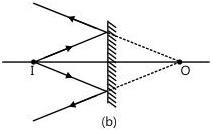
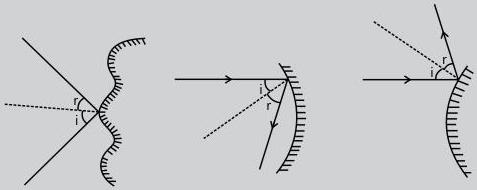
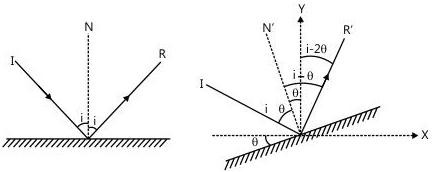
A ray incident at angle of incidence deviates through . For a plane mirror, an incident ray and its reflection are symmetric about the normal; the image of an object is virtual, erect, of the same size, as far behind the mirror as the object is in front, and laterally inverted.
Rotated mirror
MCQ Questions
1 Mark Questions
- 1State the two laws of reflection of light.
- 2Define the angle of deviation for reflection from a plane mirror.
- 3Write the expression for deviation produced when a ray is reflected by a plane mirror.
2 Mark Questions
- 1A ray of light makes an angle of 30° with a plane mirror. Find the angle of deviation produced on reflection.
- 2A plane mirror is rotated by 20°. Through what angle does the reflected ray rotate? Justify.
- 3Two plane mirrors are inclined at 60°. How many images of an object placed between them will be formed?
- 4Why does a plane mirror form a laterally inverted image?
3 Mark Questions
- 1Derive an expression for the number of images formed by two plane mirrors inclined at an angle θ with each other.
- 2A point object is placed between two plane mirrors inclined at 40°. Find the number of images formed and explain the special case that arises.
- 3Show with ray diagrams how the deviation of a ray reflected from a plane mirror depends on the angle of incidence.
Spherical Mirrors: Parameters and Sign Convention
Spherical mirror
A mirror whose reflecting surface is a part of a hollow sphere. A concave (converging) mirror reflects from its inner surface; a convex (diverging) mirror reflects from its outer surface.
- Pole (P): the centre of the reflecting surface.
- Centre of curvature (C): the centre of the sphere of which the mirror is a part.
- Radius of curvature (R): the distance PC;
- .
- Principal axis: the line joining P and C.
- Focus (F): the point where rays parallel to the principal axis converge (concave) or appear to diverge from (convex).
- Radius of the circular aperture: the radius of the reflecting surface measured along the principal axis aperture.
New Cartesian sign convention
Distances are measured from the pole of the mirror, along the principal axis. Distances measured in the direction of the incident light are positive; those opposite are negative. Heights above the principal axis are positive and below it are negative. With this convention, the mirror formula holds for both concave and convex mirrors.
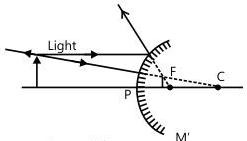
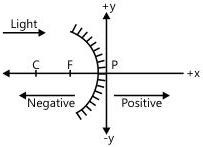
f and R signs
MCQ Questions
1 Mark Questions
- 1Define pole, centre of curvature and radius of curvature of a spherical mirror.
- 2State the relation between the focal length and the radius of curvature of a spherical mirror.
- 3State the New Cartesian sign convention for measuring distances in mirror problems.
2 Mark Questions
- 1A concave mirror has a radius of curvature of 30 cm. Where is its focus?
- 2Distinguish between concave and convex mirrors on the basis of the sign of their focal length.
- 3Why can a convex mirror never form a real image of a real object?
3 Mark Questions
- 1With a neat ray diagram, define the focus of (a) a concave mirror and (b) a convex mirror.
- 2State the new Cartesian sign convention for reflection by spherical mirrors and apply it to write the value of u and R for a concave mirror with the object on the principal axis.
Mirror Formula, Magnification and Image Velocity
Mirror formula
The relation between object distance u, image distance v and focal length f of a spherical mirror: , with the distances measured from the pole using the Cartesian sign convention.
For a real image h₂ is negative; for a virtual image it is positive. A magnification m > 1 means the image is magnified, m < 1 diminished, m = 1 of the same size, and the magnification of a virtual erect image is positive.
Using the mirror equation (NCERT Q9.15)
Velocity of the image
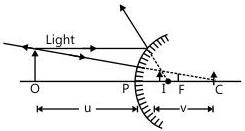
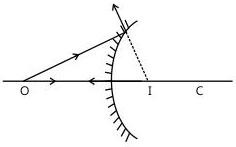
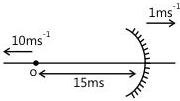
MCQ Questions
1 Mark Questions
- 1State the mirror formula for a spherical mirror.
- 2Write the expression for the linear magnification of a spherical mirror.
- 3What is the relation between image velocity and object velocity for a plane mirror?
2 Mark Questions
- 1An object is placed 30 cm in front of a concave mirror of focal length 15 cm. Find the position, nature and size of the image.
- 2A convex mirror has focal length 15 cm. A needle 12 cm from the mirror gives an image at what distance, and what is the magnification?
- 3Use the mirror formula to show that a concave mirror forms a real image beyond 2f when the object lies between f and 2f.
3 Mark Questions
- 1Derive the mirror formula 1/v + 1/u = 1/f for a concave mirror using a ray diagram and the Cartesian sign convention.
- 2An object moves with speed 2 cm/s towards a concave mirror of focal length 20 cm along its principal axis. At the instant when the object is 40 cm from the mirror, find the velocity of the image.
- 3Derive the relation for the velocity of the image of an object moving along the principal axis of a spherical mirror.
Refraction and Snell’s Law
Refraction of light
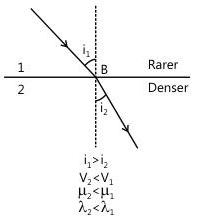
The change in direction of the path of light when it passes from one transparent medium to another, caused by the change in its speed. The incident ray, the refracted ray and the normal at the point of incidence all lie in the same plane (the second law of refraction).
Snell’s law
The ratio of the sine of the angle of incidence to the sine of the angle of refraction is constant for a given pair of media: . The refractive index of a medium is , the ratio of the speed of light in vacuum to its speed in the medium.
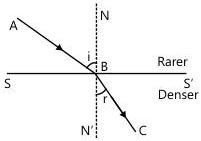
Bending rules
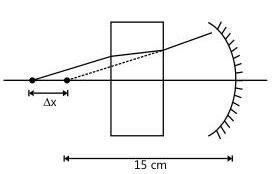
Real and apparent depth: a point object at the bottom of a tank appears raised. For normal viewing, . A glass slab of thickness t raises an object by the lateral shift .
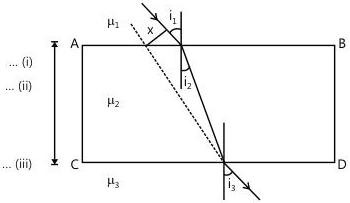
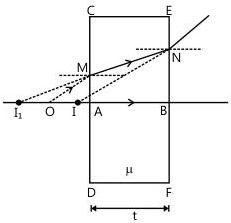
MCQ Questions
1 Mark Questions
- 1State the laws of refraction of light.
- 2State Snell’s law and define relative refractive index.
- 3A glass slab of thickness t is placed over a table. By how much does a point on the table appear raised when viewed normally? (Write the expression.)
2 Mark Questions
- 1The apparent depth of a needle at the bottom of a tank measured with a microscope is 9.4 cm for a water depth of 12.5 cm. Find the refractive index of water and the new apparent depth if the liquid is replaced by one with n = 1.63.
- 2A glass slab of thickness 15 cm and refractive index 1.5 is held parallel to a table. A pin fixed on the table is viewed from above. By how much does it appear to rise? Does the answer depend on where the slab is kept?
- 3Explain why a fish in water appears closer to the surface than it actually is.
3 Mark Questions
- 1Derive the expression for the apparent shift of an object viewed through a glass slab of thickness t and refractive index n.
- 2Light travels from air into a medium of refractive index 1.5 at an angle of incidence 60°. Find the angle of refraction and the angle of deviation.
Total Internal Reflection and Optical Fibres
Critical angle
When light travels from a denser medium of refractive index n₁ to a rarer medium n₂, it bends away from the normal. The critical angle C is the angle of incidence in the denser medium for which the angle of refraction is 90°: .
Conditions for total internal reflection
- Optical fibres: light is guided down a thin core by repeated total internal reflection at the core–cladding interface (used in communication and endoscopy).
- Mirages: in hot air near the ground the refractive index of air decreases, so light bends up and total internal reflection creates the illusion of water.
- Diamond brilliance: diamond has a small critical angle (≈ 24.4°), so light undergoes many total internal reflections and sparkles.
- Prisms: right-angled (45°–45°–90°) prisms are used to turn rays by 90° or 180° where reflection is 100% efficient, unlike mirrors.
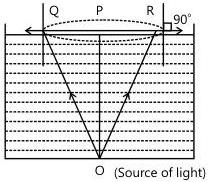
Area of emergence from a point source: a point source at a depth h in water (n = 1.33) lets light emerge through a circular patch of radius , where is the critical angle. For h = 0.8 m this gives r ≈ 0.91 m and area ≈ 2.6 m².
MCQ Questions
1 Mark Questions
- 1Define critical angle.
- 2State the two necessary conditions for total internal reflection.
- 3Why does a diamond sparkle more than a glass piece of the same shape?
2 Mark Questions
- 1A light pipe is made of a glass fibre of refractive index 1.68 clad with a material of refractive index 1.44. Find the range of angles of incidence with the axis for which total internal reflection guides light along the pipe.
- 2The refractive index of water is 1.33. Find the critical angle for the water–air interface.
- 3A small bulb is placed at the bottom of a tank of water 80 cm deep. Find the radius of the circular patch on the surface through which light emerges.
3 Mark Questions
- 1Derive the condition for total internal reflection and obtain the expression for the critical angle in terms of the refractive indices.
- 2Explain with a diagram the propagation of light in an optical fibre. A fibre with core index 1.68 and no cladding accepts light incident at any angle up to what value with its axis?
Refraction at Spherical Surfaces and Lenses
Refraction at a spherical surface
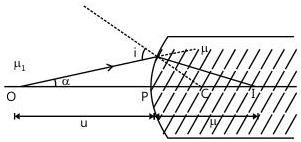
For refraction at a single spherical surface separating media of refractive indices n₁ and n₂, with the object distance u and image distance v measured from the pole of the surface: , where R is the radius of curvature. (Assumptions: the aperture is small and light is paraxial.)
Lens
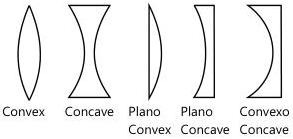
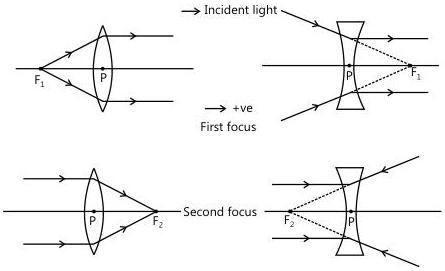
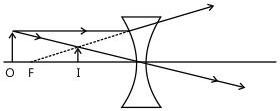
A lens is a transparent medium bounded by two curved surfaces (usually spherical). A double-convex or plano-convex lens is converging; a double-concave or plano-concave lens is diverging. The optical centre is the point inside a thin lens through which a ray passes undeviated.
Lens formula sign convention
If a converging beam falls on a lens, u is effectively positive (virtual object). For a convex lens of f = 20 cm with the virtual object 12 cm beyond the lens, the lens formula gives the beam converging at v = 7.5 cm; for a concave lens of f = 16 cm, v = 48 cm.
MCQ Questions
1 Mark Questions
- 1State the lens formula for a thin lens.
- 2Define optical centre of a lens.
- 3Distinguish between concave and convex lenses by the sign of the focal length.
2 Mark Questions
- 1An object 3.0 cm tall is placed 14 cm in front of a concave lens of focal length 21 cm. Describe the image and what happens as the object is moved farther away.
- 2A convex lens of focal length 30 cm and a concave lens of focal length 20 cm are placed in contact. Is the combination converging or diverging?
- 3A converging beam falls on a convex lens of focal length 20 cm placed 12 cm from the point of convergence. Where does the beam converge now?
3 Mark Questions
- 1Derive the refraction formula at a spherical surface for light going from rarer to denser medium at a convex refracting surface.
- 2Obtain the lens formula 1/v − 1/u = 1/f for a thin convex lens using the refraction formula for a single spherical surface, stating clearly the assumptions used.
Lens Maker’s Formula, Power and Combination
Lens maker’s formula
The focal length f of a thin lens depends on its refractive index n (relative to the surrounding medium) and the radii of curvature R₁, R₂ of its surfaces: . R₁ is the radius of the first refracting surface and R₂ the second, positive if the centre of curvature lies on the emergent side.
Power of a lens
Power is the reciprocal of the focal length in metres: (dioptre). A converging lens has positive power and a diverging lens negative power. For thin lenses in contact, powers add: .
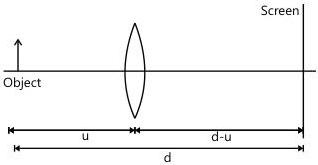
Displacement method (NCERT Q9.20)
MCQ Questions
1 Mark Questions
- 1Write the lens maker’s formula and name each symbol.
- 2Define the power of a lens. State its SI unit.
- 3State the formula for the effective power of two thin lenses placed in contact.
2 Mark Questions
- 1A double-convex lens of n = 1.55 is wanted with f = 20 cm and both faces of equal radius. Find the required radius of curvature.
- 2A convex lens of f = 30 cm and a concave lens of f = 20 cm are in contact. Find the focal length and nature of the combination.
- 3Object and screen are 90 cm apart. A convex lens gives two sharp images separated by 20 cm. Find the focal length of the lens.
3 Mark Questions
- 1Derive the lens maker’s formula for a thin double-convex lens stating all assumptions.
- 2Show that two thin lenses in contact behave as a single lens of focal length F with 1/F = 1/f₁ + 1/f₂.
Prism and the Angle of Minimum Deviation
Prism
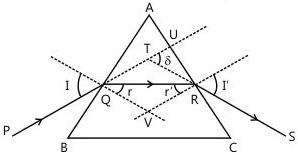
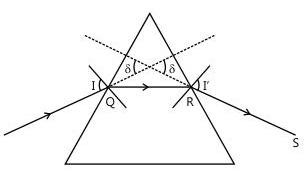
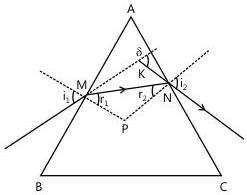
A prism is a transparent wedge with refracting surfaces inclined at the angle A (refracting angle). A ray passing through a prism is deviated by , where i is the angle of incidence and e the angle of emergence.
Angle of minimum deviation
As i varies, δ passes through a minimum δ_m when the ray traverses the prism symmetrically (i = e). Then the refractive index of the prism material is .
Thin prism and no emergence
MCQ Questions
1 Mark Questions
- 1Define the refracting angle of a prism and the angle of deviation.
- 2State the condition for minimum deviation in a prism.
- 3Write the thin-prism expression for deviation.
2 Mark Questions
- 1A prism of refracting angle 60° gives minimum deviation 40° for sodium light. Find its refractive index.
- 2If the same prism is placed in water (n = 1.33), estimate the new angle of minimum deviation.
- 3A ray is incident on a prism of angle 60° with refractive index 1.524. Find the angle of incidence at which it just suffers total internal reflection at the other face.
3 Mark Questions
- 1Derive the prism formula n = sin((A + δ_m)/2) / sin(A/2).
- 2Show that the deviation is minimum when the ray passes symmetrically through the prism, and obtain the relation between the angle of incidence and the angle of emergence at minimum deviation.
Dispersion of Light
Dispersion
The splitting of white light into its constituent colours on refraction because the refractive index of a material varies with wavelength (violet deviates the most, red the least). The deviation for a thin prism of small angle A is for each colour.
- Angular dispersion:
- for a thin prism — the angular separation between violet and red rays.
- Dispersive power:
- , where n_y is the refractive index for the mean (yellow) colour. It is a pure number describing how strongly a material separates colours.
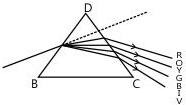
Rainbow
Deviation without dispersion / dispersion without deviation
MCQ Questions
1 Mark Questions
- 1Define dispersion of light.
- 2Define the dispersive power of a material.
- 3Which colour has the highest refractive index in glass?
2 Mark Questions
- 1Why is violet light deviated more than red light when passing through a prism?
- 2A thin prism gives angular dispersion (n_v − n_r)A. What does this quantity represent?
- 3How would you combine a crown and a flint glass prism so that white light is deviated without dispersion?
3 Mark Questions
- 1Derive the expression for the dispersive power of a prism material in terms of the refractive indices of two colours.
- 2Explain the formation of a rainbow, mentioning the roles of refraction, dispersion and total internal reflection in water droplets.
Optical Instruments: The Eye, Microscope and Telescope
The eye
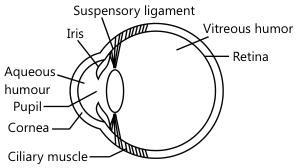
The eye acts as a camera: the lens (a converging lens of adjustable focal length) forms a real, inverted image on the retina. The ciliary muscles change the focal length (accommodation). For a normal eye the far point is at infinity and the near point of distinct vision is at D ≈ 25 cm.
Simple microscope
A single convex lens used to magnify small objects. With the final image at the near point (D = 25 cm), magnifying power is ; with the image at infinity, . Maximum magnification uses the closest object distance: u = Df/(D + f).
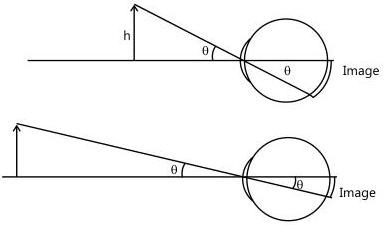
Compound microscope
Two lenses: an objective (small f₀) forming a real, magnified, inverted image, and an eyepiece (small f_e) acting as a magnifier. Total magnification M = m₀ × m_e. For final image at infinity, M = (L/f₀)(D/f_e) roughly, where L is the tube length; the two lenses are separated by L = v₀ + u_e.
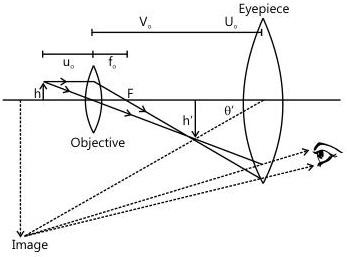
Astronomical telescope
Used to view distant objects: an objective of large f₀ and an eyepiece of small f_e. In normal adjustment the final image is at infinity and with tube length L = f₀ + f_e. If the final image is at the near point, .
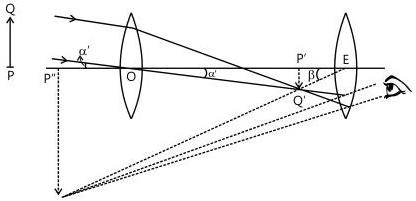
Myopia and hypermetropia
MCQ Questions
1 Mark Questions
- 1Define the near point and far point of a normal human eye.
- 2State the formula for the magnifying power of a simple microscope with the final image at the near point.
- 3Write the expression for the magnifying power of an astronomical telescope in normal adjustment.
2 Mark Questions
- 1A telescope has objective f₀ = 144 cm and eyepiece f_e = 6 cm. Find its magnifying power and the separation between the lenses.
- 2Explain the correction of myopia and hypermetropia with suitable lenses.
- 3A person with normal near point 25 cm uses a magnifying glass of focal length 5 cm. Find the closest and farthest object distances for clear reading and the corresponding magnifications.
3 Mark Questions
- 1Draw a labelled ray diagram of a compound microscope and derive an expression for its magnifying power with the final image at infinity.
- 2A giant telescope has an objective of focal length 15 m and an eyepiece of focal length 1.0 cm. Find the angular magnification and, for the moon of actual diameter 3.48 × 10⁶ m at a distance 3.8 × 10⁸ m, the diameter of the image formed by the objective.
Some Natural Phenomena Due to Sunlight
Rainbow
A rainbow is caused by dispersion of sunlight by tiny water droplets in the atmosphere, followed by total internal reflection inside each droplet. The primary rainbow shows red on the outer edge and violet on the inner, with a secondary rainbow (fainter, colours reversed) outside it. (See the Dispersion section for the prism combination reasoning.)
- Angular size of the primary rainbow: about 42° (red) to 40° (violet) from the antisolar point.
- Secondary rainbow: about 50° (violet) to 53° (red) — colours are reversed.
- Scattering of sunlight by air molecules makes the sky look blue (Rayleigh scattering) and reddening occurs at sunrise and sunset when sunlight travels through a longer atmospheric path.
Exam focus
MCQ Questions
1 Mark Questions
- 1Name the optical phenomenon responsible for the formation of a rainbow.
- 2Why is the sky blue?
- 3In which order do the colours appear in the primary rainbow?
2 Mark Questions
- 1Using refraction and total internal reflection inside a water drop, explain the formation of a primary rainbow.
- 2Why does the red colour appear on the outer edge of the primary rainbow?
3 Mark Questions
- 1Explain with a diagram the formation of the primary rainbow and the physical reason for the order of colours.
- 2Why is the secondary rainbow fainter and how are its colours arranged?
NCERT Exercise Questions
From the textbook
Exercises (NCERT Q9.1–Q9.27)
- 9.1) A small candle, 2.5 cm in size, is placed 27 cm in front of a concave mirror of radius of curvature 36 cm. At what distance from the mirror should a screen be placed to obtain a sharp image? Describe the nature and size of the image. If the candle is moved closer to the mirror, how would the screen have to be moved?
- 9.2) A 4.5 cm needle is placed 12 cm away from a convex mirror of focal length 15 cm. Give the location of the image and the magnification. Describe what happens as the needle is moved farther from the mirror.
- 9.3) A tank is filled with water to a height of 12.5 cm. The apparent depth of a needle lying at the bottom measured by a microscope is 9.4 cm. What is the refractive index of water? If water is replaced by a liquid of refractive index 1.63 up to the same height, by what distance would the microscope have to be moved to focus on the needle again?
- 9.4) Figures (a) and (b) show refraction of a ray in air incident at 60° with the normal to a glass–air and water–air interface respectively. For (c) predict the angle of refraction in glass when the angle of incidence in water is 45°.
- 9.5) A small bulb is placed at the bottom of a tank containing water to a depth of 80 cm. What is the area of the surface of water through which light from the bulb can emerge? Take the refractive index of water as 1.33.
- 9.6) A prism is made of glass of unknown refractive index. A parallel beam of light is incident on a face and the angle of minimum deviation measured is 40°. What is the refractive index of the prism material? (Refracting angle 60°.) If the prism is placed in water (n = 1.33), predict the new angle of minimum deviation.
- 9.7) Double-convex lenses are to be manufactured from glass of refractive index 1.55, both faces having the same radius of curvature. What radius is required for a focal length of 20 cm?
- 9.8) A beam of light converges at a point P. A lens is placed in its path 12 cm from P. Where does the beam converge if the lens is (a) a convex lens of focal length 20 cm, (b) a concave lens of focal length 16 cm?
- 9.9) An object of size 3.0 cm is placed 14 cm in front of a concave lens of focal length 21 cm. Describe the image formed. What happens if the object is moved further away from the lens?
- 9.10) What is the focal length of a convex lens of focal length 30 cm in contact with a concave lens of focal length 20 cm? Is the system converging or diverging?
- 9.11) A compound microscope consists of an objective of focal length 2.0 cm and an eyepiece of focal length 6.25 cm, separated by 15 cm. How far from the objective should the object be placed for the final image at (a) the least distance of distinct vision (25 cm), (b) infinity? What is the magnifying power in each case?
- 9.12) A person with normal near point (25 cm) uses a compound microscope with objective f = 8 mm and eyepiece f = 2.5 cm, object placed 9.0 mm from the objective. What is the separation between the two lenses? Calculate the magnifying power of the microscope.
- 9.13) A small telescope has an objective of focal length 144 cm and an eyepiece of focal length 6.0 cm. What is the magnifying power and the separation between the objective and the eyepiece?
- 9.14) (a) A giant refracting telescope has an objective of focal length 15 m and eyepiece 1.0 cm. What is the angular magnification? (b) For the moon of diameter 3.48 × 10⁶ m at a distance 3.8 × 10⁸ m, what is the diameter of the image formed by the objective?
- 9.15) Use the mirror equation to deduce that: (a) an object placed between f and 2f of a concave mirror produces a real image beyond 2f; (b) a convex mirror always produces a virtual image independent of the object location; (c) the virtual image by a convex mirror is always diminished and lies between the pole and the focus; (d) an object between the pole and focus of a concave mirror produces a virtual and enlarged image.
- 9.16) A small pin fixed on a table top is viewed from above from a distance of 50 cm. By what distance would it appear to be raised if viewed through a 15 cm thick glass slab of n = 1.5 held parallel to the table? Does the answer depend on the location of the slab?
- 9.17) (a) A "light pipe" is a glass fibre of refractive index 1.68 clad with material of index 1.44. What range of angles of incidence with the axis gives total internal reflection inside the pipe? (b) What if there is no outer covering?
- 9.18) Answer: (a) Can plane and convex mirrors produce real images under some circumstances? (b) A virtual image cannot be caught on a screen, yet we see one on the retina. Is there a contradiction? (c) A diver under water looks obliquely at a fisherman on the bank — taller or shorter? (d) Does the apparent depth of a tank change when viewed obliquely? (e) Is the much larger refractive index of diamond of use to a diamond cutter?
- 9.19) The image of a small electric bulb fixed on a wall is to be obtained on the opposite wall 3 m away by a large convex lens. What is the maximum possible focal length of the lens?
- 9.20) A screen is placed 90 cm from an object. The image is formed by a convex lens at two positions separated by 20 cm. Determine the focal length of the lens.
- 9.21) (a) Determine the effective focal length of the two lenses of Q9.10 placed 8.0 cm apart with coincident principal axes. Does the answer depend on which side the parallel beam is incident? (b) An object 1.5 cm tall is placed 40 cm from the convex lens. Find the magnification and size of the final image.
- 9.22) At what angle should a ray be incident on a prism of refracting angle 60° and refractive index 1.524 so that it just suffers total internal reflection at the other face?
- 9.23) You are given prisms of crown and flint glass of a wide variety of angles. Suggest combinations that (a) deviate a pencil of white light without much dispersion, (b) disperse and displace a pencil of white light without much deviation.
- 9.24) For a normal eye: far point at infinity, near point 25 cm, cornea converges with power 40 D and the eye-lens contributes about 20 D at least. Estimate the range of accommodation of the eye-lens.
- 9.25) Does short-sightedness (myopia) or long-sightedness (hypermetropia) necessarily imply partial loss of accommodation? If not, what might cause these defects?
- 9.26) A myopic person wears spectacles of power −1.0 D for distant vision and in old age also needs a reading glass of +2.0 D. Explain what may have happened.
- 9.27) A person sees vertical lines of a shirt pattern more distinctly than horizontal lines. What is this defect due to, and how is it corrected?
Additional Exercises (NCERT Q9.28–Q9.38)
- 9.28) A man with normal near point (25 cm) reads small print using a thin convex lens of focal length 5 cm. (a) Find the closest and farthest distances at which he should keep the lens from the page to read through it. (b) What is the maximum and minimum angular magnification possible?
- 9.29) A card sheet divided into squares of each size 1 mm² is viewed at a distance of 9 cm through a magnifying glass of focal length 10 cm held close to the eye. (a) What is the magnification and the area of each square in the virtual image? (b) What is the angular magnification? (c) Are the two equal? Explain.
- 9.30) (a) At what distance should the lens of the previous question be held from the figure to view the squares distinctly with the maximum magnifying power? (b) What is the magnification then? (c) Is it equal to the magnifying power? Explain.
- 9.31) What should be the distance between the object of the previous question and the magnifier if each square in the virtual image is to have area 6.25 mm²? Would you be able to see the squares distinctly with your eyes close to the magnifier?
- 9.32) Answer: (a) The angle subtended by an object at the eye equals that subtended by the virtual image in a magnifying glass — in what sense then is there angular magnification? (b) If the eye is moved back, does the angular magnification change? (c) What stops us from using lenses of smaller and smaller focal length for greater magnification? (d) Why must both lenses of a compound microscope have short focal lengths? (e) When viewing through a compound microscope, why should the eye be a short distance from the eyepiece, and how much?
- 9.33) A magnification of 30× is desired using an objective of f = 1.25 cm and an eyepiece of f = 5 cm. How will you set up the compound microscope?
- 9.34) A small telescope has an objective of focal length 140 cm and an eyepiece of focal length 5.0 cm. Find the magnifying power for distant objects when (a) the final image is at infinity, (b) the final image is at the least distance of distinct vision.
- 9.35) (a) For the telescope of Q9.34(a), what is the separation between the objective and the eyepiece? (b) If used to view a 100 m tall tower 3 km away, what is the height of the image formed by the objective? (c) What is the height of the final image formed at 25 cm?
- 9.36) A Cassegrain telescope uses two mirrors as shown. Built with mirrors 20 mm apart: the large mirror radius of curvature is 220 mm and the small one 140 mm. Where will the final image of an object at infinity be formed?
- 9.37) Light incident normally on a plane mirror attached to a galvanometer coil retraces backwards. A current deflects the mirror by 3.5°. What is the displacement of the reflected spot on a screen 1.5 m away?
- 9.38) An equiconvex lens (n = 1.50) in contact with a liquid layer on a plane mirror gives an inverted image at the needle position at 45.0 cm. With the liquid removed the distance is 30.0 cm. What is the refractive index of the liquid?
Answers at a Glance
- 9.1) Screen at 54 cm from the mirror; image real, inverted, magnified (5 cm); moving the candle closer moves the screen away. | 9.2) Image at 6.7 cm behind the mirror, m ≈ +0.56, erect and diminished; image stays between pole and focus as the needle moves away. | 9.3) n = 1.33; microscope raised by 1.73 cm. | 9.4) About 38.7°. | 9.5) Area ≈ 2.6 m². | 9.6) n ≈ 1.532; in water δ_m ≈ 10.3°. | 9.7) R = 22 cm.
- 9.8) (a) 7.5 cm, (b) 48 cm from the lens. | 9.9) Virtual, erect, at 8.4 cm, m = 0.6; image moves closer to the focus as the object recedes. | 9.10) f = −60 cm, diverging. | 9.11) (a) u₀ = −2.5 cm, m = 20; (b) u₀ ≈ −2.59 cm, m ≈ 13.5. | 9.12) Separation ≈ 9.47 cm; magnifying power ≈ 88. | 9.13) m = 24; L = 150 cm. | 9.14) (a) 1500; (b) ≈ 13.7 cm. | 9.15) Deductions from 1/v + 1/u = 1/f as stated. | 9.16) Apparent rise 5 cm; independent of slab position. | 9.17) (a) 0°–60°; (b) 0°–90°.
- 9.18) (a) Yes, with a converging incident beam (virtual object); (b) no contradiction — the retina is a screen; (c) taller; (d) apparent depth decreases; (e) yes — smaller critical angle, more total internal reflection. | 9.19) f_max = 0.75 m. | 9.20) f ≈ 21.4 cm. | 9.21) (a) Depends on the side (216 cm / 416 cm) — not a useful concept; (b) m ≈ 0.65, size ≈ 0.98 cm. | 9.22) i = 29.75°. | 9.23) (a) Crown + flint, bases opposite: deviation without dispersion; (b) same arrangement sized for dispersion without deviation.
- 9.24) Eyepiece lens range ≈ 20–24 D (total eye power 60–64 D). | 9.25) No — they come from an elongated/shortened eyeball; loss of accommodation itself is presbyopia. | 9.26) Far point was 100 cm (myopia) and the near point receded to about 50 cm in old age — needs −1.0 D for distance, +2.0 D for near. | 9.27) Astigmatism — a non-spherical cornea — corrected with a cylindrical lens. | 9.28) (a) 4.17 cm to 5 cm; (b) m = 6 maximum, 5 minimum. | 9.29) (a) m = 10, area 100 mm² (=1 cm²); (b) ≈ 2.8; (c) not equal.
- 9.30) (a) 7.14 cm; (b) m = 3.5; (c) yes, equal when the image is at the near point. | 9.31) u = 6 cm; no — the image forms inside the near point. | 9.32) (a) The object can be brought closer than 25 cm, subtending a larger angle; (b) it decreases; (c) manufacturing limits and increasing aberrations; (d) to get large magnification; (e) at the emergent-beam (eye-ring) position. | 9.33) Object 1.5 cm from the objective; lenses separated by 11.67 cm. | 9.34) (a) 28; (b) 33.6. | 9.35) (a) 145 cm; (b) 4.7 cm; (c) ≈ 28 cm.
- 9.36) Final image 315 mm from the small mirror. | 9.37) ≈ 18.4 cm. | 9.38) n ≈ 4/3 ≈ 1.33.
CBSE Pattern Questions
How CBSE asks this chapter
MCQ Questions
1 Mark Questions
- 1State the sign convention used in the mirror and lens formulae.
- 2Define the power of a lens and give its SI unit.
- 3State the conditions for total internal reflection.
- 4Write the lens maker's formula.
2 Mark Questions
- 1An object is placed 30 cm in front of a convex lens of focal length 20 cm. Find the position and nature of the image. (Ans: v = 60 cm, real and inverted)
- 2A concave mirror has a focal length of 20 cm. Where should an object be placed to get a real image double the object size? (Ans: 2 = v/u ⇒ u = −30 cm)
- 3The refractive index of glass is 1.5. Find the critical angle for glass–air interface. (Ans: sin ic = 1/1.5 ⇒ ic ≈ 41.8°)
3 Mark Questions
- 1Derive the lens maker's formula for a thin convex lens. (Ans: 1/f = (μ − 1)(1/R₁ − 1/R₂))
- 2Derive the relation between refractive index, prism angle and minimum deviation, μ = sin[(A + δm)/2]/sin(A/2).
- 3Explain the construction and working of a compound microscope and derive its magnifying power at normal adjustment.
5 Mark Questions
- 1Describe the construction and working of a refracting astronomical telescope in normal adjustment, derive its magnifying power, and state the effect of objectives of different apertures on the resolving power.
- 2Explain total internal reflection — conditions, relation with critical angle, and two applications (optical fibre and mirage formation) — with ray diagrams.
PDF: Assignments & Tests
Printable study material
Free PDF Downloads & Assignments
Suggested path: finish the two topic-wise assignments first, then attempt each timed 40-mark test in 90 minutes and check yourself against the answer key.
Every concept of the chapter, arranged topic by topic: reflection and mirrors, refraction, total internal reflection, lenses, prisms and dispersion.
Higher-difficulty second set — mixed multi-topic numericals and derivations covering the whole chapter.
Full board-pattern test: 1-mark MCQs/VSA, 2-mark, 3-mark and 5-mark long answers totalling 40 marks — to be done in 90 minutes, with an answer key.
Second full paper with a different question set — same 40-mark, 90-minute blueprint and answer key.
Quick Revision
Key formulas at a glance
Memorise these equations — direct application numericals and derivations in CBSE & JEE frequently hinge on these.
Snell’s law
Critical angle
Mirror formula
Mirror magnification
Refraction at a spherical surface
Lens formula
Lens maker’s formula
Power of lens
Prism deviation
Simple microscope
Compound microscope
Astronomical telescope
Exam Strategy
How this chapter is asked
High-yield question patterns observed across CBSE boards, JEE Main & Advanced, and NEET.
- Mirror formula 1/f = 1/u + 1/v (Cartesian signs): u is negative for a real object; f is negative for a concave mirror and positive for a convex mirror.
- Lens formula 1/f = 1/v − 1/u; lens maker 1/f = (n − 1)(1/R₁ − 1/R₂), with power P = 1/f in dioptres and P_total = P₁ + P₂ for contact lenses.
- Total internal reflection needs n₁ > n₂ and i > C with sin C = n₂/n₁ — used in optical fibres, mirages and prisms.
- Prism: δ = i + e − A, minimum deviation at i = e with n = sin((A + δ_m)/2)/sin(A/2).
- Dispersion: δ grows with 1/λ; dispersive power ω = (n_v − n_r)/(n_y − 1).
- Instruments: simple microscope m = 1 + D/f, telescope M = f₀/f_e (normal adjustment), compound microscope M = m₀ × m_e.
- Eye defects: myopia corrected by concave (−D), hypermetropia by convex, astigmatism by cylindrical lens.
Practice Numericals
Step-by-step worked examples
Standard exam-level problems solved with clear conceptual breakdowns.
Image by a concave mirror (NCERT 9.1)
Step-by-Step Solution
- 1Here u = −27 cm, R = −36 cm so f = R/2 = −18 cm.
- 2Mirror formula: 1/v = 1/f − 1/u = −1/18 + 1/27 = (−3 + 2)/54 = −1/54, so v = −54 cm.
- 3m = −v/u = −(−54)/(−27) = −2, image size = m × object size = 2 × 2.5 = 5.0 cm.
- 4Since v is negative and m is negative, the image is real, inverted and magnified, formed 54 cm in front of the mirror.
- 5Moving the candle closer moves the real image farther from the mirror, so the screen must move away from the mirror.
Final Answer
Screen at 54 cm in front of the mirror; real, inverted, 5.0 cm tall (m = −2).
Apparent depth and refractive index (NCERT 9.3)
Step-by-Step Solution
- 1n = real depth / apparent depth = 12.5 / 9.4 = 1.33.
- 2For the new liquid, apparent depth = real depth / n = 12.5 / 1.63 = 7.67 cm.
- 3The apparent depth is smaller, so the microscope must be raised by 9.4 − 7.67 = 1.73 cm.
Final Answer
n = 1.33; the microscope is raised by 1.73 cm.
Minimum deviation and refractive index (NCERT 9.6)
Step-by-Step Solution
- 1n = sin((A + δ_m)/2) / sin(A/2) = sin(50°) / sin(30°) = 0.766/0.5 = 1.532.
- 2In water the relative refractive index is n_water_rel = n_glass/n_water = 1.532/1.33 = 1.152.
- 3With this relative index, sin((A + δ_m′)/2) = 1.152 × sin 30° = 0.576, so (A + δ_m′)/2 = 35.16° and δ_m′ ≈ 70.3° − 60° = 10.3°.
Final Answer
n ≈ 1.532; new minimum deviation ≈ 10.3°.
Lens maker formula radius (NCERT 9.7)
Step-by-Step Solution
- 1For equal radii R₁ = R, R₂ = −R, so 1/f = (n − 1)(1/R − (−1/R)) = (n − 1)(2/R).
- 21/20 = (1.55 − 1) × 2/R = 0.55 × 2/R ⇒ 1/20 = 1.1/R.
- 3R = 1.1 × 20 = 22 cm.
Final Answer
R = 22 cm for each face.
Combination of lenses (NCERT 9.10)
Step-by-Step Solution
- 1For thin lenses in contact: 1/F = 1/f₁ + 1/f₂ = 1/30 + 1/(−20) = (2 − 3)/60 = −1/60.
- 2F = −60 cm. The negative sign shows the combination is diverging.
Final Answer
F = −60 cm — a diverging (concave) system.
Telescope magnification (NCERT 9.13)
Step-by-Step Solution
- 1In normal adjustment (final image at infinity), M = f₀/f_e = 144/6 = 24.
- 2The objective forms the primary image at its focus; for the relaxed eye the eyepiece is placed so that this image is at the eyepiece focus.
- 3Tube length L = f₀ + f_e = 144 + 6 = 150 cm.
Final Answer
M = 24; separation = 150 cm.
FAQ
Frequently asked questions
What is total internal reflection?
When light travels from a denser to a rarer medium at an angle of incidence greater than the critical angle, it is completely reflected back into the denser medium. Optical fibres, mirages, and right-angled prisms rely on it.
What is the difference between a concave and a convex mirror?
A concave mirror converges light and forms real, inverted images (and enlarged virtual images when the object is between the pole and focus); a convex mirror diverges light and always forms virtual, erect, diminished images — useful as rear-view mirrors.
What does the lens maker’s formula give?
The focal length of a thin lens from its refractive index and the radii of curvature of its two surfaces: 1/f = (n − 1)(1/R₁ − 1/R₂).
How does a compound microscope magnify?
The objective forms a real, magnified, inverted image of the object and the eyepiece acts as a magnifier on that image; total magnification is the product of the two, M = m₀ × m_e.
Why does a diamond sparkle more than glass?
Diamond has a much higher refractive index, so its critical angle (≈ 24°) is much smaller than glass (≈ 42°). Light entering a diamond undergoes total internal reflection many times before emerging, giving it a brilliant sparkle — light is trapped until it exits at favourable angles.
What is the difference between myopia and hypermetropia?
Myopia (short sight) means the far point is closer than infinity — the eye focuses a distant object in front of the retina; corrected with a diverging lens. Hypermetropia (long sight) means the near point recedes beyond 25 cm — the eye focuses a near object behind the retina; corrected with a converging lens.
Next Chapters
Continue learning
Same chapter
Read alongside
Interactive Quiz
Chapter MCQ practice test
Instant scoring with complete solutions — test your mastery in under 15 minutes.
Chapter MCQ Mock Test
Evaluate how well you have retained the concepts, formulas, and reaction mechanisms from this chapter. Questions adhere strictly to latest CBSE, JEE & NEET trends.
Master this chapter with expert live guidance
Self-study notes lay the ground, but conceptual doubts clear fastest in an interactive classroom. Narayan Gurukul Academy (ClassApna) conducts small-batch CBSE, JEE & NEET coaching with daily doubt solving and rigorous mock tests.
Small batches · 1-on-1 personal mentorship · Live online & offline centre