Class 11 Maths · NCERT Chapter 9
~42 min readStraight Lines Class 11 Maths Notes
A complete, exam-ready pass on straight lines — the slope of a line and what it measures, conditions for parallel and perpendicular lines, every form of the equation of a line (point–slope, two-point, intercept, normal), the general equation and how to convert between forms, the angle between two lines, perpendicular-distance formulas, and the area of a triangle. Every topic ends with mark-wise question banks matching the CBSE pattern, followed by the chapter's full NCERT questions and two free CBSE-pattern test PDFs. No signup required.
What is this chapter about in one line?
Straight lines connects geometry and algebra: the slope links angle to direction, and every line has an equation you can derive from a point, a slope, or two intercepts.
Slope of a Line
Slope (gradient)
The slope m of a line measures its steepness — the tangent of the angle θ it makes with the positive x-axis: . For two points (x₁, y₁) and (x₂, y₂) on the line: .
- A horizontal line has m = 0; a vertical line has m undefined (90° with x-axis).
- The angle of inclination θ lies in [0°, 180°); m = tan θ gives a one-to-one mapping.
- A positive slope rises left to right; a negative slope falls left to right.
MCQ Questions
1 Mark Questions
- 1Define the slope of a line. What does it measure in terms of the angle of inclination?
- 2State the slope of a horizontal line and of a vertical line.
- 3What is the slope of the line that makes an angle of 45° with the positive direction of the x-axis?
- 4Write the formula for the slope of the line through (x₁, y₁) and (x₂, y₂).
2 Mark Questions
- 1Find the slope of the line joining the points (5, 4) and (2, −3).
- 2Find the slope of a line passing through the origin and the mid-point of the segment joining P(0, −4) and B(8, 0).
- 3Find the slope of the line which makes an angle of 30° with the positive direction of the y-axis measured anticlockwise.
- 4Using slopes, show that the points A(4, 4), B(3, 5) and C(−1, −1) are the vertices of a right angled triangle (without using Pythagoras' theorem).
3 Mark Questions
- 1Find the value of x for which the points (x, −1), (2, 1) and (4, 5) are collinear.
- 2If the three points (h, 0), (a, b) and (0, k) lie on a straight line, then show that a/h + b/k = 1.
- 3The slope of a line is double of the slope of another line. If the tangent of the angle between them is ⅓, find the slopes of the two lines.
Parallel and Perpendicular Lines
Parallel lines
Two non-vertical lines with slopes m₁ and m₂ are parallel if and only if .
Perpendicular lines
Two lines are perpendicular if and only if the product of their slopes is −1: . If one line is vertical, the other must be horizontal.
Exam shortcut
MCQ Questions
1 Mark Questions
- 1State the condition for two non-vertical lines to be parallel.
- 2State the condition for two lines to be perpendicular.
- 3Find the slope of a line perpendicular to a line whose slope is −5.
- 4Are the lines y = 2x + 3 and y = 2x − 5 parallel or perpendicular?
2 Mark Questions
- 1Find the equation of the line passing through (−3, 5) and perpendicular to the line through the points (2, 5) and (−3, 6).
- 2Find the equation of the line parallel to the line 3x − 4y + 2 = 0 and passing through the point (−2, 3).
- 3Find the value of k so that the lines 2x + 3y − 5 = 0 and kx − 6y + 7 = 0 are perpendicular.
- 4Find the equation of a line that passes through the point (0, 2) and is perpendicular to the line x + y = 4.
3 Mark Questions
- 1Find the equation of the right bisector (perpendicular bisector) of the line segment joining the points (3, 4) and (−1, 2).
- 2A line perpendicular to the line segment joining the points (1, 0) and (2, 3) divides it in the ratio 1 : n. Find the equation of the line.
- 3Find the equation of the line through the point (2, 3) that is perpendicular to the line joining (1, −2) and (4, 4), and hence find its distance from the origin.
Forms of the Equation of a Line
- Point-slope form: y − y₁ = m(x − x₁) — the workhorse for most problems.
- Two-point form: (y − y₁)/(y₂ − y₁) = (x − x₁)/(x₂ − x₁).
- Slope-intercept form: y = mx + c, where c is the y-intercept.
- Intercept form: x/a + y/b = 1, where a and b are the x- and y-intercepts.
- Normal form: x cos α + y sin α = p, where p is the perpendicular distance from origin.
MCQ Questions
1 Mark Questions
- 1Write the equations of the x-axis and the y-axis.
- 2Write the point-slope form of the equation of a line.
- 3Write the slope–intercept form of the equation of a line.
- 4Write the equation of a horizontal line at a distance 5 above the x-axis.
2 Mark Questions
- 1Find the equation of the line passing through the point (−4, 3) with slope ½.
- 2Find the equation of the line passing through (2, 2√3) and inclined with the x-axis at an angle of 75°.
- 3Find the equation of a line that cuts off equal intercepts on the coordinate axes and passes through the point (2, 3).
- 4Find the equation of the line which intersects the x-axis at a distance of 3 units to the left of the origin and has slope −2.
3 Mark Questions
- 1Find the equation of the line passing through the point (2, 2) and cutting off intercepts on the axes whose sum is 9.
- 2Find the equation of the line through the point (0, 2) making an angle 2π/3 with the positive x-axis. Also find the equation of the line parallel to it and crossing the y-axis at a distance of 2 units below the origin.
- 3A line with slope m makes an x-intercept d. Show that its equation is y = m(x − d), and use it to find the equation of a line of slope 3 whose x-intercept is 2.
General Equation and Converting Between Forms
General form
Every line can be written as . From this: slope m = −a/b (b ≠ 0), x-intercept = −c/a (a ≠ 0), y-intercept = −c/b (b ≠ 0). To convert to slope-intercept, solve for y.
Watch the sign
MCQ Questions
1 Mark Questions
- 1Write down the general (linear) form of the equation of a line.
- 2Find the slope of the line 2x + 3y − 6 = 0.
- 3Write the intercepts made by the line x/2 + y/3 = 1 on the axes.
- 4Express 3x − 4y + 7 = 0 in slope–intercept form.
2 Mark Questions
- 1Reduce the equation x + 7y = 0 into slope–intercept form and find its slope and y-intercept.
- 2Reduce the equation 3x + 2y − 12 = 0 into intercept form and find its intercepts on the axes.
- 3Reduce 6x + 3y − 5 = 0 into slope–intercept form and find its slope and y-intercept.
- 4Find the equation of a vertical line passing through the point (2, 3).
3 Mark Questions
- 1Reduce 4x − 3y = 6 into intercept form and find its intercepts on the axes; then write its slope–intercept form.
- 2Show that the equation of the line passing through the origin and making an angle θ with the line y = mx + c is y/x = (tan θ ± m)/(1 ∓ m tan θ).
- 3Find the equation of the line passing through the point of intersection of the lines 4x + 7y − 3 = 0 and 2x − 3y + 1 = 0 that has equal intercepts on the axes.
Angle Between Two Lines
Angle between lines
If two lines have slopes m₁ and m₂, the acute angle θ between them satisfies: . If the denominator is zero (m₁m₂ = −1), the lines are perpendicular and θ = 90°.
- The formula gives the acute angle by default; drop the absolute value to get the directed angle.
- If one line is vertical (m undefined), θ = |90° − α| where α is the other line's inclination.
- For concurrent lines, use the formula pairwise and sum appropriately.
MCQ Questions
1 Mark Questions
- 1Write the formula for the tangent of the acute angle between two lines with slopes m₁ and m₂.
- 2What is the angle between the two lines y = 2x + 1 and y = 2x − 4?
- 3If the product of the slopes of two lines is −1, what is the angle between them?
- 4Find the acute angle between the line y = x and the x-axis.
2 Mark Questions
- 1Find the angle between the x-axis and the line joining the points (3, −1) and (4, −2).
- 2Find the acute angle between the lines √3x + y = 1 and x + √3y = 1.
- 3Find the acute angle between lines with slopes 1 and 2 (give tan θ and hence θ).
- 4Two lines passing through the point (2, 3) intersect each other at an angle of 60°. If the slope of one line is 2, find the slope(s) of the other line.
3 Mark Questions
- 1Two lines passing through the point (2, 3) intersect each other at an angle of 60°. If the slope of one line is 2, find the equation of the other line.
- 2Find the equations of the lines passing through the point (3, 2) which make an angle of 45° with the line x − 2y = 3.
- 3Show, using the angle-between-lines formula, that the lines 12x + 5y = 13 and 5x − 12y = 26 are perpendicular to each other, and hence find the angle between them.
Distance Formulas
Perpendicular distance of a point from a line
The distance from point (x₁, y₁) to line ax + by + c = 0 is: .
Distance between two parallel lines
For parallel lines ax + by + c₁ = 0 and ax + by + c₂ = 0: . The coefficients a and b must be identical before applying this formula.
MCQ Questions
1 Mark Questions
- 1State the formula for the perpendicular distance of the point (x₁, y₁) from the line Ax + By + C = 0.
- 2State the formula for the distance between the parallel lines Ax + By + C₁ = 0 and Ax + By + C₂ = 0.
- 3Write the distance of the origin from the line Ax + By + C = 0.
- 4Find the distance of the line 4x + 3y = 5 from the origin.
2 Mark Questions
- 1Find the distance of the point (−1, 1) from the line 12(x + 6) = 5(y − 2).
- 2Find the distance between the parallel lines 15x + 8y − 34 = 0 and 15x + 8y + 31 = 0.
- 3Find the points on the x-axis whose distances from the line x/3 + y/4 = 1 are 4 units.
- 4Find the distance between the parallel lines 3x − 4y + 7 = 0 and 3x − 4y + 5 = 0.
3 Mark Questions
- 1Find the coordinates of the foot of the perpendicular from the point (−1, 3) to the line 3x − 4y − 16 = 0.
- 2The perpendicular from the origin to the line y = mx + c meets it at the point (−1, 2). Find the values of m and c.
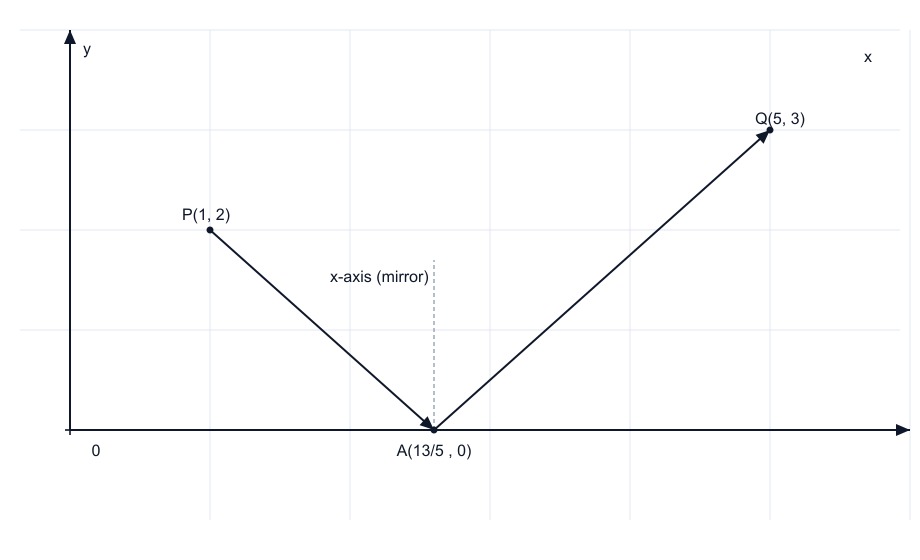
- 3A ray of light passing through the point (1, 2) reflects on the x-axis at point A and the reflected ray passes through the point (5, 3). Find the coordinates of A.
Area of a Triangle
Area from three vertices
For vertices (x₁, y₁), (x₂, y₂), (x₃, y₃): . The area is zero if and only if the three points are collinear.
Collinearity check
MCQ Questions
1 Mark Questions
- 1Write the formula for the area of a triangle with vertices (x₁,y₁), (x₂,y₂) and (x₃,y₃).
- 2What does a zero area from the three-vertices formula signify?
- 3Find the area of the triangle with vertices (0, 0), (4, 0) and (0, 3).
- 4State the collinearity condition of three points in terms of area.
2 Mark Questions
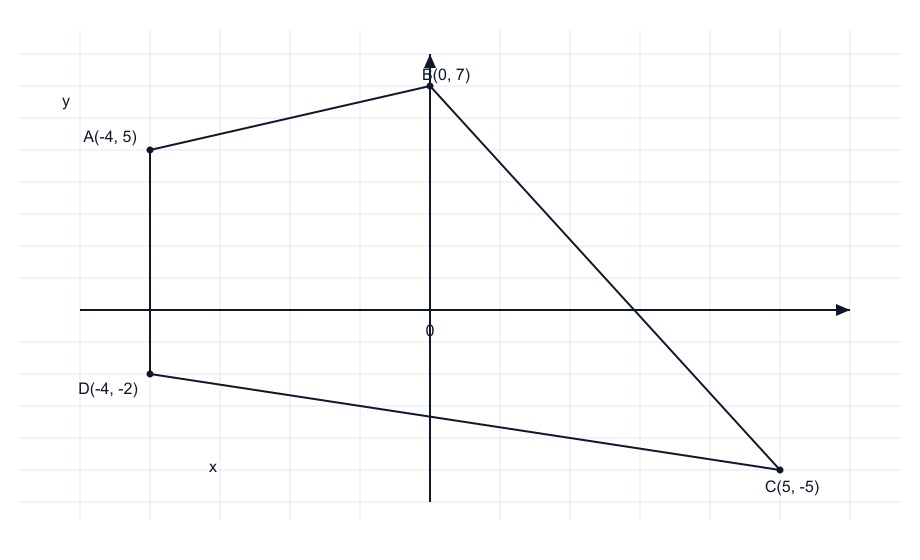
- 1Draw a quadrilateral in the Cartesian plane, whose vertices are (−4, 5), (0, 7), (5, −5) and (−4, −2). Also find its area.
- 2Find the area of the triangle formed by the lines y − x = 0, x + y = 0 and x − k = 0.
- 3By using the concept of the equation of a line (or the area formula), prove that the points (3, 0), (−2, −2) and (8, 2) are collinear.
- 4Find the area of the triangle formed by the lines 2x + y − 5 = 0, x − y + 2 = 0 and the x-axis.
3 Mark Questions
- 1The hypotenuse of a right angled triangle has its ends at the points (1, 3) and (−4, 1). Find the equations of the legs (perpendicular sides) of the triangle which are parallel to the axes, and hence the area of the triangle.
- 2Show that the area of the triangle formed by the lines y = m₁x + c₁, y = m₂x + c₂ and x = 0 equals (c₁ − c₂)² / (2|m₁ − m₂|) square units, and verify it for m₁ = 2, m₂ = 3, c₁ = 5, c₂ = −1.
- 3Show that the area of the triangle with vertices (2, 3), (5, 7) and (0, 2) equals the area of the triangle with vertices (0, 0), (2, 3), (5, 7). Interpret this using translation of the origin.
NCERT Exercise Questions
Exercises (NCERT Ex 9.1–9.3 & Miscellaneous)
9.1.1) Draw a quadrilateral in the Cartesian plane, whose vertices are (−4, 5), (0, 7), (5, −5) and (−4, −2). Also, find its area.
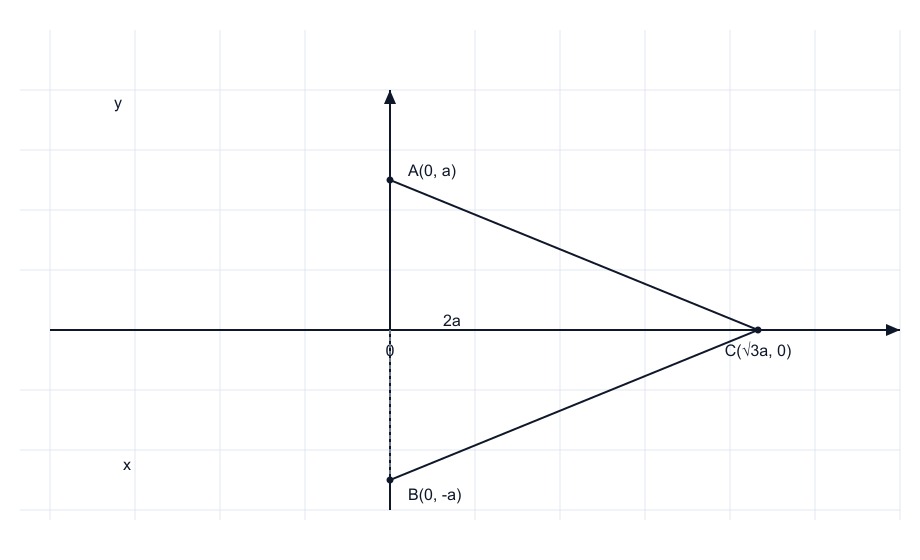
9.1.2) The base of an equilateral triangle with side 2a lies along the y-axis such that the mid-point of the base is at the origin. Find vertices of the triangle.
9.1.3) Find the distance between P(x₁, y₁) and Q(x₂, y₂) when: (i) PQ is parallel to the y-axis, (ii) PQ is parallel to the x-axis.
9.1.4) Find a point on the x-axis, which is equidistant from the points (7, 6) and (3, 4).
9.1.5) Find the slope of a line, which passes through the origin, and the mid-point of the line segment joining the points P(0, −4) and B(8, 0).
9.1.6) Without using the Pythagoras theorem, show that the points (4, 4), (3, 5) and (−1, −1) are the vertices of a right angled triangle.
9.1.7) Find the slope of the line, which makes an angle of 30° with the positive direction of the y-axis measured anticlockwise.
9.1.8) Without using the distance formula, show that the points (−2, −1), (4, 0), (3, 3) and (−3, 2) are the vertices of a parallelogram.
9.1.9) Find the angle between the x-axis and the line joining the points (3, −1) and (4, −2).
9.1.10) The slope of a line is double of the slope of another line. If the tangent of the angle between them is ⅓, find the slopes of the lines.
9.1.11) A line passes through (x₁, y₁) and (h, k). If slope of the line is m, show that k − y₁ = m(h − x₁).
9.2.1) Write the equations for the x- and y-axes.
9.2.2) Passing through the point (−4, 3) with slope ½.
9.2.3) Passing through (0, 0) with slope m.
9.2.4) Passing through (2, 2√3) and inclined with the x-axis at an angle of 75°.
9.2.5) Intersecting the x-axis at a distance of 3 units to the left of origin with slope −2.
9.2.6) Intersecting the y-axis at a distance of 2 units above the origin and making an angle of 30° with the positive direction of the x-axis.
9.2.7) Passing through the points (−1, 1) and (2, −4).
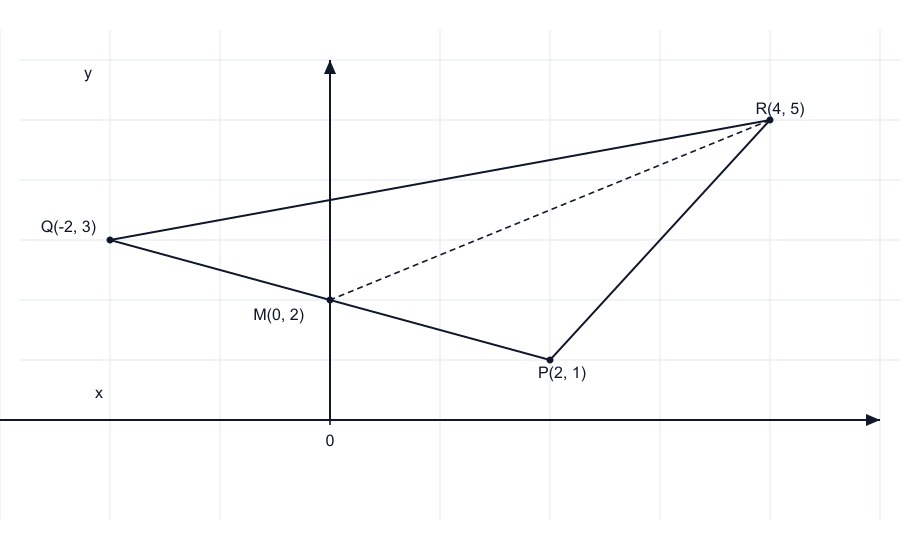
9.2.8) The vertices of ∆PQR are P(2, 1), Q(−2, 3) and R(4, 5). Find the equation of the median through the vertex R.
9.2.9) Find the equation of the line passing through (−3, 5) and perpendicular to the line through the points (2, 5) and (−3, 6).
9.2.10) A line perpendicular to the line segment joining the points (1, 0) and (2, 3) divides it in the ratio 1 : n. Find the equation of the line.
9.2.11) Find the equation of a line that cuts off equal intercepts on the coordinate axes and passes through the point (2, 3).
9.2.12) Find the equation of the line passing through the point (2, 2) and cutting off intercepts on the axes whose sum is 9.
9.2.13) Find the equation of the line through the point (0, 2) making an angle 2π/3 with the positive x-axis. Also, find the equation of the line parallel to it and crossing the y-axis at a distance of 2 units below the origin.
9.2.14) The perpendicular from the origin to a line meets it at the point (−2, 9). Find the equation of the line.
9.2.15) The length L (in centimetre) of a copper rod is a linear function of its Celsius temperature C. In an experiment, if L = 124.942 when C = 20 and L = 125.134 when C = 110, express L in terms of C.
9.2.16) The owner of a milk store finds that he can sell 980 litres of milk each week at ₹14/litre and 1220 litres each week at ₹16/litre. Assuming a linear relationship between selling price and demand, how many litres could he sell weekly at ₹17/litre?
9.2.17) P(a, b) is the mid-point of a line segment between axes. Show that the equation of the line is x/a + y/b = 2.
9.2.18) Point R(h, k) divides a line segment between the axes in the ratio 1 : 2. Find the equation of the line.
9.2.19) By using the concept of the equation of a line, prove that the three points (3, 0), (−2, −2) and (8, 2) are collinear.
9.3.1) Reduce the following equations into slope–intercept form and find their slopes and the y-intercepts: (i) x + 7y = 0, (ii) 6x + 3y − 5 = 0, (iii) y = 0.
9.3.2) Reduce the following equations into intercept form and find their intercepts on the axes: (i) 3x + 2y − 12 = 0, (ii) 4x − 3y = 6, (iii) 3y + 2 = 0.
9.3.3) Find the distance of the point (−1, 1) from the line 12(x + 6) = 5(y − 2).
9.3.4) Find the points on the x-axis, whose distances from the line x/3 + y/4 = 1 are 4 units.
9.3.5) Find the distance between the parallel lines (i) 15x + 8y − 34 = 0 and 15x + 8y + 31 = 0, (ii) l(x + y) + p = 0 and l(x + y) − r = 0.
9.3.6) Find the equation of the line parallel to the line 3x − 4y + 2 = 0 and passing through the point (−2, 3).
9.3.7) Find the equation of the line perpendicular to the line x − 7y + 5 = 0 and having x-intercept 3.
9.3.8) Find the angles between the lines √3x + y = 1 and x + √3y = 1.
9.3.9) The line through the points (h, 3) and (4, 1) intersects the line 7x − 9y − 19 = 0 at right angle. Find the value of h.
9.3.10) Prove that the line through the point (x₁, y₁) and parallel to the line Ax + By + C = 0 is A(x − x₁) + B(y − y₁) = 0.
9.3.11) Two lines passing through the point (2, 3) intersect each other at an angle of 60°. If the slope of one line is 2, find the equation of the other line.
9.3.12) Find the equation of the right bisector of the line segment joining the points (3, 4) and (−1, 2).
9.3.13) Find the coordinates of the foot of the perpendicular from the point (−1, 3) to the line 3x − 4y − 16 = 0.
9.3.14) The perpendicular from the origin to the line y = mx + c meets it at the point (−1, 2). Find the values of m and c.
9.3.15) If p and q are the lengths of perpendiculars from the origin to the lines x cos θ − y sin θ = k cos 2θ and x sec θ + y cosec θ = k respectively, prove that p² + 4q² = k².
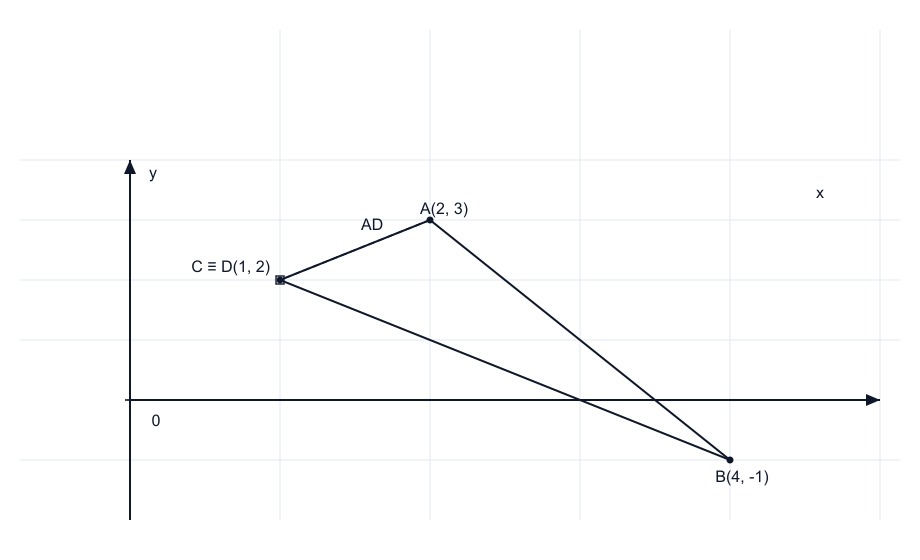
9.3.16) In the triangle ABC with vertices A(2, 3), B(4, −1) and C(1, 2), find the equation and length of the altitude from the vertex A.
9.3.17) If p is the length of the perpendicular from the origin to the line whose intercepts on the axes are a and b, show that 1/p² = 1/a² + 1/b².
9.M1) Find the values of k for which the line (k − 3)x − (4 − k²)y + k² − 7k + 6 = 0 is (a) parallel to the x-axis, (b) parallel to the y-axis, (c) passing through the origin.
9.M2) Find the equations of the lines, which cut-off intercepts on the axes whose sum and product are 1 and −6, respectively.
9.M3) What are the points on the y-axis whose distance from the line x/3 + y/4 = 1 is 4 units?
9.M4) Find the perpendicular distance from the origin to the line joining the points (cos θ, sin θ) and (cos φ, sin φ).
9.M5) Find the equation of the line parallel to the y-axis and drawn through the point of intersection of the lines x − 7y + 5 = 0 and 3x + y = 0.
9.M6) Find the equation of a line drawn perpendicular to the line x/4 + y/6 = 1 through the point where it meets the y-axis.
9.M7) Find the area of the triangle formed by the lines y − x = 0, x + y = 0 and x − k = 0.
9.M8) Find the value of p so that the three lines 3x + y − 2 = 0, px + 2y − 3 = 0 and 2x − y − 3 = 0 may intersect at one point.
9.M9) If three lines whose equations are y = m₁x + c₁, y = m₂x + c₂ and y = m₃x + c₃ are concurrent, then show that m₁(c₂ − c₃) + m₂(c₃ − c₁) + m₃(c₁ − c₂) = 0.
9.M10) Find the equation of the lines through the point (3, 2) which make an angle of 45° with the line x − 2y = 3.
9.M11) Find the equation of the line passing through the point of intersection of the lines 4x + 7y − 3 = 0 and 2x − 3y + 1 = 0 that has equal intercepts on the axes.
9.M12) Show that the equation of the line passing through the origin and making an angle θ with the line y = mx + c is y/x = (tan θ ± m)/(1 ∓ m tan θ).
9.M13) In what ratio, the line joining (−1, 1) and (5, 7) is divided by the line x + y = 4?
9.M14) Find the distance of the line 4x + 7y + 5 = 0 from the point (1, 2) along the line 2x − y = 0.
9.M15) Find the direction in which a straight line must be drawn through the point (−1, 2) so that its point of intersection with the line x + y = 4 may be at a distance of 3 units from this point.
9.M16) The hypotenuse of a right angled triangle has its ends at the points (1, 3) and (−4, 1). Find the equations of the legs (perpendicular sides) of the triangle which are parallel to the axes.
9.M17) Find the image of the point (3, 8) with respect to the line x + 3y = 7 assuming the line to be a plane mirror.
9.M18) If the lines y = 3x + 1 and 2y = x + 3 are equally inclined to the line y = mx + 4, find the value of m.
9.M19) If the sum of the perpendicular distances of a variable point P(x, y) from the lines x + y − 5 = 0 and 3x − 2y + 7 = 0 is always 10, show that P must move on a line.
9.M20) Find the equation of the line which is equidistant from the parallel lines 9x + 6y − 7 = 0 and 3x + 2y + 6 = 0.
9.M21) A ray of light passing through the point (1, 2) reflects on the x-axis at point A and the reflected ray passes through the point (5, 3). Find the coordinates of A.
9.M22) Prove that the product of the lengths of the perpendiculars drawn from the points (√(a² − b²), 0) and (−√(a² − b²), 0) to the line x/a · cos θ + y/b · sin θ = 1 is b².
9.M23) A person standing at the junction (crossing) of two straight paths represented by the equations 2x − 3y + 4 = 0 and 3x + 4y − 5 = 0 wants to reach the path whose equation is 6x − 7y + 8 = 0 in the least time. Find the equation of the path that he should follow.
Answers at a glance
- 19.1.1 — Shoelace: Σ xᵢyᵢ₊₁ = (−4)(7)+(0)(−5)+(5)(−2)+(−4)(5) = −58; Σ yᵢxᵢ₊₁ = (5)(0)+(7)(5)+(−5)(−4)+(−2)(−4) = 63. Area = ½|−58−63| = 121/2 = 60.5 sq units.
- 29.1.2 — Vertices are (0, a) and (0, −a) with apex at (±√3 a, 0) or (−√3 a, 0): the third vertex is (±√3a, 0).
- 39.1.3 — (i) PQ parallel to y-axis: distance = |y₂ − y₁|. (ii) Parallel to x-axis: distance = |x₂ − x₁|.
- 49.1.4 — Point on x-axis is (3, 0): distance to (7,6) = √(16+36), to (3,4) = 4; solve √((x−7)²+36) = √((x−3)²+16) → x = 3.
- 59.1.5 — Mid-point of P(0,−4) and B(8,0) is (4,−2); slope through origin = (−2−0)/(4−0) = −½.
- 69.1.6 — Slope AB = (5−4)/(3−4) = −1; slope BC = (−1−5)/(−1−3) = 3/2; slope AC = (−1−4)/(−1−4) = 1. Slope AB × slope AC = −1, so AB ⟂ AC.
- 79.1.7 — Angle with y-axis = 30°, so angle with x-axis = 60°; m = tan 60° = √3.
- 89.1.8 — Slope AB = (0+1)/(4+2) = 1/6; slope DC = (2−3)/(−3−3) = 1/6; slope BC = (3−0)/(3−4) = −3; slope AD = (2+1)/(−3+2) = −3. Opposite sides have equal slopes, so it is a parallelogram.
- 99.1.9 — Slope = (−2+1)/(4−3) = −1; angle with positive x-axis = 135°; acute angle with x-axis = 45°.
- 109.1.10 — Let the slopes be m and 2m. |(2m − m)/(1 + 2m²)| = 1/3 ⇒ 3m = ±(1 + 2m²). Plus: 2m² − 3m + 1 = 0 ⇒ m = 1/2 or 1. Minus: 2m² + 3m + 1 = 0 ⇒ m = −1/2 or −1. Slopes: (1/2, 1), (1, 2), (−1/2, −1) or (−1, −2).
- 119.1.11 — Slope of line through (x₁,y₁) and (h,k) is (k−y₁)/(h−x₁) = m ⇒ k − y₁ = m(h − x₁).
- 129.2.1 — x-axis: y = 0; y-axis: x = 0.
- 139.2.2 — y − 3 = ½(x + 4) ⇒ x − 2y + 10 = 0.
- 149.2.3 — y = mx.
- 159.2.4 — tan 75° = 2 + √3; y − 2√3 = (2+√3)(x − 2).
- 169.2.5 — y = −2(x + 3) ⇒ 2x + y + 6 = 0.
- 179.2.6 — tan 30° = 1/√3; y = (1/√3)x + 2 ⇒ x − √3y + 2√3 = 0.
- 189.2.7 — Slope = (−4−1)/(2+1) = −5/3; y − 1 = (−5/3)(x + 1) ⇒ 5x + 3y + 2 = 0.
- 199.2.8 — Median from R(4,5) meets PQ at its mid-point M((2−2)/2, (1+3)/2) = (0, 2); slope RM = (5−2)/(4−0) = 3/4; equation: 3x − 4y + 8 = 0.
- 209.2.9 — Slope of line through (2,5),(−3,6) = −1/5; perpendicular slope = 5; y − 5 = 5(x + 3) ⇒ 5x − y + 20 = 0.
- 219.2.10 — Slope of segment = 3; perpendicular slope = −1/3. Section formula (AP:PB = 1:n for A(1,0), B(2,3)): P = ((n·1+1·2)/(n+1), (n·0+1·3)/(n+1)) = ((n+2)/(n+1), 3/(n+1)). Line through P with slope −1/3: (n+1)x + 3(n+1)y = n + 11.
- 229.2.11 — Equal intercepts: x/a + y/a = 1 ⇒ x + y = a; through (2,3): a = 5 ⇒ x + y − 5 = 0.
- 239.2.12 — Let intercepts a, b with a + b = 9 and a·b: 2/a + 2/b = 1 ⇒ ab = 18. Factors of 18 with sum 9: a, b = 3, 6. Lines: x/3 + y/6 = 1 and x/6 + y/3 = 1.
- 249.2.13 — tan(2π/3) = −√3; y − 2 = −√3(x − 0) ⇒ √3x + y − 2 = 0. Parallel line crossing y-axis 2 units below origin: √3x + y + 2 = 0.
- 259.2.14 — Perpendicular from origin meets line at (−2, 9); slope of perpendicular = 9/(−2) = −9/2, so slope of line = 2/9; line through (−2,9): y − 9 = (2/9)(x + 2) ⇒ 2x − 9y + 85 = 0.
- 269.2.15 — Linear function L = mC + c. m = (125.134 − 124.942)/(110 − 20) = 0.192/90 = 8/375. Using C = 20: c = 124.942 − (8/375)(20) ≈ 124.515. So L = (8/375)C + 124.515 (cm).
- 279.2.16 — Linear demand: sale = 980 at ₹14, 1220 at ₹16. Slope = 240/2 = 120 litres per ₹; at ₹17 (₹3 above 14): 980 + 3×120 = 1340 litres/week.
- 289.2.17 — P(a, b) is mid-point between (2a, 0) and (0, 2b); line through them: x/a + y/b = 2.
- 299.2.18 — Let the segment join (α, 0) and (0, β). R(h, k) divides it in 1 : 2, so h = (1·0 + 2α)/3 = 2α/3 and k = (1β + 2·0)/3 = β/3, giving α = 3h/2, β = 3k. Intercept form: x/(3h/2) + y/(3k) = 1 ⇒ 2kx + hy = 3hk.
- 309.2.19 — Slope of (3,0):(−2,−2) = (−2−0)/(−2−3) = 2/5; slope of (−2,−2):(8,2) = (2+2)/(8+2) = 4/10 = 2/5; equal slopes with a common point ⇒ collinear.
- 319.3.1 — (i) x + 7y = 0 ⇒ y = −x/7: slope −1/7, y-intercept 0. (ii) 6x + 3y − 5 = 0 ⇒ y = −2x + 5/3: slope −2, y-intercept 5/3. (iii) y = 0: slope 0, y-intercept 0.
- 329.3.2 — (i) 3x + 2y = 12 ⇒ x/4 + y/6 = 1: intercepts 4, 6. (ii) 4x − 3y = 6 ⇒ x/(3/2) + y/(−2) = 1: intercepts 3/2, −2. (iii) 3y + 2 = 0 ⇒ y = −2/3, line parallel to x-axis.
- 339.3.3 — 12(x+6) = 5(y−2) ⇒ 12x − 5y + 82 = 0; distance = |12(−1) − 5(1) + 82|/√(144+25) = |−12−5+82|/13 = 65/13 = 5 units.
- 349.3.4 — x/3 + y/4 = 1 ⇒ 4x + 3y − 12 = 0. Point (x, 0): distance = |4x − 12|/5 = 4 ⇒ x = 8 or x = −2. Points: (8, 0) and (−2, 0).
- 359.3.5 — (i) d = |31 − (−34)|/√(15²+8²) = 65/17 units. (ii) d = |p + r|/(|l|√2).
- 369.3.6 — Parallel line: 3x − 4y + c = 0; through (−2, 3): −6 − 12 + c = 0 ⇒ c = 18 ⇒ 3x − 4y + 18 = 0.
- 379.3.7 — Perpendicular to x − 7y + 5 = 0 ⇒ 7x + y + k = 0; x-intercept 3 ⇒ at (3,0): 21 + k = 0 ⇒ k = −21 ⇒ 7x + y − 21 = 0.
- 389.3.8 — Slopes −√3 and −1/√3: tan θ = |(−1/√3 + √3)/(1+1)| = |(2/√3)/2| = 1/√3 ⇒ θ = 30°.
- 399.3.9 — Slope of line through (h,3),(4,1) = (1−3)/(4−h) = −2/(4−h). Perpendicular to 7x − 9y − 19 = 0 whose slope is 7/9 ⇒ (−2/(4−h))·(7/9) = −1 ⇒ 14 = 9(4−h) ⇒ h = 22/9.
- 409.3.10 — Required line has slope −A/B; line through (x₁,y₁): y − y₁ = (−A/B)(x − x₁) ⇒ A(x − x₁) + B(y − y₁) = 0.
- 419.3.11 — Other slope m: |(m−2)/(1+2m)| = tan 60° = √3 ⇒ m−2 = ±√3(1+2m). Case +: m = (2+√3)/(1−2√3); case −: m = (2−√3)/(1+2√3).
- 429.3.12 — Mid-point = (1, 3); slope of segment = (2−4)/(−1−3) = ½; perpendicular slope = −2 ⇒ y − 3 = −2(x − 1) ⇒ 2x + y − 5 = 0.
- 439.3.13 — Foot formula: foot = (x₁ − aL/(a²+b²), y₁ − bL/(a²+b²)) where L = ax₁ + by₁ + c. For (−1, 3) on 3x − 4y − 16 = 0: L = 3(−1) − 4(3) − 16 = −31, a²+b² = 25 ⇒ foot = (−1 − 3(−31)/25, 3 + 4(−31)/25) = (−1 + 93/25, 3 − 124/25) = (68/25, −49/25).
- 449.3.14 — Line through origin perpendicular to y = mx + c and meeting it at (−1, 2) ⇒ slope of perpendicular = −2 ⇒ m = ½; and (−1,2) lies on y = ½x + c ⇒ c = 5/2. So m = 1/2, c = 5/2.
- 459.3.15 — p = |k cos 2θ| (distance from origin to x cosθ − y sinθ = k cos2θ since √(cos²θ+sin²θ)=1) and q = |k|/√(sec²θ+cosec²θ) = |k| sinθcosθ ⇒ 4q² = 4k²sin²θcos²θ = k²sin²2θ; p² + 4q² = k²(cos²2θ + sin²2θ) = k².
- 469.3.16 — Altitude from A is perpendicular to BC. Slope BC = (2+1)/(1−4) = −1, so the altitude has slope 1; through A(2,3): y − 3 = x − 2, i.e. x − y + 1 = 0. Foot is where it meets BC: B(4,−1),C(1,2) ⇒ x + y = 3. Solve x − y = −1 and x + y = 3 ⇒ foot = (1, 2) = C. Length of the altitude = distance from A(2,3) to line x + y − 3 = 0 = |2 + 3 − 3|/√2 = 2/√2 = √2 units.
- 479.3.17 — Line x/a + y/b = 1 ⇒ bx + ay − ab = 0; p = |−ab|/√(a²+b²) ⇒ 1/p² = (a²+b²)/(a²b²) = 1/a² + 1/b².
- 489.M1 — (a) Parallel to x-axis: y coefficient zero ⇒ 4 − k² = 0 ⇒ k = ±2 (check k=3 gives 0x, invalid also). (b) Parallel to y-axis: x coefficient zero ⇒ k − 3 = 0 ⇒ k = 3. (c) Passing through origin: constant term zero ⇒ k² − 7k + 6 = 0 ⇒ k = 1 or 6.
- 499.M2 — Intercepts a, b with a + b = 1, ab = −6 ⇒ a,b = 3, −2 (roots of t² − t − 6 = 0). Lines: x/3 + y/(−2) = 1 and x/(−2) + y/3 = 1.
- 509.M3 — Line x/3 + y/4 = 1 ⇒ 4x + 3y − 12 = 0. Point (0, y): |3y − 12|/5 = 4 ⇒ 3y − 12 = ±20 ⇒ y = 32/3 or y = −8/3. Points (0, 32/3), (0, −8/3).
- 519.M4 — Distance from origin to line through P(cosθ, sinθ) and Q(cosφ, sinφ) = |x₁y₂ − y₁x₂| / √((x₂−x₁)² + (y₂−y₁)²) = |cosθ sinφ − sinθ cosφ| / √((cosφ−cosθ)² + (sinφ−sinθ)²) = |sin(φ−θ)| / √(2 − 2cos(φ−θ)) = |sin(φ−θ)| / (2|sin((φ−θ)/2)|) = |cos((θ−φ)/2)|.
- 529.M5 — Intersection of x − 7y + 5 = 0 and 3x + y = 0: y = −3x; x − 7(−3x) + 5 = 0 ⇒ 22x + 5 = 0 ⇒ x = −5/22, y = 15/22. A line parallel to the y-axis through it: x = −5/22 ⇒ 22x + 5 = 0.
- 539.M6 — x/4 + y/6 = 1 meets y-axis at (0, 6). Perpendicular slope: line slope = −6/4 = −3/2, perp slope = 2/3. Equation: y − 6 = (2/3)x ⇒ 2x − 3y + 18 = 0.
- 549.M7 — Lines y = x, y = −x, x = k form a right triangle with base on x = k from (k,k) to (k,−k) (length 2k) and altitude = distance of origin from x = k ⇒ k. Area = ½·(2k)·k = k².
- 559.M8 — Enter intersection of 3x+y−2=0 and 2x−y−3=0: solve: y = 2−3x; 2x − (2−3x) − 3 = 0 ⇒ 5x − 5 = 0 ⇒ x = 1, y = −1. Third line through (1,−1): px + 2y − 3 = 0 ⇒ p − 2 − 3 = 0 ⇒ p = 5.
- 569.M9 — Concurrent means the point of intersection of any two satisfies the third; equating determinants of the coefficients gives m₁(c₂−c₃) + m₂(c₃−c₁) + m₃(c₁−c₂) = 0.
- 579.M10 — Line x − 2y = 3 has slope ½. Lines making 45°: slopes m = (½ ± 1)/(1 ∓ ½) = (3/2)/(1/2) = 3, and (−1/2)/(3/2) = −1/3. Through (3,2): y − 2 = 3(x−3) and y − 2 = (−1/3)(x−3).
- 589.M11 — Family through intersection: (4x + 7y − 3) + k(2x − 3y + 1) = 0, slope = −(4 + 2k)/(7 − 3k). Equal intercepts on the axes ⇒ slope −1: (4 + 2k)/(7 − 3k) = 1 ⇒ k = 3/5. Line: (26/5)x + (26/5)y − 12/5 = 0 ⇒ 13x + 13y − 6 = 0 (intercepts 6/13, 6/13).
- 599.M12 — Slope of line through origin = y/x = m'. Angle with y = mx + c satisfies tan θ = |(m' − m)/(1 + m·m')| ⇒ (m' − m)/(1 + mm') = ± tan θ ⇒ m' = (m ± tan θ)/(1 ∓ m tan θ) ⇒ y/x = (tan θ ± m)/(1 ∓ m tan θ).
- 609.M13 — Point of division on x + y = 4: parametrise line (−1,1)→(5,7): (−1+6t, 1+6t); x+y = 4 ⇒ (−1+6t)+(1+6t) = 12t = 4 ⇒ t = 1/3. Ratio = t:(1−t) = 1/3:2/3 = 1:2.
- 619.M14 — Distance along 2x − y = 0: point (1,2) to intersection of 4x+7y+5=0 with y=2x: 4x+14x+5=0 ⇒ x=−5/18, y=−5/9. Distance = √((1+5/18)² + (2+5/9)²) = √((23/18)²+(23/9)²) = (23/18)√5.
- 629.M15 — Required line through (−1,2) meets x+y=4 at distance 3 from (−1,2). Point = (−1+3cosθ, 2+3sinθ) lies on x+y=4 ⇒ 1 + 3(cosθ+sinθ) = 4 ⇒ cosθ+sinθ = 1 ⇒ sin2θ = 0 ⇒ θ = 0 or 90° ⇒ directions: 0° (parallel to x-axis → y = 2) or 90° (x = −1).
- 639.M16 — Legs parallel to the axes: vertical through (1, 3): x = 1; horizontal through (−4, 1): y = 1. They meet at (1, 1), forming the right angle. Legs: x = 1 and y = 1.
- 649.M17 — Image of (3,8) in x + 3y = 7: foot H solves; image P' = 2H − P. Standard formula: image = ( (x₁ − 2a(ax₁+by₁+c)/(a²+b²)), (y₁ − 2b(ax₁+by₁+c)/(a²+b²)) ) ⇒ a=1,b=3,c=−7; val = 3+24−7 = 20; a²+b²=10 ⇒ P' = (3 − 2·20/10, 8 − 2·3·20/10) = (3−4, 8−12) = (−1, −4).
- 659.M18 — Slopes: line1 = 3, line2 = ½. Equally inclined to y = mx + 4 (slope m): |(m−3)/(1+3m)| = |(m−½)/(1+½m)|. Squaring and solving: (7/2)m² − m − 7/2 = 0 ⇒ 7m² − 2m − 7 = 0 ⇒ m = (2 ± √(4+196))/14 = (1 ± 5√2)/7.
- 669.M19 — Sum of perpendicular distances = |x+y−5|/√2 + |3x−2y+7|/√13 = 10. For P restricted to one region the absolute values open with fixed signs to give a linear equation in x, y — i.e., P moves on a straight line.
- 679.M20 — Equidistant line is the mid-parallel: rewrite both in same coefficients 3x + 2y: 9x+6y−7=0 ⇒ 3x+2y−7/3=0; 3x+2y+6=0. Mid value = (−7/3 + 6)/2 = (11/3)/2 = 11/6 ⇒ 3x + 2y + 11/6 = 0 ⇒ 18x + 12y + 11 = 0.
- 689.M21 — Reflection point A = (13/5, 0): image of P(1,2) in x-axis is (1,−2); line through (1,−2) and (5,3) cuts x-axis at A. Slope = 5/4; y+2 = (5/4)(x−1); y=0 ⇒ 2 = (5/4)(x−1) ⇒ x = 13/5. A = (13/5, 0).
- 699.M22 — Line: x/a cosθ + y/b sinθ = 1 ⇒ (cosθ/a)x + (sinθ/b)y − 1 = 0, with √(cos²θ/a² + sin²θ/b²) in each denominator. p₁p₂ = |((√(a²−b²)/a)cosθ − 1)(−(√(a²−b²)/a)cosθ − 1)| / (cos²θ/a² + sin²θ/b²) = |1 − ((a²−b²)/a²)cos²θ| / (cos²θ/a² + sin²θ/b²) = [(a²sin²θ + b²cos²θ)/a²]·[a²b²/(a²sin²θ + b²cos²θ)] = b².
- 709.M23 — Least-distance path is the line through the junction perpendicular to 6x − 7y + 8 = 0. Junction of 2x − 3y + 4 = 0 and 3x + 4y − 5 = 0: from first x = (3y − 4)/2; into second: 3(3y−4)/2 + 4y − 5 = 0 ⇒ 9y − 12 + 8y − 10 = 0 ⇒ 17y = 22 ⇒ y = 22/17, x = (66/17 − 68/17)/2 = −1/17. Perpendicular to 6x − 7y + 8 = 0 has the form 7x + 6y + c = 0; through (−1/17, 22/17): −7/17 + 132/17 + c = 0 ⇒ c = −125/17. Line: 119x + 102y − 125 = 0.
CBSE Pattern Questions
MCQ Questions
1 Mark Questions
- 1Write the equation of a line passing through the origin and having slope m.
- 2State the condition for which the lines a₁x+b₁y+c₁=0 and a₂x+b₂y+c₂=0 are perpendicular.
- 3What is the area of the triangle with vertices (1,0), (0,1), (0,0)?
- 4Find the slope of the line parallel to the x-axis.
2 Mark Questions
- 1Find the equation of the line through (−1, 1) and (2, −4).
- 2Find the value of h if the line through (h, 3) and (4, 1) is perpendicular to 7x − 9y − 19 = 0.
- 3Reduce 2x − 3y + 6 = 0 to intercept form and state the intercepts.
- 4Find the distance between 3x − 4y + 7 = 0 and 6x − 8y + 15 = 0.
3 Mark Questions
- 1Find the equation of the right bisector of the segment joining (3, 4) and (−1, 2).
- 2Two lines through (2, 3) make 60° with each other; one has slope 2. Find the equation of the other.
- 3Find the foot of the perpendicular from (−1, 3) to 3x − 4y − 16 = 0.
5 Mark Questions
- 1(a) Derive the normal form x cos ω + y sin ω = p of a line. (b) Find the normal form of the line √3x + y − 4 = 0 and hence its distance from the origin.
- 2(a) Prove that the three lines y = m₁x+c₁, y = m₂x+c₂, y = m₃x+c₃ are concurrent iff m₁(c₂−c₃)+m₂(c₃−c₁)+m₃(c₁−c₂) = 0. (b) Find the area of the triangle formed by the lines y = 2x+3, y = 3x−1 and x = 0 using the concurrency of its sides' family.
PDF: Assignments & Tests
Free PDF Downloads & Assignments
Practice path: complete Assignment 1 first (topic-by-topic), then Assignment 2 (mixed difficulty with figure-based NCERT questions), then attempt the timed tests.
Covers all seven topics: slope of a line, parallel and perpendicular lines, forms of the equation of a line, the general equation and conversions, angle between two lines, distance formulas, and area of a triangle. Arranged topic by topic.
Second set with multi-topic integration problems, JEE-style numericals, and figure-based NCERT questions (Ex 9.1 Q1, Q2; Ex 9.2 Q8; Ex 9.3 Q16; Misc Q21). Higher difficulty than Assignment 1. Answer key included.
Full CBSE-pattern paper: Section A (10 MCQ/VSA × 1M), Section B (4 × 2M), Section C (4 × 3M), Section D (2 × 5M). Complete marking scheme included.
Second 40-mark CBSE-pattern paper with fresh questions and a full solution key.
Quick Revision
Key formulas at a glance
Memorise these equations — direct application numericals and derivations in CBSE & JEE frequently hinge on these.
Slope of a line
Parallel lines
Perpendicular lines
Angle between lines
Point–slope form
Slope–intercept form
Two-point form
Intercept form
General form
Normal form
Distance of a point from a line
Distance between parallel lines
Area of a triangle
Exam Strategy
How this chapter is asked
High-yield question patterns observed across CBSE boards, JEE Main & Advanced, and NEET.
- m = tan θ always gives the angle with the positive x-axis, measured anticlockwise.
- Parallel lines: m₁ = m₂; perpendicular lines: m₁m₂ = −1 — memorise these.
- Convert ax + by + c = 0 to slope-intercept to read slope and intercept instantly.
- For distance formulas, always reduce the line equation to general form first.
- Area formula returning zero is the quickest collinearity test in coordinate geometry.
- In angle-between-lines, if m₁m₂ = −1 the denominator is zero — lines are perpendicular.
- The intercept form x/a + y/b = 1 directly gives both intercepts; useful for sketching.
- Board exams love combining slope + distance — practice converting between forms quickly.
Practice Numericals
Step-by-step worked examples
Standard exam-level problems solved with clear conceptual breakdowns.
Slope from two points
Step-by-Step Solution
- 1m = (y₂ − y₁)/(x₂ − x₁) = (1 − 5)/(−1 − 3) = (−4)/(−4) = 1.
- 2The line makes an angle of 45° with the positive x-axis since tan 45° = 1.
Final Answer
Equation through a point with a given slope
Step-by-Step Solution
- 1m = tan 135° = −1.
- 2Using point–slope form: y − (−3) = −1(x − 2).
- 3y + 3 = −x + 2 ⇒ x + y + 1 = 0.
Final Answer
Distance of a point from a line
Step-by-Step Solution
- 1d = |3(3) − 4(−5) − 26| / √(3² + 4²).
- 2= |9 + 20 − 26| / 5 = |3|/5 = 3/5 units.
Final Answer
Line through the intersection of two lines (family of lines)
Step-by-Step Solution
- 1Family: (4x + 7y − 3) + k(2x − 3y + 1) = 0, i.e. (4 + 2k)x + (7 − 3k)y + (k − 3) = 0.
- 2Equal intercepts on both axes means slope = −1: −(4 + 2k)/(7 − 3k) = −1 ⇒ 4 + 2k = 7 − 3k ⇒ k = 3/5.
- 3Line: (4 + 6/5)x + (7 − 9/5)y + (3/5 − 3) = 0 ⇒ 26/5 x + 26/5 y − 12/5 = 0 ⇒ 13x + 13y − 6 = 0.
Final Answer
Foot of perpendicular
Step-by-Step Solution
- 1Using foot formula with x₁ = 0, y₁ = 2, a = 3, b = −4, c = 8; value = 3(0) − 4(2) + 8 = 0.
- 2The point (0, 2) already lies on the line (0 − 8 + 8 = 0), so the foot of the perpendicular is the point itself: (0, 2).
Final Answer
Angle between two lines
Step-by-Step Solution
- 1m₁ = 2, m₂ = 3.
- 2tan θ = |(3 − 2)/(1 + 2·3)| = |1/7|.
- 3θ = tan⁻¹(1/7) ≈ 8.13°.
Final Answer
FAQ
Frequently asked questions
What is the slope of a line?
The slope m is the tangent of the angle the line makes with the x-axis: m = tan θ. It equals (y₂ − y₁)/(x₂ − x₁) for any two points on the line.
When are two lines parallel?
Two non-vertical lines are parallel if and only if their slopes are equal: m₁ = m₂.
How do you find the distance of a point from a line?
For a line ax + by + c = 0 and point (x₁, y₁), the perpendicular distance is |ax₁ + by₁ + c| / √(a² + b²).
What is the general equation of a straight line?
Any straight line can be written as ax + by + c = 0 where a and b are not both zero. The slope is −a/b when b ≠ 0.
What is the difference between slope–intercept and intercept forms of a line?
Slope–intercept form y = mx + c reads off the slope m and y-intercept c directly, and is ideal for comparing parallel/perpendicular lines. Intercept form x/a + y/b = 1 reads off where the line crosses the axes, x-intercept a and y-intercept b. Convert between them by dividing the general equation through by the constant term.
When do two lines have no finite angle between them?
When the denominator 1 + m₁m₂ in the angle formula is zero — that is, when m₁m₂ = −1 and the lines are perpendicular, so the angle is 90°. Also, parallel lines (m₁ = m₂) give tan θ = 0 and θ = 0. Always read the absolute value so you get the acute angle.
How do I find the equation of a line through the intersection of two given lines without fully solving them?
Use the family of lines: every line through the intersection of a₁x+b₁y+c₁=0 and a₂x+b₂y+c₂=0 has the form (a₁x+b₁y+c₁) + k(a₂x+b₂y+c₂) = 0. Choose k by imposing the extra condition (passing through a point, a given slope, equal intercepts). This is faster and often avoids solving the pair explicitly.
What is the condition for three points to be collinear, and how is it tested?
Three points A, B, C are collinear when the slope of AB equals the slope of BC (with a shared point B), or equivalently when the area of the triangle they form is zero: ½|x₁(y₂−y₃)+x₂(y₃−y₁)+x₃(y₁−y₂)| = 0.
How is the distance between two parallel lines derived?
Take one point of the first line (e.g., its x-intercept) and find the perpendicular distance of that point from the second line using d = |ax₁+by₁+c|/√(a²+b²). Because the lines are parallel the result is independent of the chosen point and simplifies to |c₂−c₁|/√(a²+b²) when both lines are written as ax+by+c = 0.
Why is the slope of a vertical line called undefined?
Slope is rise over run, Δy/Δx. For a vertical line Δx = 0 for any two distinct points, so the ratio Δy/0 is not defined. On a graph the line makes 90° with the x-axis, and tan 90° is also undefined, so both views agree.
Next Chapters
Continue learning
Same chapter
Read alongside
Interactive Quiz
Chapter MCQ practice test
Instant scoring with complete solutions — test your mastery in under 15 minutes.
Chapter MCQ Mock Test
Evaluate how well you have retained the concepts, formulas, and reaction mechanisms from this chapter. Questions adhere strictly to latest CBSE, JEE & NEET trends.
Master this chapter with expert live guidance
Self-study notes lay the ground, but conceptual doubts clear fastest in an interactive classroom. Narayan Gurukul Academy (ClassApna) conducts small-batch CBSE, JEE & NEET coaching with daily doubt solving and rigorous mock tests.
Small batches · 1-on-1 personal mentorship · Live online & offline centre