Class 11 Physics · NCERT Chapter 2
~42 min readMotion in a Straight Line Class 11 Physics Notes
A complete, exam-ready pass on one-dimensional motion — distance/displacement, the two average-speed traps that show up every year, the equations of motion and their nth-second form, motion graphs, free fall, non-uniform acceleration, and relative motion with river-boat problems. Written for CBSE, JEE and NEET revision.
What is motion in a straight line in one line?
It is the study of one-dimensional (rectilinear) motion using distance, displacement, speed, velocity and acceleration, linked by the three kinematic equations v = u + at, s = ut + ½at², and v² = u² + 2as, valid whenever acceleration is constant.
Position, Distance and Displacement
Kinematics is the branch of mechanics that describes how bodies move — position, velocity, acceleration — without asking what causes the motion. When a body is small enough that every part of it moves together, it can be treated as a single point, or particle, for the purpose of describing its motion.A particle's position is fixed by its coordinates relative to a chosen origin. As it moves, it traces a path called its trajectory. Distance is the total length of that path; displacement is the straight-line vector from the starting point to the ending point, regardless of the path taken in between.
Key point
MCQ Questions
1 Mark Questions
- 1Define a point object (particle) in the study of motion.
- 2Write the SI unit of displacement.
- 3When is the magnitude of displacement equal to the distance travelled?
- 4Can the displacement of a moving body be zero while the distance travelled is non-zero? Give one example.
2 Mark Questions
- 1Distinguish between distance and displacement, giving one example each.
- 2A body travels 40 m due north and then 30 m due east. Find the total distance travelled and the magnitude of its displacement.
- 3A man walks 5 m north, 3 m east and finally 5 m south. Find the magnitude of his displacement and the distance he walked.
- 4Explain, with an example, why the magnitude of displacement is never greater than the distance travelled.
3 Mark Questions
- 1Define position, trajectory and displacement. A particle moves from x = 2 m to x = 8 m and then back to x = 5 m. Find the distance travelled and its displacement.
- 2A cyclist rides one full round of a square park of side 100 m in 12 minutes. Find (i) the distance travelled, (ii) the magnitude of his displacement, and (iii) his average speed in m/s.
Average Speed and Average Velocity — the Two Exam Traps
Average speed is total distance divided by total time; average velocity is total displacement divided by total time elapsed. The former is a scalar and can never be zero for a body that has actually moved; the latter is a vector and can be exactly zero even after a long, fast journey — any round trip has zero average velocity no matter how far it travelled.
The equal-distance vs. equal-time trap
Instantaneous velocity is the limit of average velocity as the time interval shrinks toward zero — the derivative of position with respect to time, v = dx/dt. Its direction is always tangential to the path at that instant, and its magnitude always equals the instantaneous speed (they only differ for average quantities, never for instantaneous ones).
MCQ Questions
1 Mark Questions
- 1Define average speed.
- 2Define average velocity.
- 3Can the average velocity of a moving body over an interval be zero while its average speed is non-zero? Give one example.
- 4What is the average speed of a body that moves at speeds v₁ and v₂ for two equal time intervals?
2 Mark Questions
- 1Derive the expression for the average speed of a body that covers equal distances at speeds v₁ and v₂.
- 2A train travels from station P to station Q at 40 km/h and returns along the same route at 30 km/h. Find its average speed for the round trip.
- 3Distinguish between average speed and average velocity. When do their magnitudes become equal?
- 4A particle moves at 10 m/s for 5 s and then at 20 m/s for 10 s. Find its average speed.
3 Mark Questions
- 1A body covers the first half of a journey at speed v₁ and the second half at speed v₂. Show that its average speed is 2v₁v₂/(v₁ + v₂).
- 2A man walks 2.5 km to a market at 5 km/h and returns at 7.5 km/h. Find (i) his average speed for the round trip and (ii) the magnitude of his average velocity for the whole trip.
Acceleration and Retardation
Average acceleration is the change in velocity divided by the time taken; instantaneous acceleration is its limiting value as the interval shrinks to zero, a = dv/dt = d²x/dt². For constant acceleration, average and instantaneous acceleration are identical, which is exactly the condition under which the standard three equations of motion apply.
Retardation is not just 'negative acceleration'
MCQ Questions
1 Mark Questions
- 1Define acceleration.
- 2What is retardation?
- 3A body starts from rest and has a uniform acceleration of 2 m/s². Find its velocity after 4 s.
- 4Can a body have negative acceleration while it is speeding up? Explain in one line.
2 Mark Questions
- 1Distinguish between acceleration and retardation with an example.
- 2A car moving at 72 km/h is brought to rest by applying brakes in 5 s. Find its retardation.
- 3Why is a negative acceleration not always retardation? Explain with an example.
- 4The velocity of a particle changes from 5 m/s to 25 m/s in 4 s. Find its average acceleration.
3 Mark Questions
- 1Define average acceleration and instantaneous acceleration, and show that they are equal when acceleration is constant.
- 2A train slows uniformly from 72 km/h to 36 km/h while covering a distance of 200 m. Find its retardation and the time taken.
- 3A body moving with uniform acceleration covers 20 m in the 1st second and 40 m in the 2nd second. Find its initial velocity and acceleration.
Equations of Motion and the nth-Second Formula
For constant acceleration a, the three kinematic equations follow directly from integrating a = dv/dt and v = ds/dt over time. They connect any three of the five quantities u, v, a, s, t, so most numericals reduce to picking the equation that already contains the three quantities you know.
A separate, frequently tested result gives the distance covered in a specific second (not up to that second): the displacement during the nth second alone, obtained by subtracting the total displacement up to (n−1) seconds from the total up to n seconds.
Distance in the nth second is not always the s_n formula
MCQ Questions
1 Mark Questions
- 1State the three equations of motion for a uniformly accelerated body.
- 2Write the formula for the displacement of a body during the nth second of its motion.
- 3Under what condition does the nth-second formula give the true distance travelled rather than just the displacement?
- 4A body starts from rest and accelerates uniformly at 5 m/s². Find its velocity after 4 s.
2 Mark Questions
- 1Derive the first equation of motion, v = u + at, using the definition of acceleration.
- 2Derive the expression for the displacement of a body in the nth second: sₙ = u + (a/2)(2n − 1).
- 3A body starting from rest moves with a uniform acceleration of 5 m/s². Find its displacement in the 8th second.
- 4A stone is dropped from rest. Taking g = 10 m/s², find the distance it falls in the 4th second.
3 Mark Questions
- 1Derive the three equations of motion for a body moving with uniform acceleration.
- 2A particle starts from rest with a uniform acceleration of 6 m/s². Find the distance covered (i) in the first 5 s and (ii) in the 5th second.
- 3A body starts from rest with uniform acceleration a. Show that the distances covered in successive seconds are in the ratio 1 : 3 : 5 : 7 ... .
Reading Motion Graphs
Three graphs describe one-dimensional motion completely, and each one's slope or enclosed area hands you the next quantity down (or up) the chain position → velocity → acceleration.
Slope and area rules
A position–time graph that is vertical would mean infinite velocity, which is physically impossible — if you ever derive a vertical segment, recheck the setup rather than accepting the result. Similarly, a velocity-time graph can never be vertical for a real object, since that would require infinite acceleration.
MCQ Questions
1 Mark Questions
- 1What does the slope of a velocity–time graph represent?
- 2What does the area under an acceleration–time graph give?
- 3What is the nature of the x–t graph of a body at rest?
- 4Can a position–time graph for a real particle ever be vertical? Give a reason.
2 Mark Questions
- 1Derive the relation s = ut + ½at² using the area under a velocity–time graph.
- 2Draw the v–t graph of a body (i) at rest, (ii) moving with uniform velocity, and (iii) moving with uniform acceleration.
- 3The velocity of a particle increases uniformly from 10 m/s to 25 m/s in 5 s. Using the v–t graph, find the distance covered.
- 4What does the slope of an x–t graph and the area under a v–t graph represent?
3 Mark Questions
- 1Draw the x–t, v–t and a–t graphs for a ball thrown vertically upward until it returns to the thrower (air resistance neglected).
- 2From the velocity–time graph of a uniformly accelerated body, derive all three equations of motion.
Motion Under Gravity (Free Fall)
Near Earth's surface every object accelerates downward at the same rate g (≈9.8 m/s², often rounded to 10 m/s²), regardless of mass, once air resistance is ignored. This is nothing but the standard equations of motion with a replaced by ±g, split into three shapes depending on how the motion starts.
The three standard cases
Galileo's odd-number rule
MCQ Questions
1 Mark Questions
- 1Define free fall.
- 2What is the approximate value of acceleration due to gravity on the Earth's surface?
- 3Write the three kinematic relations for a body dropped from rest.
- 4In what ratio do the distances fallen from rest in successive seconds stand?
2 Mark Questions
- 1Derive the expression for the maximum height reached by a body thrown vertically upward with speed u.
- 2A ball is thrown upward with a speed of 30 m/s. Taking g = 10 m/s², find (i) the maximum height reached and (ii) the total time of flight.
- 3Show that the time of ascent equals the time of descent for a body thrown vertically upward (air resistance neglected).
- 4A stone dropped from a tower reaches the ground in 3 s. Taking g = 10 m/s², find the height of the tower and the velocity of impact.
3 Mark Questions
- 1A ball thrown vertically upward returns to its starting point in 6 s. Taking g = 10 m/s², find (i) its initial velocity and (ii) the maximum height reached.
- 2A stone is dropped from the top of a tower 100 m high and, at the same instant, another stone is thrown vertically upward from the foot of the tower at 25 m/s. Taking g = 10 m/s², find when and where the two stones meet.
- 3A body is thrown vertically upward with a speed of 40 m/s. Taking g = 10 m/s², find (i) its height after 2 s, (ii) the total time of flight, and (iii) the velocity with which it passes the thrower's hand on its way down.
Non-Uniform Acceleration and Calculus
The three equations of motion only hold when acceleration is a constant number. The moment acceleration is given as a function of time, velocity, or position instead, those shortcuts break down and you must return to the defining calculus relations.
Going from acceleration back to velocity, or velocity back to position, means integrating rather than differentiating: if a is given as a function of t, integrate once (using the initial velocity as the constant of integration) to get v(t), then integrate again to get x(t). When acceleration is instead given as a function of velocity or position, the chain-rule form a = v(dv/dx) lets you separate variables in terms of x directly, without ever going through t.
Exam tip
MCQ Questions
1 Mark Questions
- 1Write the differential definitions of velocity and acceleration.
- 2Can the equation v = u + at be used when the acceleration varies with time? Give a reason.
- 3Write the relation a = v(dv/dx). When is this form especially useful?
- 4The displacement of a particle is x = 2t² − 3t. Find its velocity at t = 2 s.
2 Mark Questions
- 1For a particle with x = 3 + 8t + 7t² (x in metres, t in seconds), find its velocity and acceleration at any time t.
- 2A particle starts from rest with an acceleration a = 6t (m/s²). Find its velocity and displacement as functions of time.
- 3Explain why the three kinematic equations cannot be applied when the acceleration is not constant.
- 4The velocity of a particle is v = 3t² + 4t + 2 (m/s). Find its acceleration at t = 1 s.
3 Mark Questions
- 1A particle starts from rest at t = 0 with an acceleration a = 3t² + 2t + 2 (m/s²). Find its velocity and displacement at t = 2 s.
- 2A particle has acceleration a = −kv (k constant) and initial velocity u. Find its velocity as a function of time.
- 3A particle moving along the x-axis has acceleration a = −2x (x in metres). If it starts from rest at x = 2 m, find its speed at x = 1 m.
Frames of Reference
Every description of motion is made from some vantage point, called a frame of reference. Two passengers sitting still inside a moving train are at rest relative to each other but moving relative to someone standing on the platform — neither description is more correct; they simply use different frames.A frame moving with constant velocity (zero acceleration) is an inertial frame, where Newton's laws hold in their simple form. An accelerating frame is a non-inertial frame, where extra pseudo-forces are needed to make Newton's laws balance — that's a topic properly developed in Laws of Motion.
MCQ Questions
1 Mark Questions
- 1Define a frame of reference.
- 2What is an inertial frame of reference?
- 3Why is a pseudo-force required in a non-inertial frame?
- 4Is a frame moving with constant velocity inertial or non-inertial?
2 Mark Questions
- 1Distinguish between inertial and non-inertial frames of reference, giving one example of each.
- 2Two passengers sit face to face inside a train moving at uniform velocity. Explain why they see each other at rest while a person on the platform sees them in motion.
- 3A lift accelerates upward with acceleration a. Find the effective weight of a man of mass m standing in the lift, as observed from the ground frame.
- 4Is the Earth a perfect inertial frame? Give a reason.
3 Mark Questions
- 1Explain with examples why motion is relative — a body at rest in one frame is in motion in another.
- 2A mass m hangs from a spring balance in a lift. The lift accelerates upward at a. Show, from the lift frame and from the ground frame, that the balance reads m(g + a).
- 3State the condition for a frame to be inertial, and show that any frame moving uniformly with respect to an inertial frame is itself inertial.
Relative Velocity in a Straight Line
If two objects A and B move with velocities v_A and v_B measured from the same fixed origin, the velocity of B as seen by an observer riding on A is the vector difference v_BA = v_B − v_A, and symmetrically v_AB = v_A − v_B = −v_BA.Along a single line this is ordinary signed subtraction: fix one direction as positive, assign each velocity a signed value, and subtract. Two bodies moving the same way have a smaller relative speed than either individual speed; two bodies moving toward each other have a relative speed equal to the sum of their speeds — which is why closing speed problems (two trains approaching, a chase, a collision course) almost always start by adding, not subtracting.
The fastest route to 'minimum distance' problems
MCQ Questions
1 Mark Questions
- 1Define relative velocity.
- 2Write the expression for the relative velocity of A with respect to B when both move along the same straight line.
- 3Two bodies move along the same line in the same direction with speeds 20 m/s and 15 m/s. What is their relative velocity?
- 4When is the relative velocity of two bodies equal to the sum of their individual speeds?
2 Mark Questions
- 1Derive the expression v_BA = v_B − v_A for two bodies moving along a straight line.
- 2Two cars move toward each other with speeds 20 m/s and 30 m/s. Find the rate at which their separation decreases and the reduction in separation in 10 s.
- 3A 120 m long train moving at 10 m/s overtakes an 80 m long train moving at 6 m/s in the same direction. Find the time taken to completely pass it.
- 4A police van moving at 30 km/h fires a bullet at a car speeding away in the same direction at 192 km/h. If the muzzle speed of the bullet is 150 m/s, find the speed with which the bullet hits the car.
3 Mark Questions
- 1A car moving at 10 m/s is 25 m behind a scooter moving at 8 m/s in the same direction. Find the time after which the car overtakes the scooter and the distance the car covers in that time.
- 2A car moving at 20 m/s is 60 m behind a bus moving at 15 m/s in the same direction. Find (i) how long the car takes to catch the bus and (ii) the distance covered by the car before catching it.
- 3Show that for two bodies moving toward each other along a straight line, the time to collision depends only on the initial separation and the sum of their speeds.
River–Boat and Rain–Man Problems
The standard application of relative velocity is a boat crossing a flowing river — equally, a swimmer against a current, an aircraft in crosswind, or a person walking through falling rain. The object's velocity relative to the ground is always the vector sum of its velocity relative to the medium and the medium's velocity relative to the ground.Along a straight channel this becomes simple addition or subtraction of speeds: moving with the current adds the current's speed to your own; moving against it subtracts. When crossing perpendicular to a current, resolve the ground velocity into a component along the flow (which causes downstream drift) and a component across it (which determines crossing time).
Round-trip average speed is not a simple average
MCQ Questions
1 Mark Questions
- 1Write the velocity-addition relation for an object moving in a river: velocity relative to the ground in terms of its velocity relative to the water and the current's velocity.
- 2For a swimmer crossing a river perpendicular to the flow, what determines the time of crossing?
- 3What is meant by drift in a river-boat problem?
- 4A boat's speed in still water is u and the current speed is w. What is its speed downstream?
2 Mark Questions
- 1A boat rows perpendicular to the banks of a 1 km wide river at 5 km/h in still water, while the current flows at 3 km/h. Find the time to cross and the drift.
- 2Rain falls vertically at 3 m/s and a man runs horizontally at 4 m/s. Find the speed with which the rain strikes the man and the direction in which he should hold his umbrella.
- 3Derive an expression for the drift of a swimmer who aims perpendicular to a river of width d, with current speed w and still-water speed u.
- 4A boy rows at 4 m/s in still water across a river 400 m wide flowing at 3 m/s, aiming perpendicular to the flow. Find how far downstream he lands and his resultant speed relative to the ground.
3 Mark Questions
- 1Derive the condition for a swimmer to cross a river along the shortest possible path: the angle at which he must aim and the time taken, in terms of u, w and the width d.
- 2A swimmer crosses a 200 m wide river at 4 m/s in still water aiming perpendicular to the flow, while the current is 3 m/s. Compute (i) the time to cross, (ii) the point of landing downstream, and (iii) the angle the actual path makes with the straight-across direction.
- 3Rain is falling with a velocity of 10 m/s at 30° to the vertical, and a man is running horizontally at 5 m/s in the direction in which the rain has its horizontal component. Find the velocity of the rain relative to the man.
NCERT Exercise Questions
From the textbook
Exercises (NCERT Q2.1–Q2.18)
2.1) In which of the following examples of motion can the body be considered approximately a point object: (a) a railway carriage moving without jerks between two stations, (b) a monkey sitting on top of a man cycling smoothly on a circular track, (c) a spinning cricket ball that turns sharply on hitting the ground, (d) a tumbling beaker that has slipped off the edge of a table.
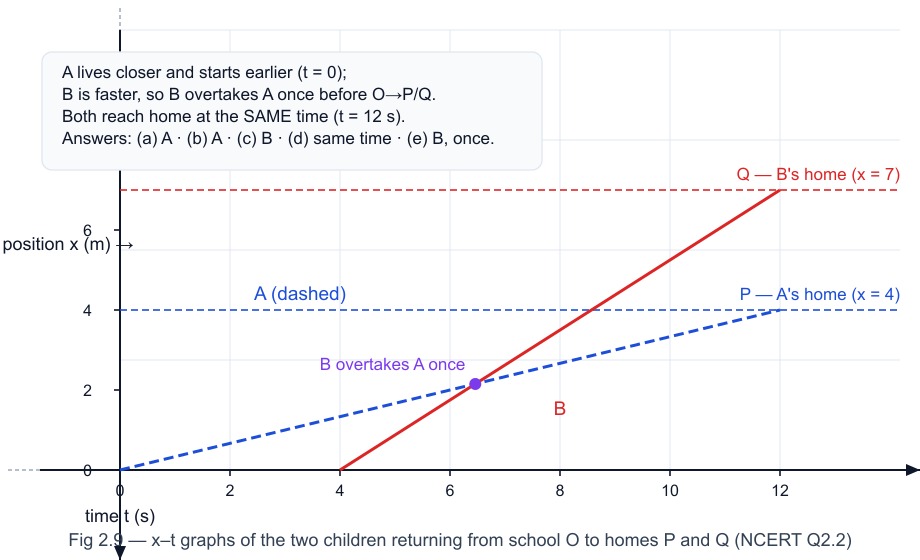
2.2) The position–time (x–t) graphs for two children A and B returning from school O to their homes P and Q are shown in Fig. 2.9. Choose the correct entries: (a) (A/B) lives closer to the school than (B/A); (b) (A/B) starts from the school earlier than (B/A); (c) (A/B) walks faster than (B/A); (d) A and B reach home at the (same/different) time; (e) (A/B) overtakes (B/A) on the road (once/twice).
2.3) A woman starts from her home at 9.00 am, walks at 5 km/h on a straight road to her office 2.5 km away, stays at the office up to 5.00 pm, and returns home by auto at 25 km/h. Choose suitable scales and plot the x–t graph of her motion.
2.4) A drunkard walking in a narrow lane takes 5 steps forward and 3 steps backward, followed again by 5 steps forward and 3 steps backward, and so on. Each step is 1 m long and requires 1 s. Plot the x–t graph of his motion and determine how long he takes to fall into a pit 13 m from the start.
2.5) A car moving along a straight highway at 126 km/h is brought to a stop within a distance of 200 m. What is the retardation of the car (assumed uniform), and how long does it take for the car to stop?
2.6) A player throws a ball upwards with an initial speed of 29.4 m/s. (a) What is the direction of acceleration during the upward motion of the ball? (b) What are the velocity and acceleration of the ball at the highest point? (c) Taking x = 0 m and t = 0 s at the highest point with the downward direction positive, give the signs of position, velocity and acceleration during the upward and downward motion. (d) To what height does the ball rise and after how long does it return to the player's hands? (Take g = 9.8 m/s² and neglect air resistance.)
2.7) Read each statement below carefully and state with reasons and examples whether it is true or false: a particle in one-dimensional motion (a) with zero speed at an instant may have non-zero acceleration at that instant, (b) with zero speed may have non-zero velocity, (c) with constant speed must have zero acceleration, (d) with a positive value of acceleration must be speeding up.
2.8) A ball is dropped from a height of 90 m on a floor. At each collision with the floor, the ball loses one-tenth of its speed. Plot the speed–time graph of its motion between t = 0 and t = 12 s.
2.9) Explain clearly, with examples, the distinction between (a) the magnitude of displacement over an interval of time and the total length of the path covered by the particle over the same interval, and (b) the magnitude of average velocity over an interval and the average speed over the same interval. Show in both cases that the second quantity is either greater than or equal to the first. When is the equality sign true?
2.10) A man walks on a straight road from his home to a market 2.5 km away at a speed of 5 km/h. Finding the market closed, he instantly turns and walks back home at 7.5 km/h. What is the (a) magnitude of average velocity, and (b) average speed of the man over the intervals (i) 0 to 30 min, (ii) 0 to 50 min, (iii) 0 to 40 min?
2.11) In Exercises 2.9 and 2.10 we carefully distinguished between average speed and the magnitude of average velocity. No such distinction is necessary when we consider instantaneous speed and the magnitude of instantaneous velocity. Why?
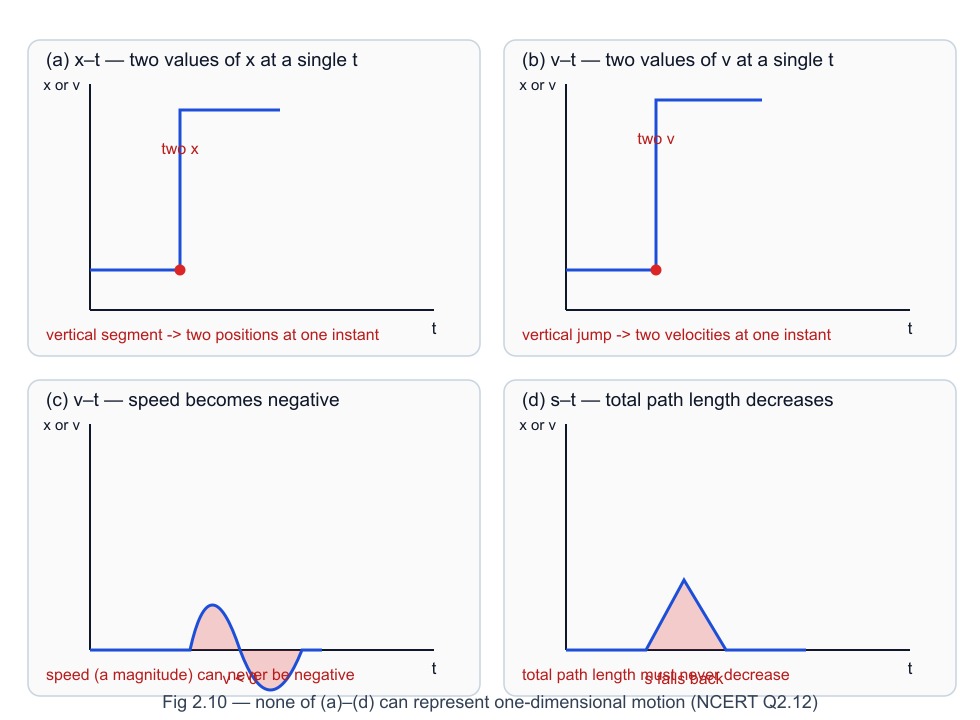
2.12) Look at the graphs (a) to (d) (Fig. 2.10) carefully and state, with reasons, which of these cannot possibly represent one-dimensional motion of a particle.
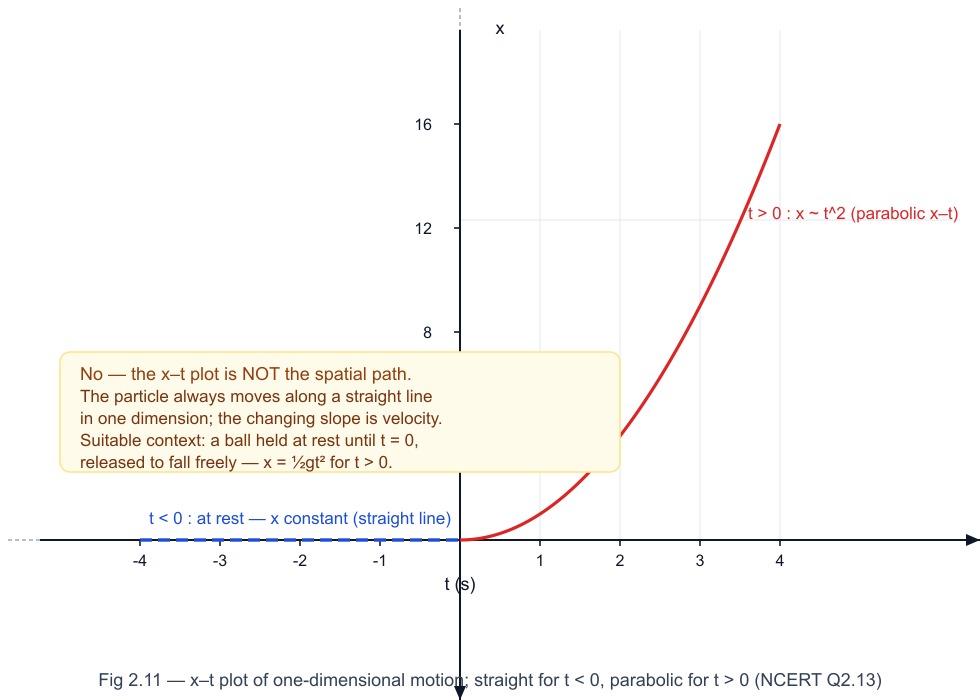
2.13) Figure 2.11 shows the x–t plot of one-dimensional motion of a particle. Is it correct to say from the graph that the particle moves in a straight line for t < 0 and on a parabolic path for t > 0? If not, suggest a suitable physical context for this graph.
2.14) A police van moving on a highway at 30 km/h fires a bullet at a thief's car speeding away in the same direction at 192 km/h. If the muzzle speed of the bullet is 150 m/s, with what speed does the bullet hit the thief's car? (Obtain the speed relevant for damaging the car.)
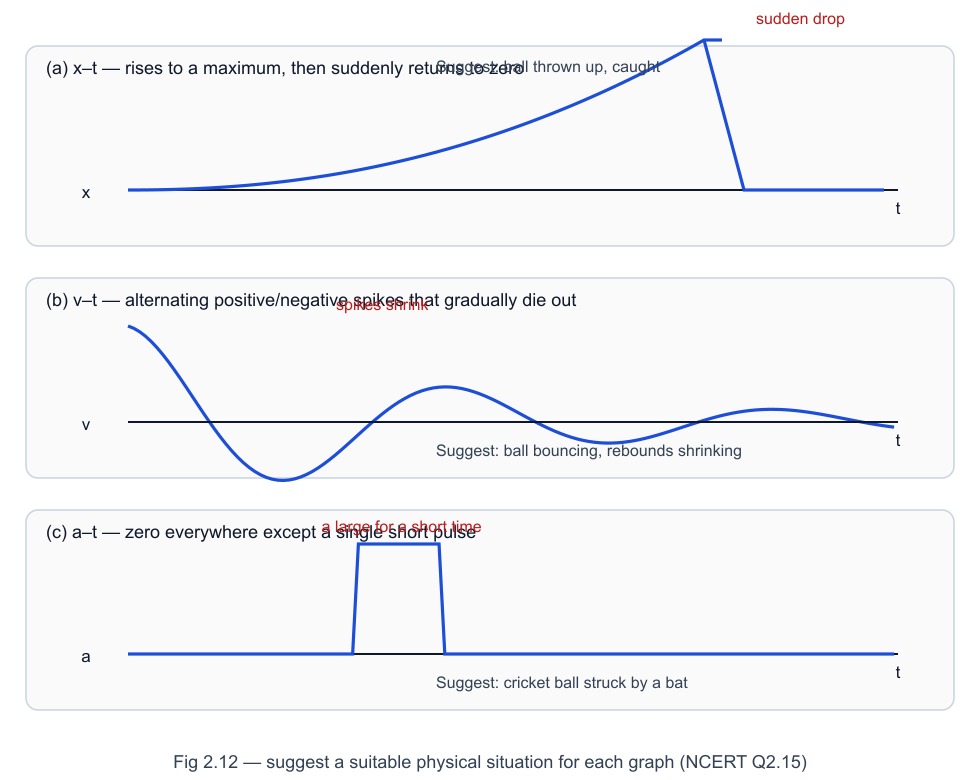
2.15) Suggest a suitable physical situation for each of the following graphs (Fig. 2.12): (a) an x–t graph that rises and then suddenly drops back to zero, (b) a v–t graph of alternating positive and negative spikes that gradually die out, (c) an a–t graph that is zero except for a short pulse.
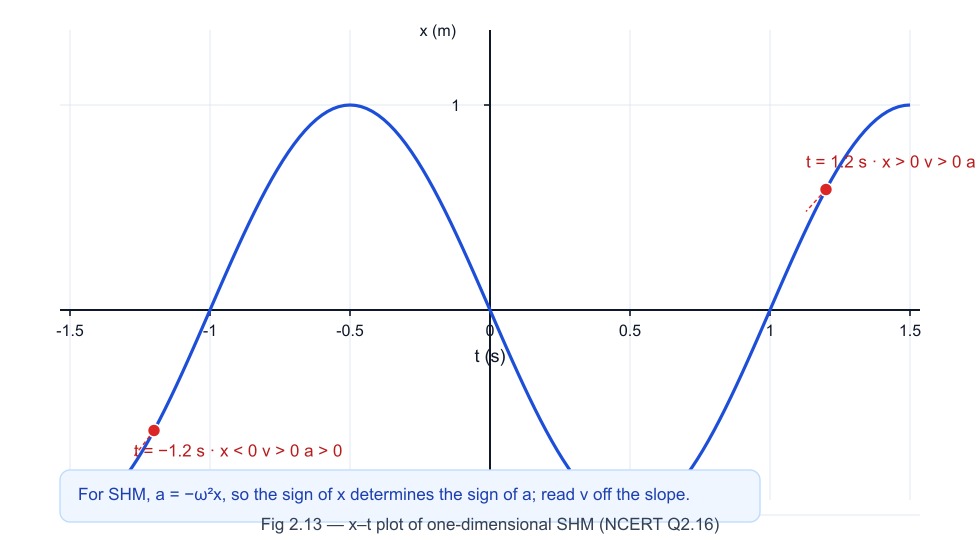
2.16) Figure 2.13 gives the x–t plot of a particle executing one-dimensional simple harmonic motion. Give the signs of position, velocity and acceleration of the particle at t = 0.3 s, 1.2 s and −1.2 s.
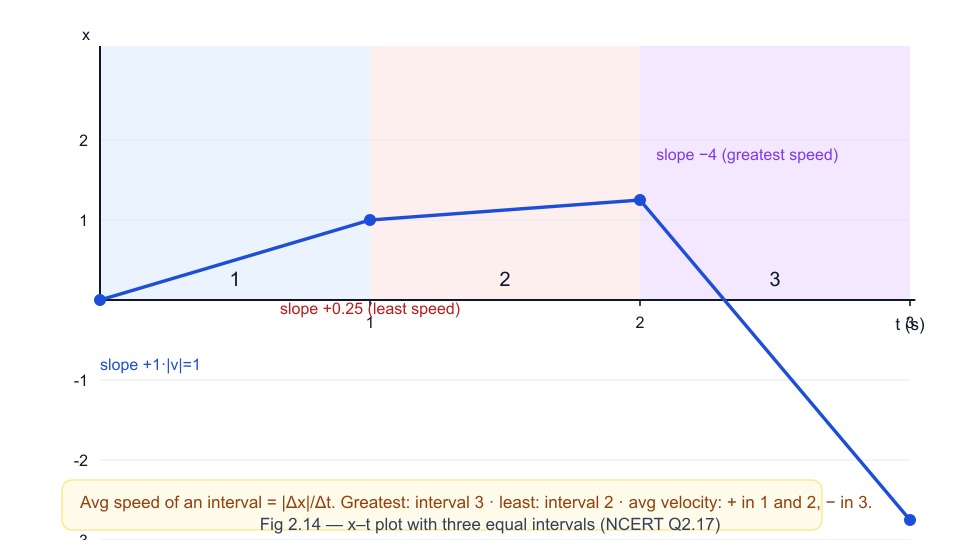
2.17) Figure 2.14 gives the x–t plot of a particle in one-dimensional motion. Three different equal intervals of time are shown. In which interval is the average speed greatest, and in which is it the least? Give the sign of the average velocity for each interval.
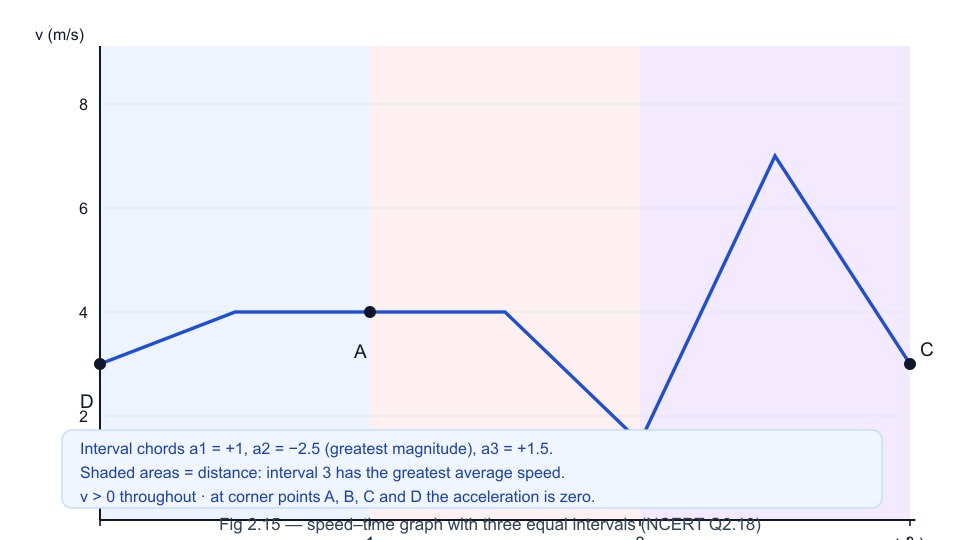
2.18) Figure 2.15 gives a speed–time graph of a particle in motion along a constant direction. Three equal intervals of time are shown. In which interval is the average acceleration greatest in magnitude? In which interval is the average speed greatest? Choosing the positive direction as the constant direction of motion, give the signs of v and a in the three intervals. What are the accelerations at the points A, B, C and D?
Answers at a glance
- 1Q2.1 — (a), (b) Yes; (c), (d) No.
- 2Q2.2 — (a) A; (b) A; (c) B; (d) same time; (e) B, once.
- 3Q2.3 — Three segments: slope +5 km/h from (0,0) to (0.5 h, 2.5 km), horizontal at 2.5 km from 0.5 h to 8.0 h, slope −25 km/h back to (8.1 h, 0); she reaches home at about 5.06 pm.
- 4Q2.4 — 37 s.
- 5Q2.5 — Retardation ≈ 3.06 m/s²; time to stop ≈ 11.4 s.
- 6Q2.6 — (a) Vertically downward (magnitude g); (b) v = 0, a = g downward; (c) upward: x<0, v<0, a>0; downward: x>0, v>0, a>0; (d) 44.1 m; 6 s.
- 7Q2.7 — (a) True; (b) False; (c) True; (d) False.
- 8Q2.8 — Saw-tooth speed–time graph: speed grows with slope g to 42 m/s at t ≈ 4.3 s, drops to 37.8 m/s at the collision, decays and returns to 37.8 m/s at about t = 12.0 s before the next collision.
- 9Q2.9 — Path length ≥ magnitude of displacement, and average speed ≥ magnitude of average velocity; equality holds only when the motion is unidirectional (no reversal of direction).
- 10Q2.10 — (i) 5 km/h and 5 km/h; (ii) 0 and 6 km/h; (iii) 1.875 km/h and 5.625 km/h.
- 11Q2.11 — Over an infinitesimal interval the particle cannot reverse direction, so the path length equals the magnitude of the displacement; dividing by the interval makes speed equal to the magnitude of velocity.
- 12Q2.12 — None of the four graphs (a)–(d) can represent one-dimensional motion: two values of x or v at a single instant (a), (b), a negative speed (c), and a decreasing total path length (d) are all impossible.
- 13Q2.13 — No. The graph is an x–t plot, not the spatial path; in one-dimensional motion the particle always moves along a straight line. Suitable context: a ball held at rest until t = 0 and then released to fall freely (x ∝ t²).
- 14Q2.14 — 105 m/s (the speed of the bullet relative to the thief's car).
- 15Q2.15 — (a) A ball thrown vertically upward, caught on its return; (b) a ball bouncing repeatedly on a hard floor with diminishing rebounds; (c) a cricket ball moving uniformly being hit by a bat — a short, large acceleration during impact.
- 16Q2.16 — t = 0.3 s: x<0, v<0, a>0; t = 1.2 s: x>0, v>0, a<0; t = −1.2 s: x<0, v>0, a>0.
- 17Q2.17 — Average speed is greatest in interval 3 and least in interval 2; average velocity is positive in intervals 1 and 2 and negative in interval 3.
- 18Q2.18 — Average acceleration is greatest in magnitude in interval 2, average speed is greatest in interval 3; v is positive in all three intervals, a is positive in interval 1, negative in interval 2 and positive in interval 3; accelerations at A, B, C and D are all zero.
CBSE Pattern Questions
How CBSE asks this chapter
MCQ Questions
1 Mark Questions
- 1Define average velocity.
- 2State the three equations of motion for a uniformly accelerated body.
- 3What does the slope of a velocity–time graph represent?
- 4Define free fall.
- 5When does the formula sₙ = u + (a/2)(2n − 1) give the true distance travelled in the nth second?
2 Mark Questions
- 1A train moving at 54 km/h is brought to rest by applying brakes uniformly in 18 s. Find the acceleration and the distance covered before stopping.
- 2Distinguish between the average speed and the average velocity of a body that returns to its starting point.
- 3A stone is dropped from the top of a tower 45 m high. Taking g = 10 m/s², find the time taken to reach the ground and the velocity of impact.
- 4A swimmer aims perpendicular to a 150 m wide river at 3 m/s in still water, while the current flows at 4 m/s. Find the time to cross and the drift.
3 Mark Questions
- 1A balloon is ascending at 5 m/s at a height of 300 m above the ground when a stone is dropped from it. Taking g = 10 m/s², find the time taken by the stone to reach the ground and the speed with which it hits the ground.
- 2Balls are released from the top of a tower at intervals of 1 s. When the 4th ball is just released, find the separations between the 1st and 2nd balls and between the 2nd and 3rd balls. (g = 10 m/s²)
- 3A body initially at rest accelerates uniformly at 2 m/s² for 5 s, then moves with constant velocity for 4 s, and finally retards uniformly to rest in 3 s. Draw the velocity–time graph of the motion and find the total distance covered.
5 Mark Questions
- 1(a) Derive the three equations of motion for a body moving with uniform acceleration using calculus. (b) A car moving at 72 km/h is brought to rest with uniform retardation in 5 s. Find the retardation and the distance covered.
- 2(a) What do the slope and the area under a velocity–time graph represent? (b) Draw the x–t, v–t and a–t graphs for a ball thrown vertically upward until it returns to the thrower. (c) From the v–t graph, obtain the maximum height and the total time of flight for an initial speed u.
PDF: Assignments & Tests
Printable study material
Free PDF Downloads & Assignments
Practice path: complete Assignment 1 first (topic-by-topic), then Assignment 2 (mixed difficulty), then attempt the timed tests.
Covers all ten topics: position, distance and displacement; average speed and velocity; acceleration; equations of motion and the nth second; motion graphs; free fall; non-uniform acceleration; frames of reference; relative velocity; and river–boat problems. Arranged topic by topic.
Second set with multi-topic integration problems, JEE-style numericals, and assertion–reason questions. Higher difficulty than Assignment 1.
Full board-pattern test: Section A (MCQ/VSA 1M × 10), Section B (2M × 5), Section C (3M × 4), Section D (5M × 2) = 40 marks. Time: 90 minutes. Includes answer key.
Second full paper with different questions, same 40-mark / 90-minute blueprint. Includes answer key.
Quick Revision
Key formulas at a glance
Memorise these equations — direct application numericals and derivations in CBSE & JEE frequently hinge on these.
Average speed, equal distances
Average speed, equal times
First equation of motion
Second equation of motion
Third equation of motion
Displacement in nth second
Free fall, upward positive
Time of flight, thrown up
Maximum height
Instantaneous velocity
Instantaneous acceleration
Acceleration in terms of position
Useful when a is given as a function of v or x
Relative velocity
Exam Strategy
How this chapter is asked
High-yield question patterns observed across CBSE boards, JEE Main & Advanced, and NEET.
- The equal-distance vs. equal-time average speed formulas are swapped constantly in CBSE and JEE Main papers specifically to catch students who memorised only the arithmetic mean — always check which quantity (distance or time) is actually equal between the two parts of the journey before picking a formula.
- Distance-in-the-nth-second questions are a favourite JEE Advanced trap when acceleration is negative: if velocity crosses zero partway through that second, the s_n formula alone gives net displacement, not true distance, and the interval must be split at the zero-velocity instant.
- Free-fall problems with 'thrown from a height' combine two phases (rise, then fall) and are best handled by fixing one consistent sign convention for the whole problem rather than restarting the sign choice at the top of the trajectory.
- Galileo's odd-number ratio (1:3:5:7...) is a fast shortcut for free-fall-from-rest problems asking for distance in a specific second — much quicker than rederiving s_n from scratch each time.
- River-boat and rain-man problems are a near-guaranteed JEE Main topic — practice resolving velocities into along-flow and across-flow components until it's automatic, and always double-check whether the question wants shortest time (swim perpendicular) or shortest path (aim upstream at an angle), since they call for different strategies.
- 'Minimum distance between two moving bodies' problems are solved fastest by switching to the frame of one body, turning it into a single-body v² = u² + 2as problem rather than tracking two positions separately.
- A frequent JEE Advanced trap: giving acceleration as a function of velocity or displacement instead of time, which silently breaks the standard three equations and requires separating variables and integrating instead.
Practice Numericals
Step-by-step worked examples
Standard exam-level problems solved with clear conceptual breakdowns.
Two-speed round trip (the harmonic-mean trap)
Step-by-Step Solution
- 1The two legs cover equal distances, not equal times, so use the harmonic-mean formula: v_avg = 2v₁v₂/(v₁+v₂).
- 2v_avg = 2(40)(30)/(40+30) = 2400/70 ≈ 34.3 km/h.
- 3Average velocity uses net displacement, not distance. Since the car returns to its starting point, net displacement is zero, so average velocity = 0, regardless of how far it actually travelled.
Final Answer
Distance in a specific second, with a direction reversal
Step-by-Step Solution
- 1Check whether velocity reaches zero during the 5th second (t = 4 s to t = 5 s). Using v = u+at: v = 8 − 2t = 0 gives t = 4 s — exactly at the start of the 5th second.
- 2So for the entire 5th second, the particle is moving in the negative direction (it has already turned around), and distance equals |displacement| for that interval — no splitting needed here since the turnaround happens exactly at the second's boundary.
- 3Displacement in the 5th second: s₅ = u + (a/2)(2×5−1) = 8 + (−1)(9) = −1 m, so the distance covered in the 5th second is 1 m.
Final Answer
Ball thrown upward from a tower
Step-by-Step Solution
- 1Maximum height above the throw point: v² = u² − 2gh with v = 0 gives h = u²/(2g) = 400/20 = 20 m above the tower top.
- 2For total time to the ground, take the tower top as origin and the ground as h = −25 m.
- 3h = ut − ½gt²: −25 = 20t − 5t² → t² − 4t − 5 = 0 → (t−5)(t+1) = 0, so t = 5 s (rejecting the negative root).
Final Answer
Galileo's odd-number rule in action
Step-by-Step Solution
- 1For a body released from rest, successive-second distances follow the ratio 1 : 3 : 5 : 7 — the 4th term in this sequence is 7.
- 2Since the 1st-second distance corresponds to 'share 1' = 5 m, each 'share' is 5 m, so the 4th second corresponds to 7 shares.
- 3Distance in the 4th second = 7 × 5 = 35 m.
Final Answer
Swimmer crossing a river
Step-by-Step Solution
- 1Her velocity component across the river equals her still-water speed, 4 m/s, since she swims perpendicular to the flow the entire time.
- 2Time to cross = width ÷ across-speed = 200/4 = 50 s.
- 3In that time, the current carries her downstream at 3 m/s: drift = 3 × 50 = 150 m.
Final Answer
Catching up: a relative-velocity chase problem
Step-by-Step Solution
- 1Switch to the scooter's frame. In this frame, the cyclist's initial velocity is 10 m/s (toward the scooter) and the cyclist's relative acceleration is −2 m/s² (away, since the scooter accelerates forward).
- 2Find the distance the cyclist covers in this frame before relative velocity hits zero: using v² = u² + 2as with v = 0, u = 10, a = −2: 0 = 100 − 4s → s = 25 m.
- 3The cyclist only closes 25 m of the initial 40 m gap before the scooter pulls away faster than the cyclist can gain, so the cyclist never catches up. Minimum distance = 40 − 25 = 15 m.
Final Answer
Velocity-dependent acceleration
Step-by-Step Solution
- 1Since a = dv/dt, write dv/dt = −kv.
- 2Separate variables: dv/v = −k dt, and integrate from v = u at t = 0 to v at time t.
- 3This gives ln(v/u) = −kt, so v = u e^(−kt) — velocity decays exponentially rather than linearly, exactly because acceleration is not constant here.
Final Answer
FAQ
Frequently asked questions
Why do the two average-speed formulas give different answers for the same two speeds?
Because they weight the speeds differently. Splitting a journey by equal distance means more time is spent at the slower speed, pulling the average down toward the harmonic mean. Splitting by equal time means each speed contributes equally regardless of distance covered, giving the plain arithmetic mean instead — the two scenarios are physically different journeys even though the two speeds are the same numbers.
Is acceleration due to gravity the same for a ball thrown up and a ball thrown down?
Yes. Gravity always accelerates a body downward at g, regardless of whether the body is moving up, down, or momentarily at rest at its highest point. Only the body's velocity changes direction and magnitude; the acceleration stays constant throughout the flight.
When do I need calculus instead of the three equations of motion?
Whenever acceleration is not a constant number — i.e., it's given as a function of time, velocity, or position. The three standard equations (v=u+at, s=ut+½at², v²=u²+2as) are only valid for constant acceleration; anything else requires differentiating or integrating the defining relations v=dx/dt and a=dv/dt.
Why can't I just add the swimmer's speed and the river's speed when crossing straight across?
Because velocity is a vector. If the swimmer aims straight across, her across-river speed and the river's along-river speed are perpendicular components of her total ground velocity, not a single number to add — you resolve them separately, one giving the crossing time and the other giving the downstream drift.
What does the slope of a velocity-time graph actually represent?
It's the instantaneous acceleration at that point in time. A steeper slope means the velocity is changing faster; a flat (horizontal) segment means zero acceleration, i.e., constant velocity; and the area enclosed between the curve and the time axis over any interval gives the displacement during that interval, not the acceleration.
What is the difference between distance and displacement?
Distance is the total path length travelled — a scalar that can only stay the same or grow. Displacement is the net change in position, a vector from the starting point to the ending point. Displacement can be zero even after a long journey (a full lap returns you to the start), but the magnitude of displacement is never greater than the distance travelled.
Is retardation the same thing as negative acceleration?
Not exactly. Retardation means the speed is decreasing; it says nothing about the sign of acceleration on its own, because the sign depends on the chosen positive direction. A body moving in the negative direction with a negative acceleration is actually speeding up. Always check whether velocity and acceleration point the same way (speeding up) or opposite ways (retardation) instead of reading the sign alone.
When does the nth-second formula fail?
The formula sₙ = u + (a/2)(2n − 1) gives the displacement during the nth second, and it equals the distance travelled only if the body keeps moving in the same direction throughout that second. If the velocity crosses zero partway through the interval (common near the top of a projectile path), split the second at the zero-velocity instant and add the two partial distances separately — otherwise you get net displacement instead of distance.
Is a uniformly moving train an inertial frame?
Yes. A frame of reference moving with constant velocity has zero acceleration, so Newton's laws hold in their simple form and no pseudo-force is needed. Only accelerating frames — a lift speeding up, a bus taking a sharp turn — are non-inertial frames where pseudo-forces must be introduced.
How do I find the minimum separation between two moving bodies?
Switch to the frame of one of the bodies: give that body zero velocity and zero acceleration, and describe the other body's motion relative to it. The two-body chase becomes a single-body problem, and the separation is minimised at the instant the relative velocity becomes zero — typically just a v² = u² + 2as calculation.
Next Chapters
Continue learning
Same chapter
Read alongside
Interactive Quiz
Chapter MCQ practice test
Instant scoring with complete solutions — test your mastery in under 15 minutes.
Chapter MCQ Mock Test
Evaluate how well you have retained the concepts, formulas, and reaction mechanisms from this chapter. Questions adhere strictly to latest CBSE, JEE & NEET trends.
Master this chapter with expert live guidance
Self-study notes lay the ground, but conceptual doubts clear fastest in an interactive classroom. Narayan Gurukul Academy (ClassApna) conducts small-batch CBSE, JEE & NEET coaching with daily doubt solving and rigorous mock tests.
Small batches · 1-on-1 personal mentorship · Live online & offline centre