Class 11 Physics · NCERT Chapter 5
Work Energy and Power Class 11 Notes
Master I.V. Work, Energy and Power with these Class 11 Physics notes: scalar products and work done, the work–energy theorem, potential energy and its conservation, spring and gravitational potential energy, power, collisions and motion in a vertical circle — every NCERT subtopic with formula sheets, solved examples, MCQs, assertion–reason and case-study questions for CBSE, JEE and NEET.
Written byDeep Narayan· Science & Mathematics EducatorReviewed byPushpanjali
Prove the work–energy theorem for a variable force.
The net work done by all forces on a particle equals the change in its kinetic energy: W = ∫F·dx = ½mv² − ½mu² = ΔK. Using F = ma and a = v(dv/dx), F dx = m v dv; integrating both sides gives W = ½mv² − ½mu². It holds whether the force is constant or variable.
Work
In physics the word 'work' has a precise meaning, different from everyday usage. A force does work on a body when it moves the body along its line of action, and the amount of work depends on the component of the force along the displacement. To define work we first need the scalar (dot) product of two vectors.
Scalar (dot) product
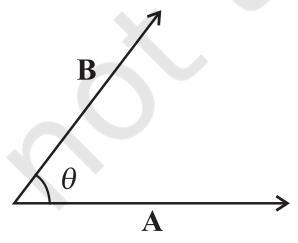
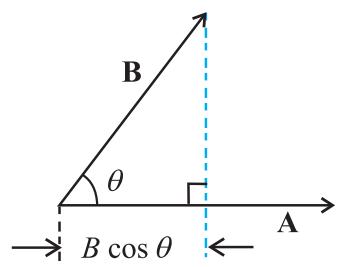
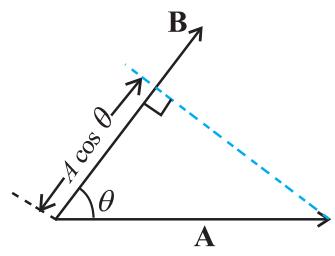
The scalar product of two vectors A and B, written A·B (read 'A dot B'), is a scalar quantity: A·B = AB cos θ, where θ is the angle between the two vectors and A, B are their magnitudes.
Geometrically, B cos θ is the projection of B onto A and A cos θ is the projection of A onto B. So A·B is the product of the magnitude of A and the component of B along A (or vice versa). The scalar product is commutative: A·B = B·A; it is distributive: A·(B + C) = A·B + A·C; and A·(λB) = λ(A·B). Since cos 0° = 1 and cos 90° = 0, A·A = A² and A·B = 0 whenever A and B are perpendicular.
Work done by a constant force
If a constant force F acts on a body while it undergoes a displacement d, the work done by the force is the product of the component of F along d and the magnitude of d: W = (F cos θ) d = F·d. Work is a scalar; its SI unit is the joule (J).
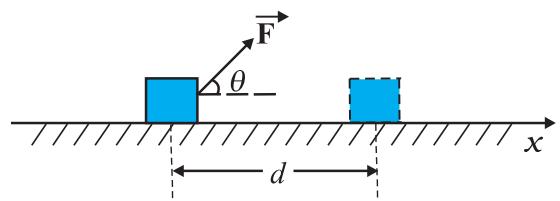
No work is done if (i) the displacement is zero (holding a 150 kg weight steady does no work on it), (ii) the force is zero (a block sliding on a smooth table), or (iii) force and displacement are mutually perpendicular (gravity does no work on a body moving horizontally, and the Earth's gravity does no work on a circular moon).
Work may be positive, negative or zero: for 0° ≤ θ < 90° it is positive, for 90° < θ ≤ 180° it is negative (friction opposing motion, θ = 180°, does negative work), and at θ = 90° it is zero.
Units of work and energy
Work and energy have the same dimensions, [ML²T⁻²], and the SI unit is the joule (J). Other common units: 1 erg = 10⁻⁷ J, 1 eV = 1.6 × 10⁻¹⁹ J, 1 cal = 4.186 J, 1 kWh = 3.6 × 10⁶ J.
MCQ Questions
1A man squatting on the ground gets straight up and stands. The force of reaction of the ground on the man during the process is —
2A uniform chain of length 2 m is kept on a table such that a length of 60 cm hangs freely from the edge of the table. The total mass of the chain is 4 kg. What is the work done in pulling the entire chain on to the table? (Take g = 10 m/s².)
3300 J of work is done in sliding a 2 kg block up an inclined plane of height 10 m. The work done against friction is (g = 10 m/s²) —
1 Mark Questions
- How much work is done by a coolie walking on a horizontal platform with a load on his head?
- A body is moving along a circular path. How much work is done by the centripetal force?
- State the two conditions under which a force does no work?
- A body is moving at constant speed over a frictionless surface. What is the work done by the weight of the body?
2 Mark Questions
- Mountain roads rarely go straight up the slope but wind up gradually. Why?
- Is it necessary that work done in the motion of a body over a closed loop is zero for every force in nature? Why?
- Give an example in which a force does work on a body but fails to change its K.E.
3 Mark Questions
- A body of mass 0.3 kg is taken up an inclined plane of length 10 m and height 5 m and then allowed to slide down to the bottom again. The coefficient of friction between the body and the plane is 0.15. Calculate (i) the work done by the gravitational force over the round trip, (ii) the work done by the applied force over the upward journey, (iii) the work done by the frictional force over the round trip, (iv) the kinetic energy of the body at the end of the trip. How is the answer to (iv) related to the first three answers?
Assertion–Reason Questions
Select the correct alternative for each assertion–reason pair from the codes given below: (a) Both A and R are true and R is the correct explanation of A. (b) Both A and R are true but R is NOT the correct explanation of A. (c) A is true but R is false. (d) A is false but R is also false.
- Assertion (A): Work done by the frictional force is negative. Reason (R): Frictional force acts along the direction of motion.
Case Study · Work
The term 'work' is frequently used in everyday language. A farmer ploughing the field, a construction worker carrying bricks on his head, a student studying for a competitive examination, an artist painting a beautiful landscape — all are said to be working, but in the language of physics they are not necessarily doing any work! In physics the word 'work' covers a definite and precise meaning. Energy is the capacity of a body to do work, and power is the rate of doing work. Though work is a scalar quantity, its value may be positive, negative or zero.
(i) In physics, work is defined as — (a) the product of the component of force in the direction of displacement and the magnitude of displacement (b) the product of the component of force perpendicular to the direction of displacement and the magnitude of displacement (c) the cross product of the force vector and the displacement vector (d) the product of the component of force in the direction of displacement and the magnitude of velocity.
(ii) Which of the following is not an example of zero work done? (a) Work done by the centripetal force (b) work done by the tension in the string of a simple pendulum (c) work done by a frictional force (d) the work done in pushing an immovable stone.
(iii) A body is subjected to a constant force F = −î + 2ĵ + 3k̂ N and is constrained to move along the z-axis. The work done by the force in moving the body through a distance of 4 m along the z-axis is — (a) 12 J (b) −12 J (c) 0 J (d) 16 J.
(iv) When a body is thrown up, during the upward journey the work done by gravity on the body is — (a) positive (b) zero (c) negative (d) cannot say.
(v) A body is initially at rest and undergoes one-dimensional motion with constant acceleration. The power delivered to it at time t is proportional to — (a) t¹ᐟ² (b) t (c) t³ᐟ² (d) t².
Work Done by a Variable Force
Not all forces are constant. When a force varies with position, we divide the displacement into many small steps dx over which the force is approximately constant, add the small amounts of work F dx, and let the steps shrink to zero — i.e. we integrate:
The work done is thus the area under the force–displacement (F–x) curve between the two positions. This is how the work of a spring, or of any force that changes with position, is computed.
Graphical method
The work done by a variable force equals the area bounded by the F–x curve and the displacement axis between the two limits.
The work–energy theorem remains valid for a variable force. Using F = ma and a = v(dv/dx), we get F dx = m v dv; integrating from u to v gives W = ½mv² − ½mu².
MCQ Questions
1A position-dependent force F = 7 − 2x + 3x² N acts on a small body of mass 2 kg and displaces it from x = 0 to x = 5 m. The work done in joules is —
2 Mark Questions
- Find the work done when a particle moves from position r₁ = (3î + 2ĵ − 6k̂) to r₂ = (14î + 13ĵ − 9k̂) under a constant force F = (4î + ĵ + 3k̂) N.
3 Mark Questions
- A body is moving along the z-axis of a coordinate system under the effect of a constant force F = (2î + 3ĵ + k̂) N. Find the work done by the force in moving the body a distance of 2 m along the z-axis.
Kinetic Energy and the Work–Energy Theorem
Begin with the kinematic relation for rectilinear motion under constant acceleration a: v² − u² = 2as. Multiplying by m/2 gives ½mv² − ½mu² = m·a·s = F·s. The quantity ½mv² is called the kinetic energy K, and the right side is exactly the work W. Hence:
Kinetic energy
Kinetic energy is the energy a body possesses by virtue of its motion: K = ½mv² = ½ m v·v. It is a scalar quantity, always positive, and zero only when the body is at rest.
Statement of the theorem
The work–energy theorem: the change in kinetic energy of a particle is equal to the net work done on it by all the forces acting on it, ΔK = W. Because kinetic energy is a scalar, the statement is independent of the path and remains true for variable forces.
Work refers to the force and the displacement over which it acts — work is done by a force on a body over a certain displacement. When a body speeds up, positive net work is done on it; when it slows down, the net work is negative.
MCQ Questions
1A body of mass 0.5 kg travels in a straight line with velocity V = a·x³ᐟ², where a = 5 m⁻¹ᐟ² s⁻¹. The work done by the net force during its displacement from x = 0 to x = 2 m is —
2An athlete in the Olympic games covers a distance of 100 m in 10 s. His kinetic energy can be estimated to be in the range (assume m = 60 kg) —
3If the linear momentum of a body is increased by 50%, then its kinetic energy will increase by —
4A body of mass 50 kg is at rest. The work done to accelerate it to 20 m/s in 10 s is —
5A particle is projected at an angle of 60° to the horizontal with a kinetic energy E. The kinetic energy at the highest point is —
1 Mark Questions
- A light and heavy body have same linear momentum. Which one has greater kinetic energy?
- How will the momentum of a body change if its kinetic energy is made double?
- K.E. of a body is increased by 300 %. Find the % increase in its momentum?
- A light and a heavy body have same K.E., which of the two have more momentum and why?
2 Mark Questions
- The momentum of a body is doubled. By what percentage does its kinetic energy change?
- A truck and a car moving with the same K.E. on a straight road. Their engines are simultaneously switched off which one will stop at a lesser distance?
- Derive an expression for the kinetic energy of a body of mass m moving with velocity v by the calculus method.
- How high must a body be lifted to gain an amount of potential energy equal to the kinetic energy it has when moving at a speed of 20 m·s⁻¹? (Take g = 9.8 m·s⁻².)
- State and prove work energy theorem.
3 Mark Questions
- In lifting a 10 kg weight to a height of 2m, 230 J energy is spent. Calculate the acceleration with which it was raised?
- A bullet of mass 0.02 kg is moving with a speed of 10 ms⁻¹. It can penetrate 10 cm of a wooden block, and comes to rest. If the thickness of the target would be 6 cm only, find the K.E. of the bullet when it comes out.
Assertion–Reason Questions
Select the correct alternative for each assertion–reason pair from the codes given below: (a) Both A and R are true and R is the correct explanation of A. (b) Both A and R are true but R is NOT the correct explanation of A. (c) A is true but R is false. (d) A is false but R is also false.
- Assertion (A): A body cannot have energy without possessing momentum but it can have momentum without having energy. Reason (R): Momentum and energy have the same dimensions.
Case Study · Work–Energy Theorem
The work–energy theorem states that the work done by the net force acting on a body is equal to the change produced in the kinetic energy of the body. The work–energy theorem is not independent of Newton's second law; it may be viewed as the scalar form of the second law. By using the work–energy theorem, the work done by a force can be calculated even if the exact nature of the force is not known.
(i) When work is done on a system, the kinetic energy of the system — (a) decreases (b) increases (c) remains the same (d) becomes zero.
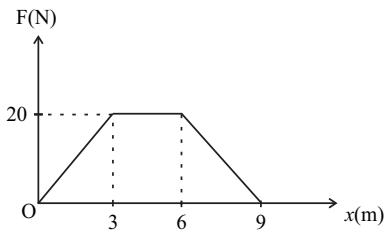
(ii) A body of mass 2.4 kg is subjected to a force which varies with distance as shown in the figure. The body starts from rest at x = 0. Using the work–energy theorem, find the velocity of the body after the force has acted over the distance shown in the graph. (Work done = area under the F–x curve, and W = ½mv².)
(iii) If the kinetic energy of a body becomes four times its initial value, the new momentum will be — (a) twice its initial value (b) four times its initial value (c) thrice its initial value (d) the same.
(iv) Two bodies with kinetic energies in the ratio 4 : 1 are moving with equal momentum. The ratio of their masses is — (a) 4 : 1 (b) 1 : 1 (c) 1 : 2 (d) 1 : 4.
(v) A ball of mass 50 g is moving over a surface with a velocity of 10 m/s. Its velocity becomes 5 m/s after travelling some distance. The work done on the ball by the force of friction is — (a) −2 J (b) +2 J (c) 3 J (d) −3 J.
The Concept of Potential Energy
Conservative force
A force is conservative if the work done by it in moving a body over a closed path is zero — equivalently, the work done depends only on the endpoints and not on the path taken. Gravitational, electrostatic and spring (elastic) forces are conservative; frictional force is non-conservative.
For a conservative force the work it does is stored as potential energy and is fully recoverable as kinetic energy. The change in potential energy of a body equals the negative of the work done by the conservative force:
Potential energy
Potential energy is the energy a body has by virtue of its position or configuration. Near the Earth's surface U = mgh measured above a chosen reference level; for a spring U = ½kx². It is defined only up to an arbitrary constant, so only changes in potential energy have physical meaning.
Because friction is non-conservative, the work done against friction in a closed loop is never zero, and the energy 'lost' is converted into heat — it cannot be stored as potential energy and recovered, which is why potential energy can be associated only with conservative forces.
1 Mark Questions
- Define the conservative and non-conservative forces. Give examples of each.
- What happens to the P.E. of a bubble when it rises in water?
Assertion–Reason Questions
Select the correct alternative for each assertion–reason pair from the codes given below: (a) Both A and R are true and R is the correct explanation of A. (b) Both A and R are true but R is NOT the correct explanation of A. (c) A is true but R is false. (d) A is false but R is also false.
- Assertion (A): Friction is a non-conservative force. Reason (R): This is because the work done against friction in moving a body over a closed path is never zero.
Case Study · Conservative and Non-Conservative Forces
The process of converting one form of energy into another is known as the transformation of energy. The mechanical energy of a system is conserved if the forces acting on it are conservative. However, if a system is acted upon by conservative and non-conservative forces together, some of the mechanical energy is converted into other forms of energy such as sound, heat and light, so mechanical energy alone is not conserved. Mechanical energy is the sum of kinetic energy and potential energy, where K.E. = ½mv² and P.E. = mgh, with symbols having their usual meanings.
(i) Which one of the following is a non-conservative force? (a) Gravitational force (b) electrostatic force (c) magnetic force (d) frictional force.
(ii) A body falls freely under the action of gravity alone in vacuum. Which of the following quantities remains constant during the fall? (a) Kinetic energy (b) potential energy (c) total mechanical energy (d) total linear momentum.
(iii) A mass of 5 kg is moving along a circular path of radius 1 m. If the mass moves with 300 rev/min, its K.E. would be — (a) 250π² J (b) 100π² J (c) 5π² J (d) 0 J.
(iv) In which case does the potential energy decrease? (a) On compressing a spring (b) on stretching a spring (c) on moving a body against the gravitational pull (d) on the rising of an air bubble in water.
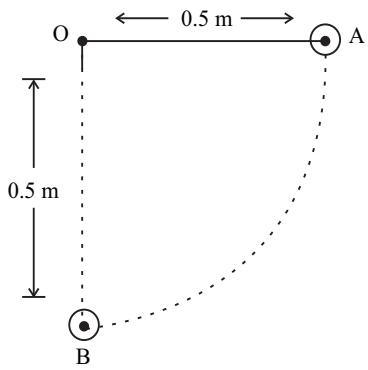
(v) The bob of a simple pendulum is held in the horizontal position A as shown in the figure. Assuming no loss of energy, the speed of the bob at the lowest position B when released is — (a) √9.8 m/s (b) 9.8 m/s (c) 0 m/s (d) √(2 × 9.8) m/s.
Conservation of Mechanical Energy
Mechanical energy
The mechanical energy of a system is the sum of its kinetic and potential energy: E = K + U.
If only conservative forces act on a system, its total mechanical energy is conserved: kinetic energy may change into potential energy and vice versa, but K + U remains constant at every instant. This is the law of conservation of mechanical energy.
Familiar examples: a freely falling body continuously converts potential energy into kinetic energy while total mechanical energy stays constant; a pendulum converts potential energy into kinetic energy and back; a stone thrown vertically upward behaves the same way at every height.
When it breaks down
If non-conservative forces (friction, air resistance) do work W_nc, then E_f = E_i + W_nc with W_nc negative — mechanical energy is not conserved; the 'lost' energy appears as heat and sound.
MCQ Questions
1A child is sitting on a swing. Its minimum and maximum heights from the ground are 0.75 m and 2 m respectively. Its maximum speed will be (g = 10 m/s²) —
2 Mark Questions
- A bob is pulled sideway so that string becomes parallel to horizontal and released. Length of the pendulum is 2 m. If due to air resistance loss of energy is 10%, what is the speed with which the bob arrived at the lowest point.
- A ball at rest is dropped from a height of 12 m. It loses 25% of its kinetic energy in striking the ground, find the height to which it bounces. How do you account for the loss in kinetic energy?
3 Mark Questions
- A ball bounces to 80% of its original height. Calculate the mechanical energy lost in each bounce.
5 Mark Questions
- Show that at any instant of time during the motion total mechanical energy of a freely falling body remains constant. Show graphically the variation of K.E. and P.E. during the motion.
Assertion–Reason Questions
Select the correct alternative for each assertion–reason pair from the codes given below: (a) Both A and R are true and R is the correct explanation of A. (b) Both A and R are true but R is NOT the correct explanation of A. (c) A is true but R is false. (d) A is false but R is also false.
- Assertion (A): According to the law of conservation of mechanical energy, the change in potential energy is equal and opposite to the change in kinetic energy. Reason (R): Mechanical energy is not a conserved quantity.
- Assertion (A): Mass and energy are not conserved separately but are conserved as a single entity called mass–energy. Reason (R): This is because one can be obtained at the cost of the other, as per Einstein's equation E = mc².
Potential Energy of a Spring
For an ideal spring the restoring force is directly proportional to the extension (or compression) x from its natural length and is directed opposite to it (Hooke's law):
Spring constant
The spring constant k is the force needed to produce unit extension. A hard (stiff) spring has a large k, a soft or delicate spring a small k. Its SI unit is the newton per metre (N/m).
The work done against the spring force in stretching or compressing a spring by x is stored as elastic potential energy. Because the force grows linearly with extension, the average force is kx/2, and the work is ½ × (kx) × x:
Equivalently, U equals the area under the triangular F–x graph (½ × base × height = ½ x (kx)). Note that U is always positive whether the spring is stretched or compressed, being proportional to x², and is maximum at the maximum extension or compression.
MCQ Questions
1A spring of force constant 800 N·m⁻¹ has an extension of 5 cm. The work done in extending it from 5 cm to 15 cm is —
1 Mark Questions
- Which spring has greater value of spring constant – a hard spring or a delicate spring?
- Does the P.E. of a spring decreases or increases when it is compressed or stretched?
- Define spring constant of a spring.
2 Mark Questions
- Two springs A and B are identical except that A is harder than B, so K_A > K_B. If both are stretched by the same force, on which spring is more work done?
- Two springs A and B are identical except that A is harder than B, so K_A > K_B. If both are stretched by the same amount, on which spring is more work done?
- A spring of force constant K is cut into two equal pieces. Calculate force constant of each part.
3 Mark Questions
- An elastic spring is compressed by an amount x. Show that its potential energy is ½kx², where k is the spring constant.
- 20 J work is required to stretch a spring through 0.1 m. Find the force constant of the spring. If the spring is further stretched through 0.1 m. Calculate work done.
- To simulate car accidents, auto manufacturers study the collisions of moving cars with mounted springs of different spring constants. Consider a typical simulation with a car of mass 1000 kg moving with a speed of 18.0 km·h⁻¹ on a smooth road and colliding with a horizontally mounted spring of spring constant 6.25 × 10⁵ N·m⁻¹. What is the maximum compression of the spring?
5 Mark Questions
- Two particles of mass m₁ and m₂, having velocities u₁ and u₂ respectively, make a head-on collision. Derive the relation for their final velocities and discuss the special cases (i) m₁ = m₂, (ii) m₁ >> m₂ and u₂ = 0, (iii) m₁ << m₂ and u₁ = 0.
Assertion–Reason Questions
Select the correct alternative for each assertion–reason pair from the codes given below: (a) Both A and R are true and R is the correct explanation of A. (b) Both A and R are true but R is NOT the correct explanation of A. (c) A is true but R is false. (d) A is false but R is also false.
- Assertion (A): A spring has potential energy both when it is compressed and when it is stretched. Reason (R): This is because work is done against the restoring force in compressing or stretching the spring.
- Assertion (A): The graph between the potential energy of a spring and the extension/compression x of the spring is a straight line. Reason (R): The potential energy is directly proportional to x.
Power
Power
Power is the rate of doing work: P = W/t. It is a scalar quantity, and its SI unit is the watt (W = J/s). In everyday machinery, 1 horsepower ≈ 746 W.
When a force F moves a body with velocity v, the power delivered is the dot product P = F·v = Fv cos θ. Instantaneous power is the product of force and instantaneous velocity.
Units of energy vs power
The kilowatt-hour (1 kWh = 3.6 × 10⁶ J) is a unit of energy — the work done by a 1 kW device in one hour. The electron-volt (1 eV = 1.6 × 10⁻¹⁹ J) is a very small unit of energy used in atomic physics. Neither is a unit of power.
MCQ Questions
1How much water can a pump of 2 kW raise in one minute to a height of 10 m? (g = 10 m/s²) —
2 Mark Questions
- Which of the two kilowatt hour or electron volt is a bigger unit of energy and by what factor?
3 Mark Questions
- A car of mass 2000 kg is lifted up a distance of 30 m by a crane in 1 min. A second crane does the same job in 2 min. Do the cranes consume the same or different amounts of fuel? What is the power supplied by each crane? Neglect Power dissipation against friction.
- A pump on the ground floor of a building can pump up water to fill a tank of volume 30 m³ in 15 min. If the tank is 40 m above the ground, how much electric power is consumed by the pump. The efficiency of the pump is 30%.
- Water is pumped out of a well 10 m deep by means of a pump rated 10 KW. Find the efficiency of the motor if 4200 kg of water is pumped out every minute. Take g = 10 m/s²
- A man pulls a lawn roller through a distance of 20 m with a force of 20 kg weight. If he applies the force at an angle of 60º with the ground, calculate the power developed if he takes 1 min in doing so.
- A truck of mass 1000 kg accelerates uniformly from rest to a velocity of 15 m·s⁻¹ in 5 s. Calculate (i) its acceleration, (ii) its gain in kinetic energy, (iii) the average power of the engine during this period. Neglect friction.
- An elevator which can carry a maximum load of 1800 kg (elevator + passengers) is moving up with a constant speed of 2 ms⁻¹. The frictional force opposing the motion is 4000 N. Determine the minimum power delivered by the motor to the elevator in watts as well as in horse power.
Assertion–Reason Questions
Select the correct alternative for each assertion–reason pair from the codes given below: (a) Both A and R are true and R is the correct explanation of A. (b) Both A and R are true but R is NOT the correct explanation of A. (c) A is true but R is false. (d) A is false but R is also false.
- Assertion (A): The time taken by a body to complete a given amount of work has nothing to do with the energy of the body. Reason (R): Power of a body is the rate of doing work.
Collisions
Collision
A collision is an event in which two bodies interact for a very short time, producing large forces. In every type of collision the linear momentum of the system is conserved; the total kinetic energy is conserved only in elastic collisions.
Types of collision: (i) perfectly elastic — kinetic energy is conserved (e.g. atomic and nuclear collisions); (ii) perfectly inelastic — the bodies stick together and move with a common velocity, losing the maximum possible kinetic energy; (iii) inelastic in general — some kinetic energy is converted into heat, sound or deformation energy.
Coefficient of restitution
e = (relative speed of separation)/(relative speed of approach) = (v₂ − v₁)/(u₁ − u₂) along the line of impact. e = 1 for an elastic collision, e = 0 for a perfectly inelastic collision, and 0 < e < 1 for an inelastic collision.
For a head-on elastic collision between masses m₁ (initial velocity u₁) and m₂ (initial velocity u₂): v₁ = ((m₁ − m₂)u₁ + 2m₂u₂)/(m₁ + m₂) and v₂ = ((m₂ − m₁)u₂ + 2m₁u₁)/(m₁ + m₂). Important special cases: identical masses exchange velocities (v₁ = u₂, v₂ = u₁); a light body colliding with a heavy body at rest rebounds with reversed direction.
Remember
In a perfectly inelastic collision (bodies sticking together) momentum is still conserved — the kinetic energy lost is converted into heat, sound and deformation.
MCQ Questions
1A block of mass 0.5 kg is moving with a speed of 2 m/s on a smooth surface. It strikes another mass of 1 kg at rest and then they move together as a single body. The energy loss during the collision is —
2A bullet fired into a fixed target loses half of its velocity after penetrating a distance of 3 cm. How much further will it penetrate before coming to rest, assuming it faces constant resistance to its motion? —
3A block of mass m collides with another stationary block of mass 2m. The lighter block comes to rest after the collision. If the velocity of the first block is V, the value of the coefficient of restitution will be —
4During an inelastic collision between two bodies, which of the following quantities always remains conserved? —
5Two bodies with kinetic energies in the ratio 4 : 1 are moving with equal linear momentum. The ratio of their masses is —
6A ball is dropped from a height h on to the ground, where the coefficient of restitution is e. After one bounce the maximum height attained is —
7A bomb of mass 30 kg at rest explodes into two pieces of masses 18 kg and 12 kg. The velocity of the 18 kg mass is 6 m/s. The kinetic energy of the other mass is —
1 Mark Questions
- Two bodies stick together after collision. What type of collision is in between these two bodies?
- Name a process in which momentum changes but K.E. does not.
3 Mark Questions
- Prove that bodies of identical masses exchange their velocities after head-on elastic collision.
- A bullet of mass 0.012 kg and horizontal speed 70 m/s strikes a block of wood of mass 0.4 kg and instantly comes to rest w.r.t. the block. The block is suspended from the ceiling by wire. Calculate the height to which the block rises. Also, estimate the amount of heat produced in the block.
- Define elastic and inelastic collision. A lighter body collides with a much more massive body at rest. Prove that the direction of lighter body is reversed and massive body remains at rest.
- A body of mass M at rest is struck by a moving body of mass m. Prove that fraction of the initial K.E. of the mass m transferred to the struck body is 4 m M/(m + M)² in an elastic collision.
- Show that in an elastic one dimensional collision the relative velocity of approach before collision is equal to the relative velocity of separation after collision.
- A railway carriage of mass 9000 kg moving with a speed of 36 km·h⁻¹ collides with a stationary carriage of the same mass. After the collision the carriages get coupled and move together. What is their common speed after the collision? What type of collision is this?
- Two identical 5 kg blocks are moving with the same speed of 2 m·s⁻¹ towards each other along a frictionless horizontal surface. The two blocks collide, stick together and come to rest. Considering the two blocks as a system, calculate the work done by (i) external forces and (ii) internal forces.
5 Mark Questions
- How does a perfectly inelastic collision differ from a perfectly elastic collision? Compare them with respect to the conservation of linear momentum and the conservation of kinetic energy.
Assertion–Reason Questions
Select the correct alternative for each assertion–reason pair from the codes given below: (a) Both A and R are true and R is the correct explanation of A. (b) Both A and R are true but R is NOT the correct explanation of A. (c) A is true but R is false. (d) A is false but R is also false.
- Assertion (A): When two equal masses undergo a glancing elastic collision in 2D, with one of them initially at rest, after the collision they move at 90° to each other. Reason (R): It follows from the principle of conservation of linear momentum.
- Assertion (A): In an elastic collision between two bodies, the relative speed of the bodies after the collision is equal to the relative speed before the collision. Reason (R): In an elastic collision the linear momentum of the system is conserved.
- Assertion (A): Two particles moving in the same direction do not lose all their energy in a perfectly inelastic collision. Reason (R): The principle of conservation of linear momentum holds true for all kinds of collisions.
Case Study · Collision
The laws of conservation of momentum and energy are successfully applied to a commonly encountered phenomenon — namely, collisions. Several games such as billiards, marbles and carom involve collisions. In all types of collisions the linear momentum is conserved; on the other hand, the total kinetic energy of the system is not necessarily conserved, because the impact and deformation during the collision may generate heat and sound. The degree of elasticity of a collision is determined by a quantity called the coefficient of restitution (e).
(i) In an elastic collision — (a) both momentum and kinetic energy are conserved (b) both momentum and kinetic energy are non-conserved (c) only energy is conserved (d) only momentum is conserved.
(ii) A body of mass M₁ collides elastically with another body of mass M₂ at rest. There is 100% transfer of energy when (assuming a perfectly elastic collision) — (a) M₁ > M₂ (b) M₁ < M₂ (c) M₁ = M₂ (d) for all values of M₁ and M₂.
(iii) A bullet hits and gets embedded in a solid block resting on a frictionless surface. In this process which one of the following is correct? (a) Only momentum is conserved (b) only K.E. is conserved (c) neither momentum nor K.E. is conserved (d) both momentum and K.E. are conserved.
(iv) Two identical balls A and B collide head-on elastically. If the velocities of A and B before the collision are +0.5 m/s and −0.3 m/s respectively, their velocities after the collision are respectively — (a) −0.5 m/s and +0.3 m/s (b) +0.5 m/s and +0.3 m/s (c) +0.3 m/s and −0.5 m/s (d) −0.3 m/s and +0.5 m/s.
(v) Two bodies, each of mass 0.25 kg, move towards each other with velocities 3 m/s and 1 m/s respectively. After collision they stick together. The velocity of the combination will be — (a) 0.1 cm/s (b) 1 cm/s (c) 1 m/s (d) cannot be predicted.
Motion in a Vertical Circle
When a particle moves in a vertical circle its speed changes continuously, because potential energy is exchanged with kinetic energy while the total mechanical energy stays constant. The energy method is the cleanest way to relate the speeds at different points of the loop.
At the top of a loop of radius r, the string or track can just provide the centripetal force if the minimum speed is v_top = √(gr) (where tension just becomes zero). Applying energy conservation between the bottom and the top:
The tension is maximum at the bottom, T_L = mv_L²/r + mg, and minimum at the top, T_t = mv_t²/r − mg. If the particle is projected from the bottom with less than √(5gr), it loses contact before completing the loop.
Exam favourite
The √(5gr) minimum speed, the √(gr) speed at the top (where T = 0), and the ratio of kinetic energies at the bottom and top (5 : 1) are frequently asked — including as case-study questions.
MCQ Questions
1A mass of 5 kg is moving along a circular path of radius 1 m. If the mass moves with 300 rev/min, its kinetic energy would be —
Assertion–Reason Questions
Select the correct alternative for each assertion–reason pair from the codes given below: (a) Both A and R are true and R is the correct explanation of A. (b) Both A and R are true but R is NOT the correct explanation of A. (c) A is true but R is false. (d) A is false but R is also false.
- Assertion (A): Work done by the centripetal force in moving a body along a circle is always zero. Reason (R): Because the displacement of the body is along the force.
Case Study · Motion in a Vertical Circle
A uniform circular motion is the motion of a particle travelling at a constant (uniform) speed along a circular path, and hence its kinetic energy remains the same everywhere. But when a particle moves in a vertical circle completing the loop, its speed goes on changing at every point, and hence its kinetic energy goes on changing, while the total mechanical energy remains constant.
(i) Uniform circular motion is an example of — (a) accelerated motion (b) uniform motion (c) non-accelerated motion (d) none of the above.
(ii) The minimum velocity with which a body of mass m must enter a vertical loop of radius r, so that it can just complete the loop, is — (a) √(2gr) (b) √(3gr) (c) √(gr) (d) √(5gr).
(iii) A bucket of water of mass m is rotated in a vertical circle of radius r such that the bucket is upside down at the highest point. The minimum angular velocity so that the water does not spill out is — (a) ω = √(r/g) (b) ω = √(g/r) (c) ω = √(rg) (d) ω = √(3rg).
(iv) A particle of mass m executing circular motion in a vertical plane of radius r has the tension in the string at the lowest point equal to — (a) T_L = mg (b) T_L = 0 (c) T_L = mv_L²/r + mg (d) T_L = mv_L²/r − mg.
(v) The ratio of the kinetic energy at the lowest point to the kinetic energy at the highest point of a vertical circle of radius r, looped by a particle of mass m, is — (a) 1 : 5 (b) 1 : 3 (c) 3 : 1 (d) 5 : 1.
Revision
Key formulas at a glance
Memorise these before attempting numericals — most exam questions hinge on one of them.
Scalar (dot) product
component form AₓBₓ + A_yB_y + A_zB_z.
Work done by a constant force
SI unit: joule (J) = N·m; W = 0 when θ = 90° or d = 0.
Work done by a variable force
equals the area under the F–x curve.
Kinetic energy / work–energy theorem
also K = p²/2m; W-E theorem holds for variable forces.
Gravitational potential energy
measured above a chosen reference level.
Potential energy of a spring
Hooke's law; k in N/m.
Power
1 hp ≈ 746 W; 1 kWh = 3.6 × 10⁶ J.
Coefficient of restitution
elastic e = 1; perfectly inelastic e = 0.
Exam tips
How this chapter is asked
Where this topic appears in CBSE, JEE Main and NEET papers.
- A 3-mark question on the work done by a variable force using the area under the F–x graph appears regularly in boards.
- Proving the work–energy theorem (K_f − K_i = W) and the spring P.E. formula U = ½kx² are favourite 3–5 mark questions.
- NCERT example: a 1000 kg car at 18 km/h hits a spring of k = 6.25 × 10⁵ N/m — compute the maximum compression (≈ 0.2 m).
- Collision numericals (coupling carriages, bullets into blocks) test momentum + energy conservation together — practise these.
Solved problems
Worked examples
JEE / NEET-style numericals, solved step by step.
Angle between force and displacement
A force F = (3î + 4ĵ − 5k̂) unit and a displacement d = (5î + 4ĵ + 3k̂) unit act on a body. Find the angle between F and d, and the projection of F on d.
- F·d = 3(5) + 4(4) + (−5)(3) = 16 units.
- |F|² = 9 + 16 + 25 = 50 → |F| = √50; |d|² = 25 + 16 + 9 = 50 → |d| = √50.
- cos θ = (F·d)/(|F||d|) = 16/50 = 0.32, so θ = cos⁻¹(0.32).
- Projection of F on d = F·d/|d| = 16/√50 units.
Answer
θ = cos⁻¹ 0.32; projection = 16/√50 units
Raindrop (work–energy theorem)
A raindrop of mass 1.00 g falls from a height of 1.00 km and hits the ground at 50.0 m/s. Find (a) the work done by gravity and (b) the work done by the resistive force.
- ΔK = ½mv² = ½ × 10⁻³ × 50 × 50 = 1.25 J.
- W_g = mgh = 10⁻³ × 10 × 10³ = 10.0 J.
- ΔK = W_g + W_r ⇒ W_r = 1.25 − 10.0 = −8.75 J.
Answer
W_g = 10.0 J; W_r = −8.75 J (opposes the motion)
Cyclist skidding to a stop
A cyclist comes to a skidding stop in 10 m; the road applies a force of 200 N directly opposed to the motion. (a) How much work does the road do on the cycle? (b) How much work does the cycle do on the road?
- (a) θ = 180°, so W = Fd cos 180° = 200 × 10 × (−1) = −2000 J. This negative work brings the cycle to a halt (work–energy theorem).
- (b) By Newton's third law the cycle exerts 200 N on the road, but the road undergoes no displacement, so W = 0.
Answer
(a) −2000 J; (b) 0 J (no displacement of the road)
Car compressing a spring
A 1000 kg car moving at 18.0 km/h on a smooth road collides with a horizontally mounted spring of k = 6.25 × 10⁵ N/m. What is the maximum compression of the spring?
- v = 18 km/h = 5 m/s.
- K = ½mv² = ½ × 1000 × 25 = 1.25 × 10⁴ J.
- ½kx² = K ⇒ x² = 2K/k = (2 × 1.25 × 10⁴)/(6.25 × 10⁵) = 0.04 ⇒ x = 0.2 m.
Answer
0.2 m
FAQ
Common questions
Is work a vector or a scalar?
Work is a scalar. It is the dot product (F·d) of two vectors, so only the component of force along the displacement contributes.
Why is work done by friction negative?
Friction always opposes motion, so θ = 180° and W = Fd cos 180° = −Fd.
Can kinetic energy be negative?
No. K = ½mv² is always ≥ 0 because it involves the square of the speed. Potential energy, however, is defined up to a constant and may be negative relative to a chosen reference.
What is the difference between momentum and kinetic energy?
p = mv is a vector and is conserved in every collision; K = ½mv² = p²/2m is a scalar and is conserved only in elastic collisions.
Is mechanical energy always conserved?
Only when all forces are conservative. With friction or other non-conservative forces, E_f = E_i + W_nc, so mechanical energy decreases (converted to heat, sound).
Continue learning
Related notes
Test yourself
MCQ mock test
Exam-style questions for this chapter — no login required. Submit to see your score instantly.
Chapter mock test
Check how much of this chapter you have actually locked in — exam-style questions with instant scoring.
Mastering this chapter with live help
Notes help, but doubts clear fastest in a live class. Narayan Gurukul Academy (ClassApna) runs small-batch CBSE, JEE and NEET coaching from our Mohali centre and online — with daily doubt support and mock tests.
One-on-one guidance available · Live online classes across India